
How Mobile Became a Key Hub in America’s Tar Sands Oil Pipeline Network
Mobile emerged as a critical link in the U.S. tar sands oil supply chain, with new pipeline and rail terminal projects raising questions.
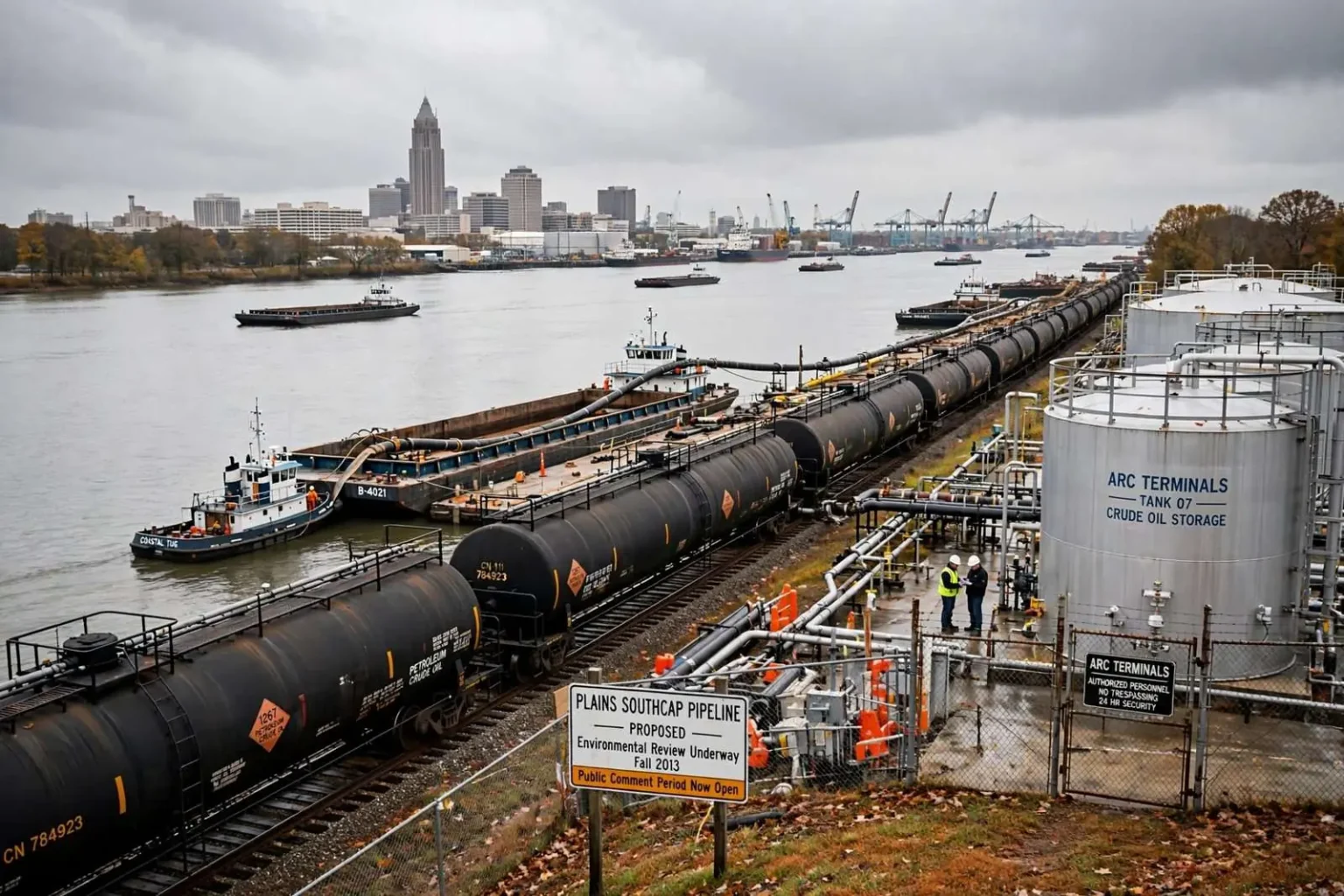
Few cities felt the side effects of North America’s oil boom more unexpectedly than Mobile, Alabama. In the fall of 2013, a series of oil pipeline controversies thrust the city into the national spotlight, revealing Mobile’s growing role in America’s unconventional oil infrastructure. Two proposed projects — the Plains Southcap pipeline and ARC Terminals — appeared to be just the beginning of a much larger wave of oil-related development along the Gulf Coast, and residents woke up to find their community cast in a role nobody had voted on.
Looking back, the fall of 2013 stands as the moment when the abstract national story of the oil boom became concrete and local for Mobile. The trains, tanks, barges and pipelines that made headlines in energy trade publications were suddenly visible from downtown streets, and the questions they raised — about risk, benefit and the kind of city Mobile intended to be — moved from boardrooms to council chambers, where they have remained ever since.
How North America’s Oil Supply Changed
Since the mid-2000s, high oil prices and advances in extraction technology made recovery of unconventional oil resources economically viable for the first time. As a result, an increasing share of U.S. oil production began flowing from Canadian tar sands and North Dakota’s Bakken Shale formation, which by 2013 had made the state the second-largest crude oil producer in the country. Some estimates suggested that combined unconventional reserves in the United States and Canada could exceed Saudi Arabia’s conventional oil supplies, a comparison that would have sounded far-fetched to energy analysts only a few years earlier.
The chemistry and geology behind that shift explain why Mobile became involved at all. Tar sands oil, also known as oil sands, is a semi-solid form of petroleum called bitumen, mixed with sand or clay, and it is typically extracted through surface mining rather than traditional wells. Because the resulting product is thick and viscous, it must be diluted for transport, creating what the industry calls diluted bitumen, or dilbit — a substance that behaves differently in pipelines, rail cars and barges than the conventional crude most communities had known.
The world’s largest tar sands deposit is the Athabasca Formation in Alberta, Canada. Shale oil, sometimes called tight oil, is extracted from petroleum-bearing rock formations, often through hydraulic fracturing, or fracking. The Bakken Shale in North Dakota represented the largest tight oil formation in the United States at the time. Neither product could stay where it was produced: Canada’s landlocked oil sands and North Dakota’s inland shale field both required long overland journeys before a refinery could use them.
The Journey to Gulf Coast Refineries
The majority of U.S. refining capacity — the facilities that turn crude oil into usable products like gasoline — is concentrated along the Gulf Coast. While imported oil from South America and the Middle East arrives primarily by tanker ship, domestically produced crude from Canada and the northern United States had to reach Gulf Coast refineries by land, whether by pipeline, rail, or truck. The result was an enormous, expensive logistics problem that the industry solved differently in different regions — and the solution that ran through Mobile surprised almost everyone who lived there.
This growing demand for overland transport capacity is what prompted proposals like the Keystone XL pipeline. However, political opposition had stalled that project, and oil producers increasingly turned to rail as an alternative. Rail shipments of crude oil more than tripled between 2011 and 2012 alone. Trains that were built to move grain and containers were suddenly hauling thousands of cars of crude across the plains and toward the coast, and the communities along those routes were learning about it as the tank cars rolled through.
The speed of the change was as disruptive as its size. Conventional oil fields took decades to reach full production, but a shale well could be drilled, fracked and producing within months, and tar sands projects scaled up in parallel. The transportation system simply could not be built that fast, which is why the industry leaned so heavily on rail — the one mode of crude transport that could expand quickly using existing tracks.
The economics of the Mobile transfer deserve a closer look, because they explain the persistence of the crude trade there. Every barrel that arrives by rail must pay for unloading, storage, barge loading, towing and insurance before it ever reaches a refinery pipe, and each of those steps supports local jobs — longshore workers, tug crews, terminal operators and maintenance contractors. The same arithmetic that made the barge leg costly to the oil companies made it economically meaningful to the city.
Why Mobile, Specifically
Mobile’s importance in this equation stemmed from its location as a southern terminus of the Canadian Northern Railway, which carried much of the tar sands and shale oil from Canada and the northern states to Gulf Coast refineries. The city served as a critical transfer point: oil arriving by rail was unloaded and then transported by barge to Chevron’s Pascagoula refinery, one of the largest and most complex refining facilities in the nation. The economics of that final leg shaped everything that followed.
Mobile was the closest Canadian Northern Railway terminus to Pascagoula. Using the alternative CSX railway route directly to Pascagoula would have added significant cost, and in the freight business, small per-barrel differences multiply into enormous annual sums across millions of barrels. Industry planners therefore treated the Mobile transfer as the efficient path, and the city’s riverfront became a place where mile-long trains were met by fleets of barges bound for Mississippi.
The proposed Plains Southcap pipeline aimed to streamline this process by transporting oil directly from Mobile to Pascagoula via pipeline rather than barge. A buried line would cut the transfer step out of the journey entirely, replacing barge traffic with a continuous flow of crude beneath the landscape between the two cities. Supporters saw efficiency and reduced congestion on the water; opponents saw a new risk corridor across wetlands and neighborhoods, and the proposal became the most visible flashpoint of Mobile’s oil debate.
That reliance on rail carried its own consequences. Crude-by-rail multiplied the number of communities with crude moving through them, since trains travel wherever track already exists, and it multiplied the frequency of movement along those lines. Railroads, emergency responders and municipal governments all had to adapt to a commodity that had rarely appeared on their risk plans before the boom.
A Wave, Not a Ripple
The second project, ARC Terminals, addressed the storage side of the same transformation. Crude that arrives by train needs somewhere to wait before it moves on, and terminal facilities — tanks, pumps, loading racks and rail sidings — are the physical expression of that need. Proposals like ARC’s signaled that the industry intended to make its presence in Mobile permanent rather than transitional, building infrastructure designed to operate for decades.
With multiple infrastructure projects on the horizon — including oil storage tanks, pipelines, and expanded rail terminals — the proposals from Plains Southcap and ARC Terminals appeared to represent only the tip of the iceberg for new oil development in the Mobile area. Infrastructure of this kind is sticky: once a city hosts a segment of the crude logistics chain, it becomes a candidate for every expansion that follows, from additional tank capacity to new pipeline laterals and more frequent unit trains.
For Mobile’s residents and officials, the challenge was that each project arrived through its own separate process. Regulators evaluated pipelines on pipeline criteria and terminals on terminal criteria, while the cumulative transformation of the community’s relationship with crude oil happened between the lines of individual permit applications. The 2013 debates were, at their core, an attempt to force that bigger picture into view.
A pipeline, by contrast, offers few jobs once construction ends. That asymmetry framed much of the local argument over Southcap: the buried line would remove the barge traffic that supported waterfront employment and replace it with an asset that generated property tax and spill risk but little ongoing work. The tradeoff between efficiency for the shipper and economic activity for the host community is a recurring theme in infrastructure debates, and Mobile was living a textbook version of it.
The environmental dimension added another layer. The route between Mobile and Pascagoula crosses terrain where drainage, wetlands and residential areas complicate any buried infrastructure, and spill response in a wet environment is slower and harder than on dry land. Opponents argued that the cumulative risk of the full chain — train, terminal, pipeline and refinery — had never been assessed as a whole, and the 2013 controversies gave that argument a concrete set of projects to attach to.
A City at a Crossroads
Mobile had spent decades rebuilding its economy around the port, aerospace and manufacturing, and the sudden arrival of tar sands crude introduced both opportunity and anxiety in the same season. The promise of industrial investment was real in a region that had welcomed energy business for generations, but so were the questions: who bears the spill risk, which neighborhoods sit along the rail lines and whether a city’s waterfront should be organized around the logistics of a Canadian oil field.
The fall of 2013 did not settle those questions, but it permanently changed who was asking them. After the Southcap and ARC controversies, oil infrastructure in Mobile was no longer a technical matter handled quietly between companies and permitting agencies — it was a public issue, covered nationally, argued at public meetings and central to the city’s sense of its own future. The unconventional oil boom had found its way to the Gulf, and Mobile had learned that geography, more than any local decision, had chosen it as a hub.


