Mobile Schools Began Rehiring Some Teachers in 2008
Mobile school officials said in May 2008 that some previously laid-off teachers, particularly in hard-to-fill subjects, were being reassigned to classrooms.
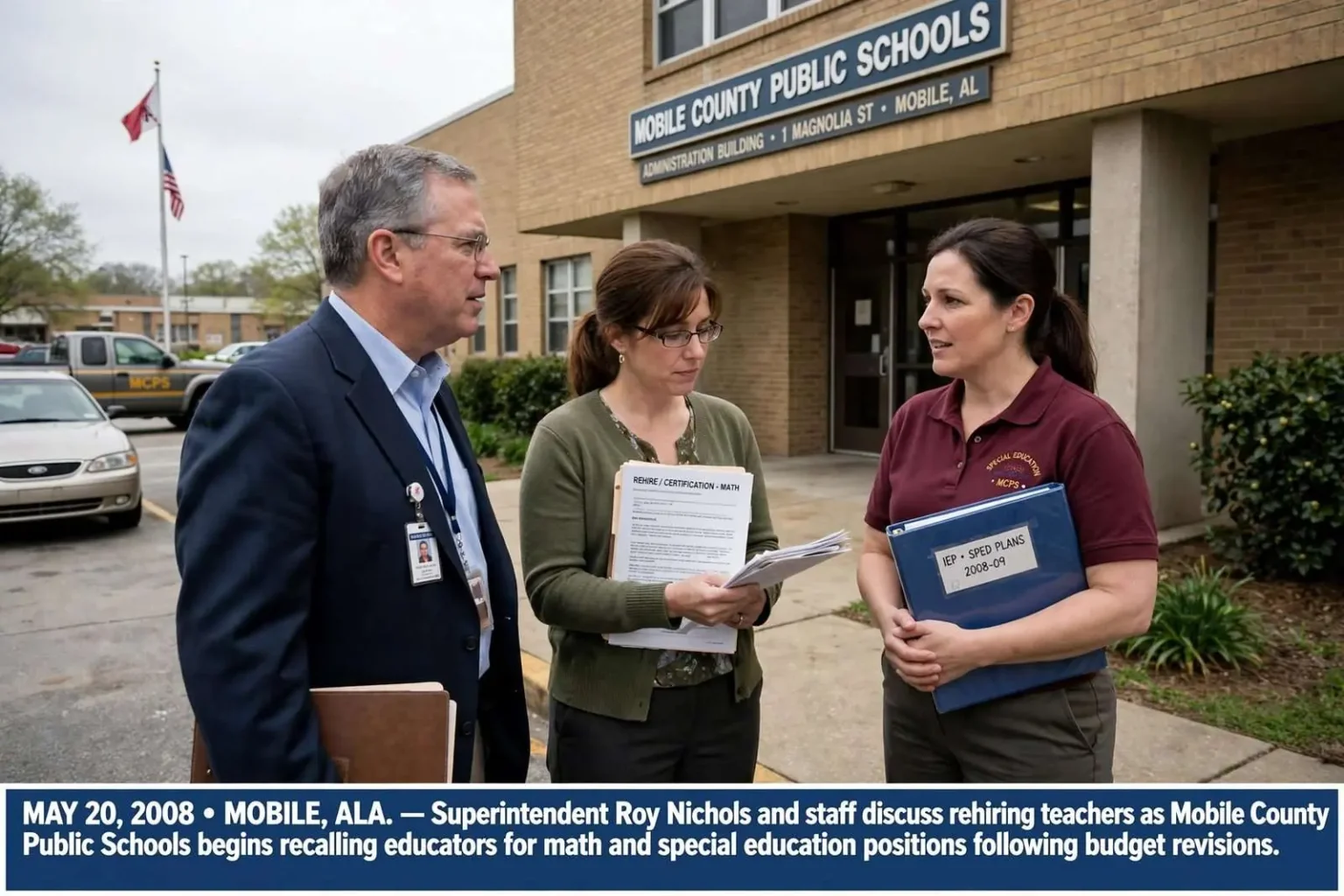
MOBILE, Ala. — Originally reported May 20, 2008. Mobile school officials said in May 2008 that some teachers who had received layoff notices earlier that spring were being reassigned back into classrooms, as the district began walking back reductions it had made in anticipation of a lean state education budget. Superintendent Roy Nichols said the early rehires were concentrated in hard-to-fill subject areas such as math and special education, with more employees expected to return as the budget picture clarified.
The announcement marked the first significant reversal in a staffing crisis that had gripped Alabama’s public schools through the spring of 2008, when districts across the state issued hundreds of reduction-in-force notices while lawmakers in Montgomery wrestled over the Education Trust Fund budget. For the affected teachers in Mobile County’s largest district, the rehiring notices brought an end to weeks of uncertainty about whether they would have jobs when the 2008-09 school year began in August.
The Budget Crisis Behind the Layoffs
The spring 2008 layoffs grew out of a budget shortfall that was statewide in scope. Alabama funds its public schools primarily through the Education Trust Fund, which draws its revenue from sales taxes and income taxes — a structure that makes school funding unusually sensitive to the economy. When the economy slows, school revenue slows with it, and by early 2008 a national economic downturn was beginning to drag on Alabama’s collections.
Districts had been warned to plan for proration — the mid-year across-the-board budget cuts Alabama’s law allows when revenue falls short of appropriations. Facing that prospect, the Mobile County Public School System, like many of its peers, sent layoff notices to teachers and support staff in the spring, a procedural step required by state law ahead of any reduction in workforce. The notices were precautionary, but they were legally necessary for the district to preserve flexibility if the money did not materialize.
Why Math and Special Education Came First
Nichols said the early rehires were primarily in hard-to-fill areas, and math and special education sat at the top of that list for reasons every Alabama district recognized. State certification rules require specialized credentials for special education positions, and Alabama — like the nation — had struggled for years to produce enough certified math teachers through its university programs. When positions in those fields opened, superintendents knew the odds of refilling them quickly with qualified candidates were poor.
That scarcity drove the rehiring logic. A district facing a budget squeeze can absorb losses in subjects with deep candidate pools far more easily than it can absorb them in fields where a single vacancy might go unfilled for a year. By reassigning math and special education teachers first, Mobile protected the instructional programs that would have been hardest to rebuild, and signaled to the rest of the workforce that additional returns were likely if the budget allowed.
How Mobile County’s Schools Were Staffed
In 2008, the Mobile County Public School System was Alabama’s largest school district, serving roughly 65,000 students across more than 90 schools under Nichols, a longtime district administrator who had led the system since the 1990s. Its workforce of several thousand teachers made any staffing decision a major enterprise: hundreds of retirement and resignation notices arrived each spring on top of the layoffs the budget climate prompted, and the personnel department spent the summer reconstructing a staffing plan school by school before classrooms opened in August.
What the May 2008 Announcement Meant
The reassignment announcement did not mean the layoffs were over — officials were careful to frame the rehires as a first wave, with “more employees expected to return” as conditions allowed. But it changed the tone of the spring. Teachers who had spent weeks unsure whether to sign contracts elsewhere, or to file for unemployment as the summer approached, suddenly had a credible reason to wait. In districts the size of Mobile County’s, a layoff notice followed by a rehiring offer is a whiplash experience, and the speed of the reversal determined how many experienced educators the system kept.
The timing also mattered for classroom quality. Every rehired teacher was one the district did not have to replace with a new hire, and in hard-to-fill fields the difference between a veteran and a first-year teacher — or no teacher at all — was measured in the quality of instruction students received that fall. Special education caseloads in particular depend on continuity, because the federal Individuals with Disabilities Education Act requires individualized service plans that are disrupted when teachers turn over mid-program.
The State Budget Picture in Montgomery
The uncertainty Nichols described traced directly to Montgomery. The Legislature had spent the 2008 regular session wrestling with an Education Trust Fund budget that could not be balanced without either new revenue or deeper cuts, and school officials statewide watched the numbers in the school foundation program — the formula that distributes state money to districts based on enrollment and personnel units. Each unit represented a teaching position, and when the appropriation shrank, units disappeared and layoff notices went out in proportion.
The 2008 episode was an early tremor of what followed: the national recession that deepened later that year eventually forced Alabama into genuine proration in subsequent fiscal years, and districts that had learned their lesson in 2008 entered that period with more cautious staffing practices. The May 2008 rehiring announcement was, in retrospect, the moment the feared shortfall looked less severe than it had in March — the recession had not yet fully arrived, and the state’s revenue projections had stabilized enough for Mobile to begin reversing course.
Reduction in Force: The Legal Machinery
Alabama’s tenure and fair-dismissal laws governed how Mobile’s layoffs and rehires proceeded. Teachers with continuing-service status held stronger re-employment rights than newer hires, and recall notices had to follow seniority and certification rules. Support workers, whose positions fell outside teacher tenure protections, had a different and more precarious path. The result was a layered process in which the personnel department matched the employees it had laid off against the positions it still needed to fill, working from the same certification records that had driven the original staffing plan.
That is why the rehiring wave began in math and special education rather than proceeding alphabetically or by campus. The employees recalled first were those whose certifications matched the vacancies the district could least afford to leave open — a practical triage that mirrored the priorities of the federal No Child Left Behind era, under which schools were required to staff core academic classes with highly qualified teachers.
Mobile County’s Position in the State
As the state’s largest district, Mobile County felt every fluctuation in the Education Trust Fund more sharply than its neighbors. A percentage cut that cost Baldwin County dozens of positions cost Mobile more than a hundred, and the system’s budget office spent the 2008 spring tracking legislative sessions and revenue forecasts the way districts in smaller systems rarely needed to. The district’s size also gave it advantages: a deep bench of internal candidates to reassign, established relationships with the state department of education, and personnel procedures refined through years of boom-and-budget cycles.
The spring 2008 crisis was not the district’s first, and it would not be its last. Mobile schools had weathered proration episodes in earlier decades, and the system’s veteran administrators had learned to treat layoff notices in lean springs as procedural rather than final. That institutional memory shaped how Nichols’ administration communicated the rehiring — as the expected next step in a cycle, not a reprieve from catastrophe.
What Teachers and Families Experienced
For the teachers themselves, the weeks between layoff notice and rehiring were weeks of difficult decisions. Some signed contracts with neighboring districts — Baldwin County’s fast-growing system among them — and were lost to Mobile permanently. Others waited, uncertain, and were rewarded with the May reassignment notices. The human cost of budget-driven layoffs is measured in those decisions, which are made under deadline and with incomplete information about whether the district will call.
For families, the stakes appeared less directly but no less really. Staffing plans determine class sizes, course offerings, and the availability of programs from advanced math to special education services. A district that begins the school year short-staffed in math and special education spreads the shortage across every campus, and parents of students with individualized education plans are often the first to feel the gaps when special education positions sit empty.
How the Story Resolved
The 2008-09 school year opened in Mobile County with far fewer vacancies than the March layoffs had implied, as the May rehires and subsequent returns rebuilt much of the workforce that had been trimmed in the spring. The episode left its mark on district practice — subsequent years saw more cautious use of reduction-in-force notices and closer attention to certification shortages in recruitment — but the immediate story, as reported May 20, 2008, was one of partial reversal and improving outlook.
Because this article records the staffing update as reported at the time, it does not describe current employment levels, current staffing policy, or the district’s present-day condition. What it documents is a specific moment in the history of Alabama school finance: the spring of 2008, when the state’s largest district began recalling the teachers it had laid off, starting with the math and special education positions it knew it could not afford to lose.