ThyssenKrupp Job Training Drew Thousands of Applicants in 2008
Archived WKRG coverage reported that thousands of people sought training connected to the planned ThyssenKrupp plant near Mobile and Washington counties.
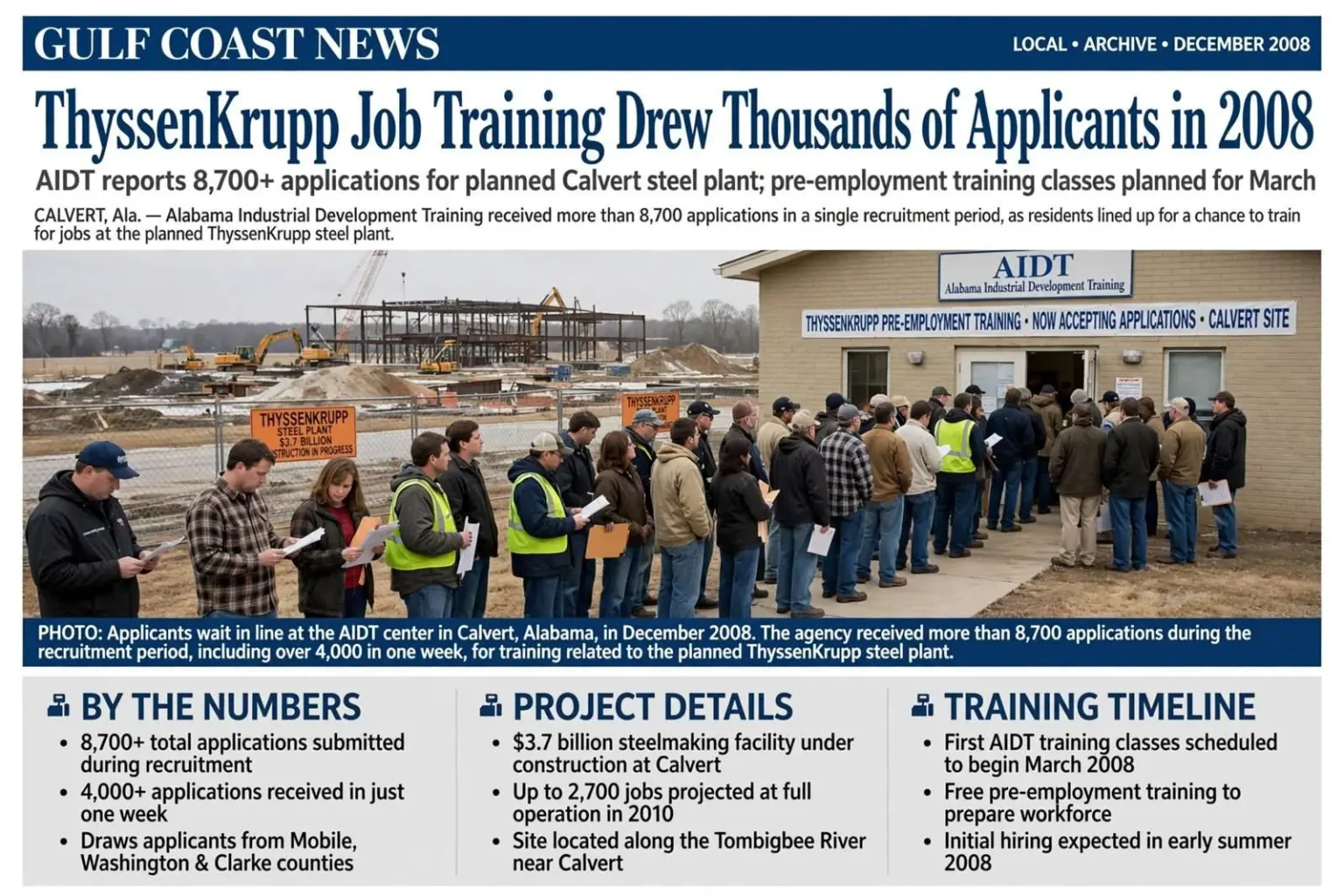
An archived local news report described strong early demand for job training linked to the planned ThyssenKrupp steel plant at Calvert, near the Mobile and Washington county line. Alabama Industrial Development Training said more than 8,700 people had sought work with the German-based company during a recent recruitment period, including at least 4,000 applications in one week. This is a historical hiring report; the application information is no longer current.
AIDT was expected to provide pre-employment training and anticipated its first classes in March, with initial hires projected for early summer. The $3.7 billion plant was under construction at the time and was expected to begin operations in 2010, creating up to 2,700 jobs.
The Numbers Behind the Rush
The application volume reported by AIDT — more than 8,700 people seeking work during a single recruitment period, with at least 4,000 applications in one week — reflected both the scale of the project and the appetite for industrial wages in southwest Alabama. A steel complex of that size promised positions across an enormous range of skills: millwrights, electricians, welders, equipment operators, metallurgists, maintenance technicians and administrative staff, at pay levels that stood well above the regional service economy’s norms.
The pace of applications also said something about how the hiring was structured. Because AIDT conducted pre-employment training before the company made final selections, the application window effectively functioned as the front door to the entire workforce, and word spread quickly once it opened. Applicants who missed a recruitment period might wait months for another chance, which helps explain a single-week surge of 4,000 or more.
For context, the 2,700 jobs the plant was expected to create at full operation would have ranked it among the largest single employers in southwest Alabama. Multiplier effects — suppliers, contractors, trucking and the retail economy that grows around a major payroll — were expected to extend the impact well beyond the plant gates, and applicants understood that math as clearly as the economists did.
Why Steel Jobs Draw Crowds
Steel employment carries a particular weight in American industrial culture, and the ThyssenKrupp recruitment tapped directly into it. Modern mill work differs from the steel towns of the last century — the Calvert facility was designed as a technologically advanced operation with computerized process control rather than the labor-intensive mills of mid-century — but the underlying bargain remained the same: demanding shift work in exchange for steady, well-paid industrial employment. In a region whose manufacturing base was thin compared with the auto-producing corridor around Tuscaloosa and Montgomery, the prospect landed with unusual force.
The pay differential drove much of the interest. Industrial production wages in the region ran well ahead of the retail, food service and hospitality work that employed much of the area’s workforce, and a mill job promised benefits and overtime on top of base pay. Households that had never counted a manufacturing paycheck among their options suddenly had one within commuting distance, and the application totals showed how many of them moved at once.
AIDT: Alabama’s Training Agency
Alabama Industrial Development Training occupied a distinctive role in the state’s economic development system. Created as a state agency in the early 1970s, AIDT had spent decades providing free, company-specific workforce training for employers locating or expanding in Alabama, funded by the state as part of recruitment incentive packages rather than charged to the companies or the trainees. Its model called for designing the curriculum around the employer’s exact equipment and processes, then screening and training prospective workers before hiring decisions were finalized.
By the time of the ThyssenKrupp recruitment, the agency’s reputation rested largely on its work for Alabama’s automotive industry. The Mercedes-Benz, Honda and Hyundai plants had all relied on AIDT programs to prepare thousands of production and maintenance workers, and the agency had refined the logistics of high-volume applications, assessment centers and classroom-plus-hands-on instruction. A project of ThyssenKrupp’s scale was a natural next assignment for that machinery.
For applicants, the AIDT route carried real advantages. Training was free, conducted in the period before permanent hiring, and completion positioned candidates for consideration as the plant’s operating dates approached. The first classes were expected in March, with initial hires projected for early summer, giving successful trainees a months-long runway into employment.
The training pipeline also served the company’s own planning needs. A steel complex cannot operate without a trained workforce in place when the first furnaces come online, and building that workforce takes months of instruction in safety, equipment operation and process fundamentals. Scheduling the first classes for March, against a 2010 operating target, reflected the arithmetic of preparing up to 2,700 workers in waves timed to the plant’s phased startup.
The Calvert Site and Its Geography
The plant site at Calvert sat in northern Mobile County near the Washington County line, along the Tombigbee River — a location chosen for its deepwater access, rail connections and room for one of the largest industrial complexes ever built in the state. ThyssenKrupp, the German industrial conglomerate, had selected the site for a $3.7 billion facility combining carbon steelmaking and stainless processing, drawing on imported raw materials that could arrive by water and finished product that could ship out the same way.
The geography shaped the labor story as much as the logistics. Calvert sits within commuting range of Mobile’s population centers to the south, Washington County’s communities to the north and Clarke County across the river, meaning the application surge drew from a broad multi-county swath of the region. Rural unemployment in parts of that radius made industrial positions all the more sought after, and the recruitment period captured demand from factory workers, loggers, construction tradespeople and service workers alike.
Construction itself was already reshaping the local economy by the time applications poured in. The build-out of a $3.7 billion complex employed thousands of craft workers, and the overlap of construction activity with pre-employment training created a region in which industrial work was suddenly the dominant topic of conversation from Saraland to Jackson.
What Happening at Calvert Meant for the Region
The recruitment surge rippled through institutions beyond AIDT itself. County economic development offices in Mobile and Washington counties fielded questions from businesses hoping to position themselves as suppliers, and school counselors and workforce boards prepared for the kind of employer whose arrival changes local career expectations. A plant hiring on the scale of ThyssenKrupp’s projections tends to reset the labor market for years, as other employers adjust wages to compete and training programs add industrial curricula.
The timing also intersected with other Gulf Coast industrial activity, from shipbuilding and aerospace work in Mobile to the petrochemical and paper operations scattered along the rivers. Those industries had long competed for the same skilled maintenance and operations workers, and a new mill drawing thousands of applicants into training pipelines added both new supply — people newly trained for industrial work — and new competition for experienced hands.
For the applicants themselves, the numbers reported by AIDT carried a sober implication alongside the opportunity: with more than 8,700 people seeking work against a long-term target of up to 2,700 jobs, the process was selective from the start. That selectivity is precisely what the pre-employment training model was built to manage, sorting motivated candidates through assessment and instruction before the company committed to permanent hires.
Local two-year colleges and technical programs also watched the process closely. AIDT’s company-specific training handled the plant’s immediate needs, but a permanent industrial workforce requires continuing education for decades — advanced maintenance, instrumentation, supervisory skills — and the region’s institutions positioned themselves to provide it. The March classes were the beginning of a workforce ecosystem, not a one-time event.
Reading the Report as History
Like the other archived coverage of the ThyssenKrupp project, this hiring report preserves a moment, and its figures belong to that moment alone. The 8,700 applicants, the weekly surge of at least 4,000, the March start for first classes, the early-summer hires and the 2010 operating target were the facts on the ground during the recruitment period the station covered. The application information, as the report itself noted, was no longer current even at the time of republication, and nothing here describes the plant’s eventual workforce or operating history.
What the report documents is demand — the clearest early measurement of how hard southwest Alabama wanted the project to succeed. Every one of those 8,700 applications represented a household recalculating its future around a steel mill under construction on the Tombigbee, and the state agency at the center of it all was executing the same playbook that had made Alabama a national name in industrial recruitment. The archive keeps that week alive: the applications pouring in, the classrooms being readied for March, and a region preparing for an operating date it had been promised in 2010.