2007 Report Outlined What ThyssenKrupp Could Mean for Calvert Area Jobs
Archived WKRG coverage outlined expected job types and community changes tied to the planned ThyssenKrupp mill near Calvert.
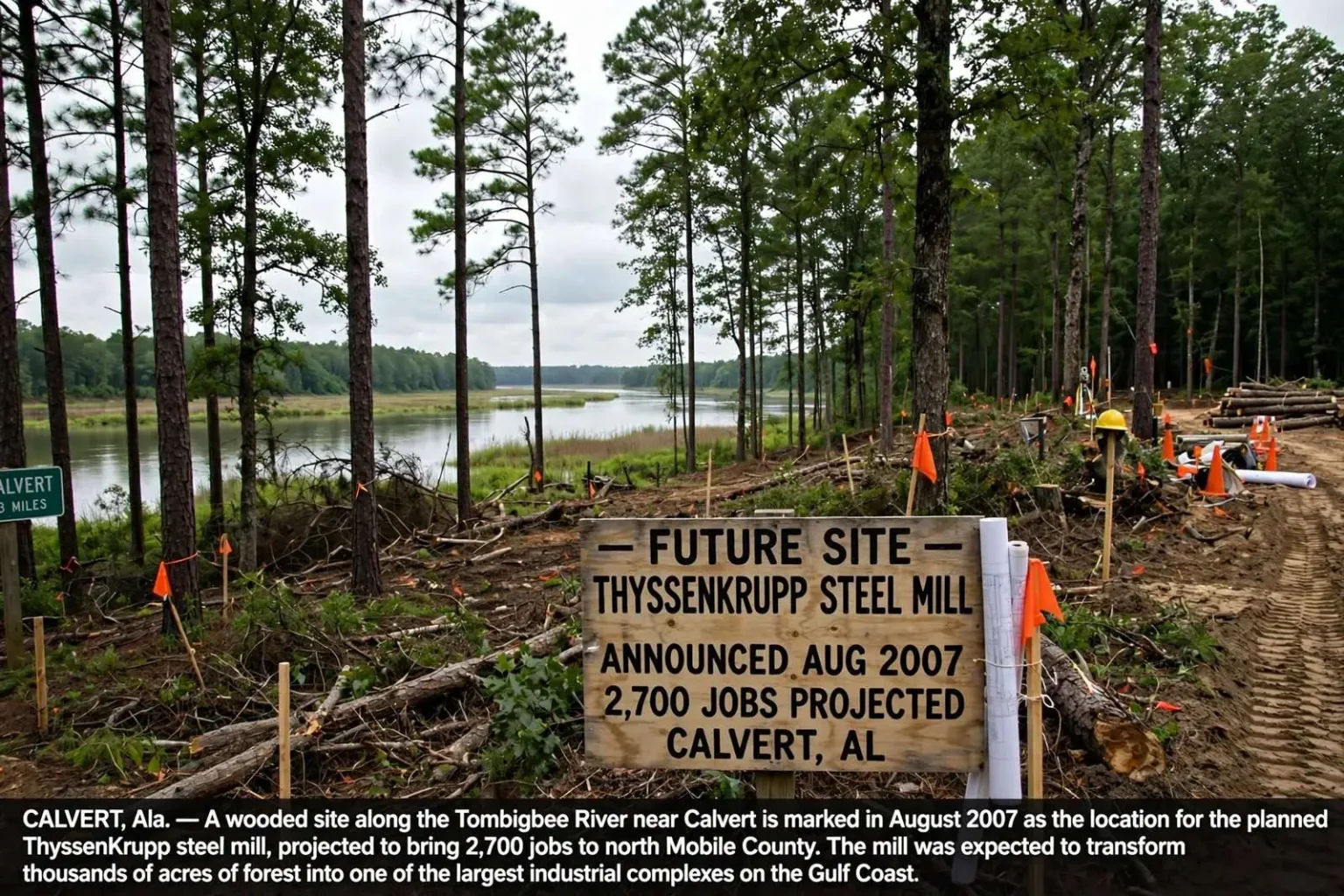
CALVERT, Ala. — An archived local news report from August 2007 described what nearby communities could expect from the planned ThyssenKrupp steel mill near Calvert, in north Mobile County straddling the Washington County line.
The station noted that the mill would replace a formerly wooded area and was expected to employ 2,700 people once operational. ThyssenKrupp anticipated needing engineers, managers, operations personnel and office workers at a range of education and experience levels.
As part of its report, the station visited a ThyssenKrupp mill in Germany to provide visual context for the planned Alabama facility, giving viewers a look at the scale and operations of the kind of plant headed for the Tombigbee River site.
This is a historical account of projected employment and construction-era expectations from 2007. It is not current hiring information, and the figures and descriptions reflect what was anticipated before construction was complete.
The announcement that reshaped north Mobile County
ThyssenKrupp’s decision to build a major steel mill in Alabama, announced in 2007, ranked among the largest economic development projects in the state’s history. The German industrial conglomerate selected a site near the unincorporated community of Calvert, along the Tombigbee River in northern Mobile County, choosing Alabama over competing sites in the Southeast after a high-stakes recruitment effort by state and local officials.
The project’s multibillion-dollar price tag made it a transformational commitment for the region. The site — thousands of acres that had been forestland — would be cleared and graded into one of the largest industrial complexes on the Gulf Coast, with river access, rail service and proximity to the port of Mobile supporting the movement of raw materials and finished steel.
For communities around Calvert — McIntosh, Mount Vernon, Citronelle and the Washington County towns across the river — the announcement promised an economic anchor in a rural stretch of south Alabama where such employers had long been scarce. The August 2007 report captured the anticipation at its height, before the first foundations were poured.
What 2,700 jobs meant
The projected workforce of 2,700 was the number that stuck in the region’s imagination. In a rural area where good-paying industrial jobs typically meant a commute to Mobile’s shipyards or chemical plants, the prospect of thousands of permanent positions within a short drive of home represented a generational change for the communities surrounding the site.
Just as important was the range of jobs the company described. The August 2007 report noted that ThyssenKrupp anticipated needing engineers, managers, operations personnel and office workers at a range of education and experience levels — a spectrum that meant opportunities not only for experienced steelworkers recruited from elsewhere but for local residents with technical training, office skills and management backgrounds.
The employment projection also carried a multiplier that economists and local officials discussed openly: each permanent mill job typically supports additional jobs in construction, services, retail and housing across the surrounding area. A mill employing thousands would, over time, support a wider regional economy — new subdivisions, expanded schools, growth in towns that had been losing population for decades.
From German mills to an Alabama forest
The station’s decision to visit a ThyssenKrupp mill in Germany reflected the gap between the project on paper and the project as residents could picture it. Steel mills of this scale are rare sights in the United States, and for south Alabamians weighing what was coming to the woods near Calvert, footage of a working ThyssenKrupp facility — the size of the buildings, the flow of slabs and coils, the workforce on the floor — was the best available preview.
The company that made the decision was a global industrial group with steelmaking roots stretching back more than a century. ThyssenKrupp’s plan for Alabama centered on carbon steel and stainless production serving customers across North America, with the Tombigbee site chosen for its combination of river transport, rail access and the deepwater port of Mobile downstream — logistics that would let raw material arrive and finished product leave economically.
The transformation of the site itself was part of the story the 2007 report emphasized. A formerly wooded area would become an industrial campus measured in thousands of acres, a change visible for miles across the rural landscape of north Mobile County and the Washington County line.
The construction era
Between the 2007 announcement and the mill’s eventual opening, the site became one of the largest construction projects in the Southeast. Thousands of construction workers cleared, graded and built the complex, and the surrounding towns absorbed the ripple effects — filled motels, busy restaurants and the pressures of rapid growth that rural infrastructure is rarely prepared for.
Local officials in the communities around Calvert spent those years planning for the permanent changes as well: road improvements, housing demand, school growth and the tax revenue that would follow a multi-billion-dollar facility onto the tax rolls. The promise of the August 2007 report — jobs, growth, a changed economy — was being built in real time within sight of communities that had watched younger residents leave for decades.
What came after the projections
History, as the 2007 report could not know, complicated the picture. The Alabama facility opened in 2010, but global steel market conditions turned sharply against the economics the project had been built on, and ThyssenKrupp spent the following years seeking to divest the Americas operations it had built at such scale and cost.
The Calvert plant was ultimately sold to a joint venture of ArcelorMittal and Nippon Steel, and it continues to operate as one of the most advanced steel facilities in North America under the AM/NS Calvert name — the employment and industrial anchor the region anticipated, under different corporate ownership than the one that announced it.
That is why the August 2007 account is preserved here as a historical projection rather than a current report. The numbers it contains — 2,700 expected employees, the range of positions, the description of a wooded site awaiting an industrial future — document what the region was promised at the moment of announcement, the starting point from which the Calvert area’s economic transformation actually unfolded.
For the communities near Calvert, the report also remains a marker of how the story began: a German steelmaker’s decision, a cleared forest on the Tombigbee, and the expectation that thousands of jobs at every level of skill and education would soon be hiring just up the road.
Training for the jobs that were coming
The range of positions ThyssenKrupp described in 2007 — engineers, managers, operations personnel and office workers — meant that the mill’s hiring would touch every level of the regional education pipeline, and Alabama’s institutions spent the construction years preparing for it. Community colleges built industrial maintenance and process-technology programs aimed at steel and chemical employers, and universities emphasized engineering pipelines for the plant’s technical staff.
For residents of the Calvert area, the practical question was how to qualify. Workforce officials encouraged job seekers to pursue the certifications and two-year degrees that process-industry employers screen for, and the state’s training programs were scaled up with employers like the mill in view. The promise of the 2007 report was not just that jobs would exist but that local people could position themselves to hold them.
The plant’s hiring also reached beyond Mobile County. Workers commuted from Washington County towns across the river, from Clarke County to the north and Baldwin County to the east, spreading the economic effect of a single site across a wide swath of southwest Alabama.
Wages formed the other half of the promise. Heavy-industry pay at the levels ThyssenKrupp’s facility was expected to offer would lift household incomes in communities where retail and service wages had long been the norm, and local officials pointed to the mill’s payroll as the kind of economic base that supports banks, builders and small businesses in a way transient employment never does.
How the region remembers the announcement
Two decades on, the August 2007 report serves as a record of the moment when north Mobile County learned what was coming. The language of the era — thousands of jobs, a multibillion-dollar investment, a global company choosing Alabama — set expectations that shaped local politics, land prices and school planning for years afterward.
The reality that followed was more complicated than the announcement but still transformative. The plant rose, opened and ultimately changed hands, yet the industrial presence on the Tombigbee — the employment, the tax base, the roads and infrastructure that grew up around the site — remained exactly what the communities had been promised in 2007, under a different name.
For readers encountering the 2007 report today, the context matters: the 2,700-employee projection, the list of job types, the description of a wooded site awaiting transformation. It documents the beginning of the largest single economic development project ever sited in north Mobile County, in the words of the people who watched it arrive.