Chatom in Washington County, AlabamaChatom in Washington County.

Historical report, published from archived local news coverage.

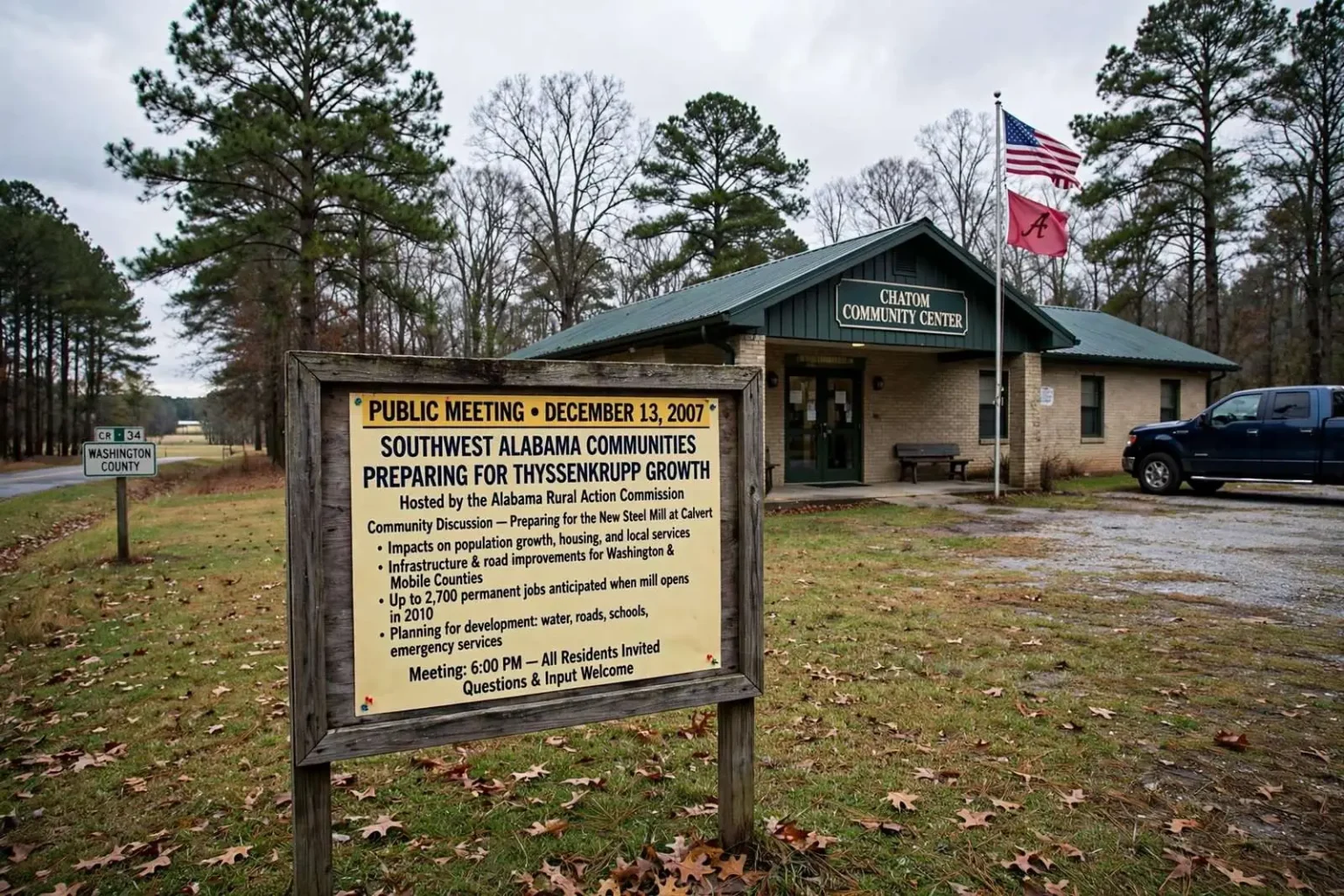
CHATOM, Ala. — In late 2007, southwest Alabama leaders were preparing for the changes expected from the planned ThyssenKrupp steel mill at Calvert, according to an archived local news report. The announcement of the German steelmaker’s selection of a site near the Mobile-Washington county line had landed that year as the biggest economic development story in the region in decades, and the communities closest to the site were beginning to reckon with what thousands of construction workers and, eventually, thousands of permanent jobs would mean for small towns built around a much slower pace of life.

Construction on the project was expected to begin the following year, with the mill’s operations projected for 2010 and up to 2,700 permanent jobs promised when the plant reached full production. Those numbers dwarfed anything the rural stretch of southwest Alabama between the Tombigbee River and the county line had seen before. The workforce would come from Mobile, Washington, and surrounding counties, and many of the workers and their families would need places to live, shop, and send their children to school — needs that fell first on the towns and counties nearest the site.

A Community Meeting in Chatom

A meeting at the Chatom Community Center was set to discuss how communities could prepare, sponsored by the Alabama Rural Action Commission. Chatom, the seat of Washington County, sat close enough to the Calvert site that its leaders knew the plant’s effects would pass directly through their communities — along the roads that workers would drive, through the schools that might gain students, and across the water, sewer, and public safety systems that small towns would be asked to expand.

The planned discussion included population growth, infrastructure needs, road improvements and other challenges. Those agenda items mapped almost exactly onto the worries local officials had been voicing since the announcement: whether housing supply could absorb an influx of workers and their families; whether volunteer fire departments, water systems, and sewer lines built for scattered rural populations could handle denser settlement; whether the two-lane roads leading toward the site could carry the commuter traffic; and whether schools, churches, and local governments would see demands grow faster than their revenues.

Gov. Bob Riley’s Assessment

Gov. Bob Riley said in a statement that a project of that size would bring major change to southwest Alabama and pledged continued state-local coordination. Riley had been personally involved in the state’s pursuit of the ThyssenKrupp project, which pitted Alabama against other states offering incentives and sites, and the win was regarded as the capstone of a strategy his administration had pursued since landing the Hyundai plant in Montgomery earlier in the decade. The governor’s pledge of coordination acknowledged the flip side of the announcement: a project large enough to reshape the region’s economy was also large enough to strain it.

See also  Air Force Concedes Cost-Estimate Error That Had Favored Boeing in Tanker Fight

State-local coordination in the ThyssenKrupp era took practical forms over the following years. The state supported road and infrastructure work serving the site, agencies helped communities plan for growth, and workforce development programs began preparing residents for the permanent positions the mill would offer. But in late 2007, all of that was still ahead — the ground had not been broken, the construction workforce had not arrived, and the communities were planning for changes they could imagine only in outline.

The Project That Changed the Map

The ThyssenKrupp announcement in 2007 was the culmination of one of the most competitive industrial site searches in American manufacturing history. The German steel conglomerate considered dozens of sites across several states for a combined carbon steel and stainless facility, and Alabama’s package — built around the rural tract at Calvert near the Tombigbee River, with rail access and reasonable distance from the Gulf Coast’s hurricane exposure — won the project. State and local incentives ultimately totaled in the hundreds of millions of dollars, an investment justified by the 2,700 permanent jobs projected for operations and by the thousands of construction jobs the build-out would create.

The site itself sat in a sparsely populated area near the Mobile-Washington county line, close to McIntosh and Calvert, where paper mills and chemical plants had long been the anchor employers. The mill brought a different scale entirely: its construction phase was projected to employ thousands of craft workers at a time, and its permanent operations would draw skilled workers from across the region. Communities within commuting distance — Chatom, McIntosh, Mount Vernon, Creola, and others — understood that the plant’s labor shed would include them all.

The Alabama Rural Action Commission

The Alabama Rural Action Commission, the sponsor of the Chatom meeting, was an initiative organized during the Riley administration to focus attention on the needs of Alabama’s rural counties — health care access, education, infrastructure, and economic development. Its regional task forces brought local officials, business people, and citizens together to identify priorities, and the ThyssenKrupp announcement gave the southwest Alabama arm of the commission an immediate, concrete subject: how rural communities absorb an industrial project of unprecedented size.

See also  Baldwin County Budget Earns National Recognition From Government Finance Officers Association

Meetings of that kind served a planning function that formal government processes often miss. County commissions and municipal councils handle budgets and road lists, but the question of whether a town can house, school, and serve several thousand new residents cuts across every institution a community has — water boards, school systems, churches, hospitals, and volunteer organizations. Bringing those groups into one room, as the Chatom Community Center meeting was set to do, was the standard first step in turning an economic announcement into a workable local response.

What the Communities Expected

The concerns on the Chatom agenda were concrete. Population growth meant housing demand, and rural Washington County had a limited stock of homes and apartments; builders and landlords anticipated rising rents and new subdivisions, while long-term residents worried about property values and taxes. Infrastructure needs meant water and sewer capacity, which small systems would have to expand with grant funding and rate increases, and road improvements meant pressing the state and county to upgrade the routes that would carry the daily commute toward Calvert.

There were other challenges, too, the ones that rarely make headlines: school enrollments that could rise with workers’ families, first-response agencies that would face more calls along busier roads, and the general strain of change on communities that had watched younger generations leave for Mobile or out of state. For some leaders, the mill represented the best chance in a lifetime to keep young people in Washington County; for others, it was a wave that could wash over towns that had never planned for growth. Both views were present as the communities prepared.

Riley’s Pledge and the State’s Role

Governor Riley’s statement promising continued state-local coordination reflected the structure Alabama had built around its big industrial recruitments. When the state lands a major manufacturer, the work of integrating the project into the region falls to a network that includes the Alabama Department of Commerce, the Alabama Department of Transportation, workforce councils, and the governor’s office itself, all coordinating with county commissions and municipal governments. Riley’s administration had refined that playbook through the Mercedes, Honda, Hyundai, and Airbus-era recruitments, and ThyssenKrupp was its largest test yet.

For Washington County and its neighbors, the pledge mattered because rural counties rarely have the staff or tax base to plan for major growth on their own. Road improvements on state routes, industrial access funding, workforce training through the state’s two-year college system, and grants for water and sewer expansion all flow through state agencies, and a governor’s stated commitment to coordination was the signal local leaders looked for before committing their own scarce resources to growth plans.

See also  Trick-or-Drink Artwalk Brings Free Drinks and Local Art to Hayley's on Oct. 12

From Preparation to Reality

The preparations discussed in late 2007 unfolded over the following years. Construction began as projected, and the Highway 43 and Highway 17 corridors filled with commuter traffic; housing, hotels, and services expanded in communities across the region; and the mill itself moved toward its projected 2010 operations start, though large industrial projects of that era saw schedules stretch as the national economy shifted. The permanent workforce the plant eventually assembled grew toward the promised scale, and the region’s economy — from Washington County’s tax digest to the industrial suppliers clustered around north Mobile County — bore the imprint of the project for years afterward.

Looking back from decades later, the Chatom meeting belongs to a specific moment: the pause between the announcement and the arrival, when southwest Alabama communities still had time to plan. The agenda items recorded then — population growth, infrastructure, roads, and the general challenge of change — turned out to be exactly the issues the region spent the following decade managing. And the meeting’s premise, that rural communities could prepare rather than merely react, was put to the test every day thereafter as the steel mill at Calvert became a fixed part of the region’s economy.

This historical report records preparation efforts and expectations at the time, not current development conditions. Employment figures, schedules, and infrastructure plans described here reflect the situation as reported in late 2007; the project, its ownership, and the region’s roads and services have all changed in the years since. Readers interested in the mill’s present status should consult current sources rather than this account of the original announcement era.