Mobile Report Considered Steroid Use in Local Baseball in 2007
A 2007 WKRG report examined whether performance-enhancing substance use was a concern among Mobile-area high school and college baseball players.
Originally reported December 13, 2007.
The release of a national report on performance-enhancing substances in Major League Baseball sent ripples through every corner of the sport in December 2007, and Mobile was no exception. The report, produced by former U.S. Senate Majority Leader George Mitchell at the request of baseball Commissioner Bud Selig, examined the history of steroids and other banned substances in the big leagues and named numerous players whose careers intersected with the game’s so-called steroid era. For a city that has produced more than its share of major league talent, the findings raised an uncomfortable but unavoidable question: if the problem reached the highest level of professional baseball, could similar issues be touching high school and college programs closer to home?
Mobile’s connection to professional baseball runs deep. The city that gave the game Hank Aaron also produced a long line of pitchers, catchers and position players who reached the majors, and baseball remains a point of civic pride from Toulminville to Tillman’s Corner. High school diamonds at McGill-Toolen, Murphy, Davidson, LeFlore and other area schools feed college programs across the Southeast, and every spring scouts from big-league clubs can be found in the stands. That pipeline is exactly why the national report resonated locally — what happens at the top of the sport eventually shapes expectations and pressures all the way down the ladder.
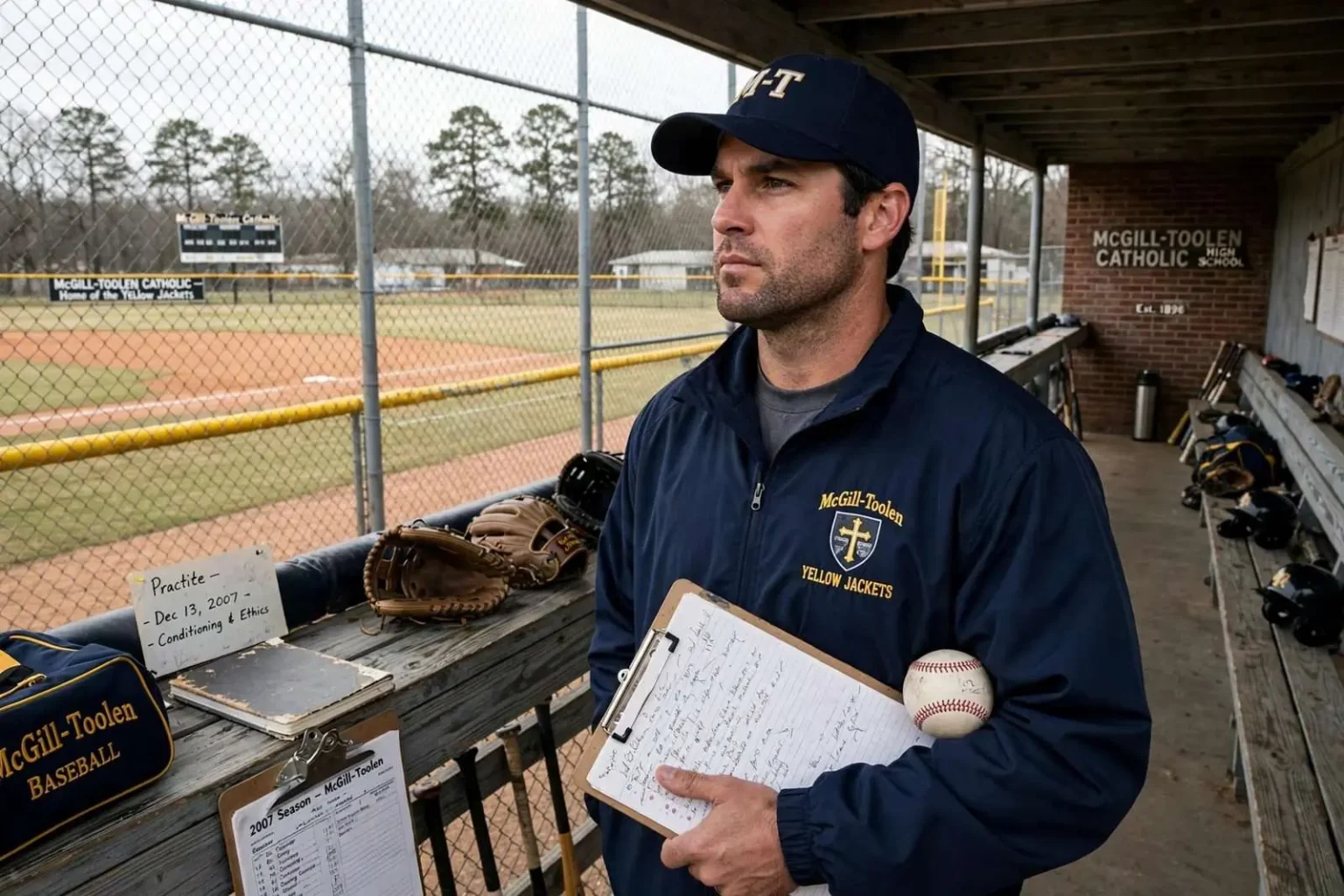
Among those weighing in locally was Blake Stein, a former Major League pitcher who had joined the coaching staff at McGill-Toolen Catholic High School. Stein, who pitched in the big leagues during the late 1990s and early 2000s, offered a perspective that combined firsthand professional experience with a coach’s view of the amateur game. Speaking about the report and its implications, Stein said he had no steroid concerns at McGill-Toolen, but he was careful not to stop there.
Stein said he believed it would be naive to assume the issue did not exist in high schools generally. In other words, while he saw no evidence of a problem within the program he helped coach, he acknowledged that the pressures and temptations that pushed some professional players toward performance-enhancing substances were not automatically absent from amateur baseball. He stressed that this was his opinion, not a statement of fact about any specific program — an important distinction at a time when the national report was generating headlines but shedding little light on what was actually happening at the high school level.
What the national report found
The Mitchell Report, as it quickly became known, was the most comprehensive independent examination of drug use in Major League Baseball ever conducted. It traced the sport’s encounter with performance-enhancing substances from the strength-training culture of the late 1980s through the home-run boom of the 1990s, and it described how a designed-in-Florida underground distribution network reached players on numerous clubs. The report did not attempt to quantify how widespread use was, but it concluded that the problem was serious enough to demand changes in testing, enforcement and club culture.
For players, the report’s recommendations pointed toward more aggressive random testing, independent investigation authority and cooperation from the players’ union. For amateur baseball, the report’s most relevant observation was indirect but significant: the culture that tolerated or encouraged substance use at the professional level did not develop overnight, and young players who grew up idolizing record-setting sluggers absorbed lessons about what it took to reach and stay in the big leagues. Educators and coaches across the country, including in Alabama, read the report as a warning about the example being set for the next generation.
The high school question in Alabama
High school athletics in Alabama operate under the governance of the Alabama High School Athletic Association, which maintains policies covering eligibility, sportsmanship and the health and safety of student-athletes. At the time of the 2007 report, systematic steroid testing of high school athletes was not a routine feature of AHSAA competition, and the vast majority of member schools relied on coaches, parents and team physicians to spot warning signs rather than on laboratory screening. That gap between professional baseball’s testing regime and the amateur level was precisely the concern Stein and other former professionals raised when the subject came up.
Coaches in the Mobile area have long emphasized that strength and conditioning work, done properly, delivers most of the gains young athletes are seeking without the health risks. The pressure to add velocity on the mound or distance at the plate is intense for players hoping to attract college scholarships, and the national report put a spotlight on how that pressure can be exploited. Health professionals have repeatedly warned that anabolic steroid use by adolescents carries particular dangers, including effects on growth, hormonal development, mood and cardiovascular health — risks that are amplified in a still-developing body.
McGill-Toolen, a private Catholic school with one of the area’s most visible athletic programs, was in a position to address the question directly. Stein’s comments reflected the approach many coaches took in the aftermath of the report: state clearly that no problem has been observed in the program, while refusing to pretend the sport’s broader culture was somehow insulated from it. That candor was notable in an era when some programs preferred to say nothing at all. By framing his remarks as opinion rather than accusation, Stein modeled the distinction between vigilance and suspicion — a coach can watch for warning signs without making allegations against players.
The conversation also touched on the role of parents and mentors. Mobile’s baseball community is tight-knit, with many former players returning to coach youth leagues and school teams, and adults in those roles were being urged in 2007 to talk openly with athletes about the long-term consequences of shortcuts. The message from health educators was consistent: the players named in the national report faced damaged reputations, suspended careers and, in some cases, legal exposure, outcomes that no athletic achievement easily offsets.
College and the path to professional ball
South Alabama’s college programs, including the University of South Alabama and Spring Hill College, sit one step below the professional ranks in the area’s baseball hierarchy, and their players face many of the same pressures as their big-league idols. The NCAA conducts drug testing at championship events and member institutions, with penalties for positive tests that can cost a player a year of eligibility or more, and conferences have their own policies as well. Still, testing at the college level samples only a fraction of athletes in any given season, which is why coaches’ personal standards and team cultures carry so much weight.
For players in Mobile with professional aspirations, the 2007 report served as a cautionary document in a more literal sense. Many of the athletes named in it were players whose careers the region had followed closely, and the report made plain that the consequences of substance use follow a player long after the statistics are posted. Scouts and clubs, the report noted, had begun treating a player’s character and decision-making as material factors in evaluations, meaning the choice to use performance-enhancing substances was no longer merely a health question but a career question as well.
What it meant for local fans and families
The report’s arrival in December 2007 came during the holiday break in the high school sports calendar, giving coaches, athletic directors and parents time to consider what it meant for their own programs. Mobile-area booster clubs and youth leagues did not wait for state-level mandates to reinforce their own standards; conversations about training, nutrition and the example set for younger players were part of the winter meeting season. Local sports coverage in the years surrounding the report had documented the area’s talent pipeline in detail, from American Legion summer ball to the high school playoffs, and the community understood that its baseball reputation depended on keeping that pipeline clean.
There was also a broader civic dimension. Mobile has invested heavily in baseball infrastructure over the decades, from youth complexes to the presence of professional baseball at Hank Aaron Stadium, and the city markets itself as a place where the game is played the right way. Allegations of steroid use at the professional level, several observers noted, put that self-image to the test. The response from people like Stein — neither dismissive nor alarmist — suggested a community confident enough to acknowledge risk without accepting an indictment.
Stein’s own career gave his remarks added weight. A pitcher who reached the majors and later returned to the sidelines at a Mobile high school, he stood at the junction between the professional world the report described and the amateur world his players inhabited. His refusal to rule out the possibility of problems somewhere in high school baseball, paired with his statement that he had no concerns at McGill-Toolen, captured the balanced posture most local educators were trying to strike: awareness without cynicism.
More than a decade and a half later, the episode stands as a snapshot of how one American baseball town processed the sport’s most damaging scandal. The national report focused on the major leagues, but its true audience included every parent, coach and young player who would decide, in gyms and batting cages across Mobile and Baldwin counties, how to chase excellence honestly. This article reflects the local discussion reported in 2007 and does not make claims about current teams, students or policies.