Industrial development in Mobile County, AlabamaIndustrial development in Mobile County.

Historical report, published from archived local news coverage.

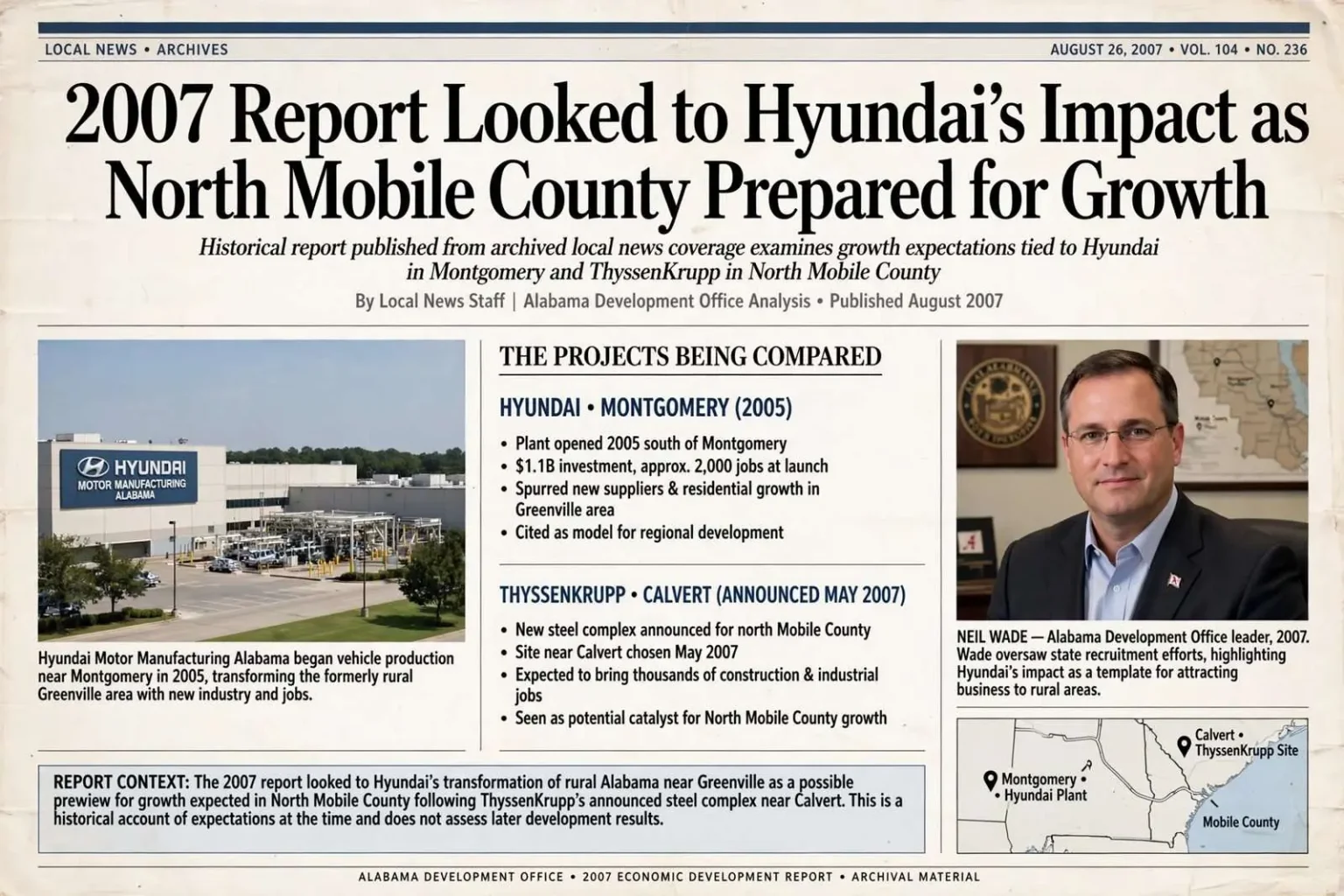
An archived local economic-development report from August 2007 looked at the changes associated with Hyundai’s central Alabama plant as a possible preview of the growth expected in North Mobile County. The report profiled Alabama Development Office leader Neil Wade and described his role in recruiting business investment to the state. It noted that Hyundai’s plant south of Montgomery had transformed a largely rural area, particularly Greenville, where new industries and residents followed the automaker’s arrival. The station presented those changes as context for the anticipated local impact of ThyssenKrupp in North Mobile County. This is a historical account of expectations at the time and does not assess later development results.

In 2007, the announcement of a ThyssenKrupp steel mill in north Mobile County stood among the largest industrial projects Alabama had ever pursued, and communities across the region were trying to imagine what such an investment would mean for their schools, roads, housing markets, and tax bases. To find an answer, the report turned to the state’s most recent comparable experience: the arrival of Hyundai Motor Manufacturing Alabama, which had opened its assembly plant south of Montgomery a few years earlier and set off a chain of growth along the Interstate 65 corridor.

The Alabama Development Office and Neil Wade

The Alabama Development Office was the state’s economic recruitment agency, the organization charged with persuading manufacturers to build in Alabama and with assembling the incentive packages, site selections, and workforce agreements that made such deals possible. During the 1990s and 2000s the agency led the campaigns that brought Mercedes-Benz to Tuscaloosa County, Honda to Talladega County, Hyundai to Montgomery, and a growing family of automotive suppliers to communities along the interstates. Those successes changed Alabama’s economic reputation from a cotton-and-iron image into one of the Southeast’s premier auto manufacturing states.

Neil Wade, profiled in the report, served as the office’s leader during this era and was identified with the state’s recruiting strategy. The report described his role in attracting business investment to Alabama, work that involved marketing the state’s highway, rail, and port access, its worker-training programs, and its relatively low operating costs to international companies scouting American locations. For a project like ThyssenKrupp, state recruiters had spent years courting the German steelmaker, offering sites near deepwater access for the raw materials and finished products a mill of that scale would ship. North Mobile County, with river and port connections and available land, emerged as the chosen location.

See also  Mobile police make arrest in DHR bomb threat

Wade’s presence in the report also reflected a broader point about how Alabama pursued industry. Economic development in the state was a coordinated effort among the governor’s office, the development office, local industrial development boards, utilities, and two-year colleges that trained workers. The state had learned from its early automotive deals how to move quickly, and by 2007 the ThyssenKrupp project was presented as the payoff of that institutional experience.

What Hyundai Did for Greenville

The report’s second anchor was Greenville, the Butler County seat along Interstate 65 between Montgomery and the Gulf Coast. Before Hyundai opened its Montgomery plant, Greenville was a small rural city whose economy rested on timber, agriculture, and highway commerce. The report noted that the automaker’s arrival had transformed the largely rural area, and Greenville became a frequently cited example of how a major plant reshapes towns far beyond the county where it is built.

Hyundai’s Montgomery facility attracted suppliers and service companies that wanted to be within an easy drive of the assembly line. Communities along I-65, including Greenville, competed for those plants with industrial parks, spec buildings, and incentive offers. New industries brought payroll that supported restaurants, hotels, retail, and housing construction, and new residents followed the jobs. For a town like Greenville, the change showed up in the school enrollment, the building permits, and the assortment of national chains that appeared along the interstate exits.

The lesson the report drew from Greenville was about timing and preparation. Places that had industrial land ready, utilities in place, and training programs coordinated with the plant’s needs captured more of the growth than places that waited to react. That was the message local leaders in Mobile County and the surrounding region were meant to take from the Hyundai experience as ThyssenKrupp’s mill moved toward construction: the ripple effects would not distribute themselves evenly, and the communities that organized first would benefit most.

North Mobile County in 2007

North Mobile County in 2007 was a landscape of small towns and rural stretches along the Mobile and Tombigbee rivers, including communities such as Mount Vernon, Creola, and the Calvert area on the county’s northern edge, where the steel site was located. The region sat within commuting distance of Mobile but had remained largely outside the suburban growth that had filled western Mobile County and Eastern Shore communities like Saraland and Satsuma. Land was comparatively inexpensive, rail lines ran through the area, and the rivers offered barge access to the Port of Mobile, a combination that suited a steel mill importing raw materials and exporting finished product.

See also  A Judicial Shuffle in Mobile County: New Faces on the Bench and a Campaign Season Underway

The ThyssenKrupp project promised thousands of construction jobs during the building phase and a permanent industrial payroll once the mill began operating, along with the secondary employers that follow heavy industry: contractors, trucking firms, fabrication shops, and service businesses. Local officials anticipated pressure on housing, schools, and roads in the northern part of the county, and conversations began about annexations, utility expansions, and school capacity. Cities near the site hoped to capture growth through new annexed territory and commercial development, while county government weighed infrastructure spending against a tax base that was expected to broaden considerably.

Residents of the area watched the process with a mixture of anticipation and caution. Industrial recruitment of this scale can remake a community’s character, and the report’s framing of Hyundai’s impact acknowledged both sides of that ledger. New payroll and opportunity arrive alongside heavier truck traffic, changed landscapes, and rising land prices that can strain longtime residents. The Greenville example suggested that the net effect could be strongly positive, but only if growth was planned for rather than merely observed.

A Regional Perspective

The August 2007 report also situated north Mobile County’s project within the Gulf Coast’s broader industrial wave. The mid-2000s brought a series of major energy, chemical, and manufacturing investments across the central Gulf, driven by port capacity, natural gas access, and the region’s transportation network. South Alabama’s recruiters argued that the region could support diversified industry rather than relying on a single sector, and a steel mill added a supply-chain dimension that could feed other manufacturers, from pipe and tube fabricators to automotive and construction suppliers.

For Mobile County as a whole, the project reinforced the area’s long-standing economic identity. Mobile had been a port city since its founding, and heavy industry along the rivers and bay was familiar terrain. What was new was the scale of the investment and the attention it brought. Local economic development organizations referenced the steel project in pitches to other companies, arguing that a community capable of supporting a mill of that magnitude had proven its infrastructure, workforce, and political cooperation.

See also  Mobile Police Search for Suspects After Man Shot, Robbed of Clothes on Azalea Road

Reading the Report Today

Reports like this one are valuable precisely because they capture expectations rather than outcomes. In August 2007, no one writing about ThyssenKrupp knew what the following year’s financial crisis would do to global steel demand, how construction timelines would shift, or how the north Mobile County landscape would actually look a decade later. The report recorded what state and local leaders believed at the time: that the Hyundai experience demonstrated a predictable pattern of supplier growth, residential expansion, and commercial development around a major industrial anchor, and that north Mobile County should expect a version of the same.

The historical record also preserves the institutional story of Alabama’s development recruiting. The Alabama Development Office, later reorganized into the state’s commerce department, had by 2007 assembled a track record that gave credibility to its projections, and figures like Neil Wade were the public faces of a strategy that had already changed the state’s economy. When the report held up Greenville as an example, it was drawing on a documented transformation that residents of Butler County had lived through.

This article is a historical account of expectations at the time and does not assess later development results. The specific projections, recruitment details, and community comparisons reported in August 2007 belong to that moment, and readers seeking the current state of north Mobile County’s economy should consult present-day sources. What the archived report preserves is a snapshot of south Alabama on the edge of one of its largest industrial bets, looking to recent history in central Alabama for a picture of what might come next.