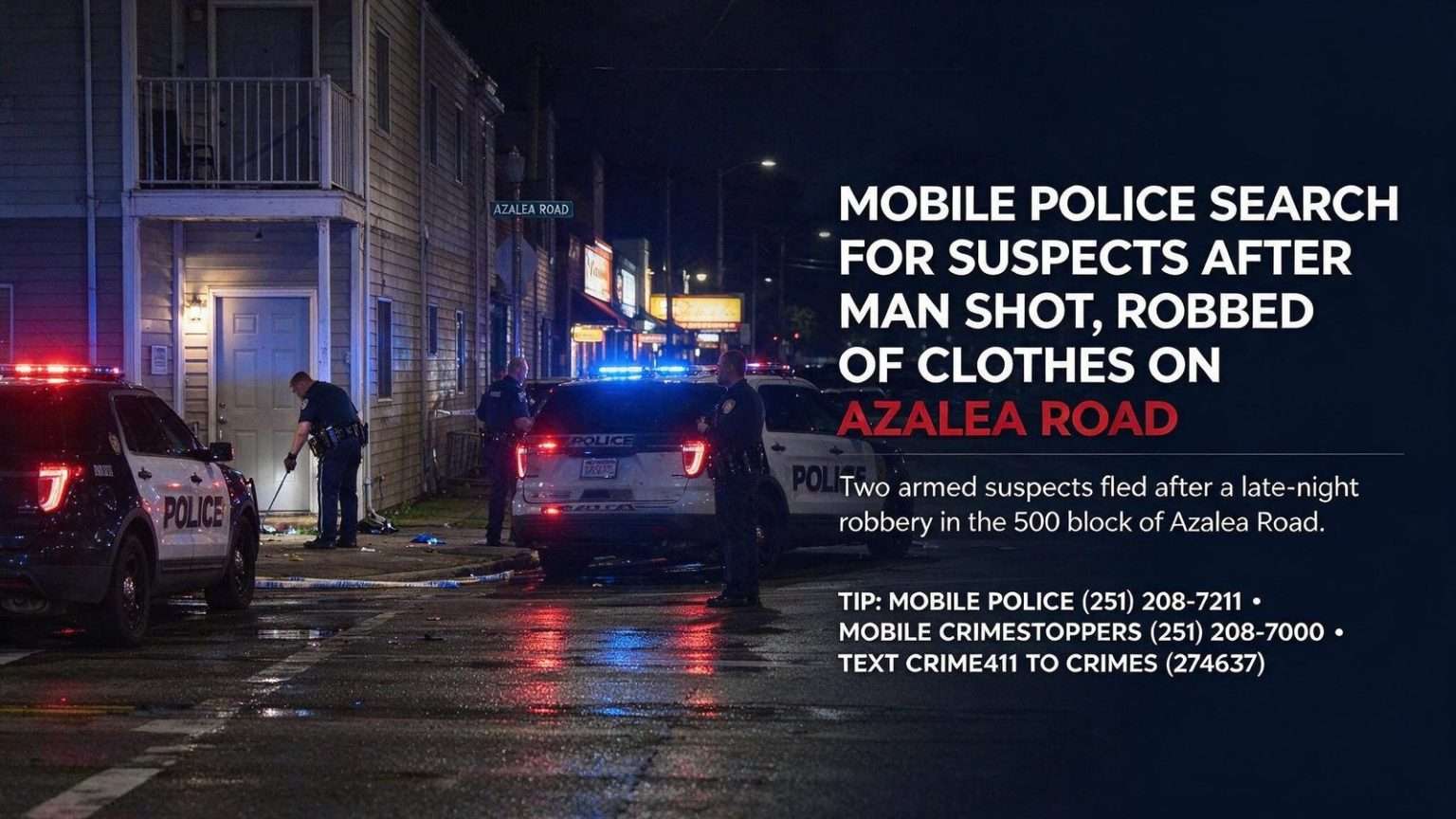
Mobile police are searching for two armed suspects after a man was shot outside his apartment in a robbery that left him without his clothes and shoes, according to the Mobile Police Department. The unusual detail — suspects taking a victim’s clothing rather than only his valuables — has made the case a talking point among residents of the corridor where it happened.
Officers responded to the 500 block of Azalea Road late one evening after receiving a report of a shooting, said police spokeswoman Ashley Rains. When officers arrived, the victim told them he had been sitting outside his apartment when he was shot once in the hip during a robbery. The two suspects fled with his clothing and shoes.
The victim was transported to USA Medical Center with what police described as non-life-threatening injuries. A single gunshot to the hip is a serious wound, but hospital staff determined the injuries did not threaten his life, and the investigation turned quickly from the hospital back to the neighborhood where the attack occurred.
Who police are looking for
Investigators said both suspects were described as Black men standing between 5-foot-6 and 5-foot-8, with dark complexions. Both wore all-black hoodies and had dark cloths covering their faces at the time of the attack, according to Rains. Each suspect was armed with a handgun.
The description — hoodies, covered faces, handguns — is characteristic of armed robbery suspects who plan their assaults to avoid identification, and it makes eyewitness identification harder for both victims and neighbors. That difficulty is precisely why investigators put out a public description quickly: someone who saw two men matching that profile in the Azalea Road area that evening, before or after the attack, may hold the detail that breaks the case.
Police said the pair now face first-degree robbery charges once identified and apprehended. First-degree robbery is a Class A felony in Alabama, reflecting the seriousness with which the department is pursuing the case given the use of a firearm during the offense. Under Alabama law, first-degree robbery covers thefts involving force or threats coupled with a deadly weapon or serious injury, and it carries the stiffest penalty classification the state assigns short of capital offenses — a prison term that can run from 20 years to life. The classification signals how prosecutors treat any robbery in which a gun is drawn and fired, regardless of whether the victim survives.
Azalea Road is one of Mobile’s busier residential and commercial corridors, running through a mix of apartment complexes, retail centers and restaurants in the western part of the city. Its apartments sit close to busy storefronts and main thoroughfares, which makes the area convenient for the people who live there — and gives robbers a steady flow of residents, shoppers and workers moving through a compact space, particularly after dark.
Robberies targeting residents outside their own homes, as opposed to businesses, tend to raise particular concern among neighbors because they can happen with little warning in areas people consider safe. A person sitting outside his own apartment — not walking to a car, not at an ATM, not in a poorly lit alley — was shot and stripped of his clothing in a place most residents regard as an extension of their living room. Attacks like that one tend to change behavior across a complex: residents who previously sat outside in the evening become warier, and managers field questions about lighting, cameras and patrols.
Police departments across the Gulf Coast have pressed apartment communities to install and retain surveillance footage in recent years, and investigators increasingly rely on it in cases like this one, where the victims and witnesses may catch only a glimpse of masked suspects. Even clips that seem unremarkable — a car passing, two figures walking at the edge of the frame — can establish timelines and movement that crack an otherwise thin case.
How residents can help
The Mobile Police Department is asking anyone with information about the shooting or the identities of the suspects to come forward. Tipsters can call Mobile Police directly at (251) 208-7211, contact Mobile CrimeStoppers at (251) 208-7000, or send a text to the Mobile Police Intel line at CRIMES (274637) using the keyword CRIME411.
CrimeStoppers tips can be submitted anonymously and sometimes qualify for a cash reward if they lead to an arrest. The anonymity matters: many people who know something about a violent crime hesitate to come forward out of fear of retaliation, and the tip line is designed for exactly that situation. Callers can pass along a name, a description, a vehicle or a location without ever giving their own, and detectives follow up on the information, not the informant.
As of the initial report, no arrests had been announced in connection with the shooting, and police continued to ask residents in the Azalea Road area to review any home security footage from the time of the incident that might help identify the suspects.
The taking of the victim’s clothing and shoes stands out even among armed robberies, and it is the detail most likely to have left neighbors unsettled. Whether the act was calculated — removing clothing that could carry evidence, or leaving a wounded man unable to chase or follow — or simply an added cruelty, it meant the victim was left injured and exposed on his own doorstep until help arrived. Police have not offered a public explanation for why the suspects took the clothing, and the investigation may never answer that question publicly unless arrests are made.
For investigators, the clothes themselves become evidence. Stolen property that can be traced, described and recovered has ended more than one robbery case, and distinctive items taken during a robbery are sometimes spotted by alert officers on later patrols or by members of the public who remember seeing them. That is one more reason police publicize every detail of what was taken, however strange the detail may seem.
The victim’s expected recovery is the one piece of good fortune in the case. A hip wound from a handgun can damage bone and require extensive treatment, but USA Medical Center — the teaching hospital complex that anchors trauma care for the central Gulf Coast — regularly receives and stabilizes gunshot patients from across the region. Had the bullet struck even slightly differently, the outcome could have been measured in a death investigation rather than a robbery report, a reality police routinely cite when urging witnesses to come forward in shootings that appear, on the surface, to have ended well.
A corridor on alert
News of the attack rippled quickly through the apartment communities that line the corridor. Residents of the area describe a neighborhood where people are accustomed to coming and going freely — joggers, dog walkers, late-night shifts ending at the surrounding restaurants and shops — and an armed ambush at an apartment door punctures that sense of routine.
The Mobile Police Department’s response in such cases typically combines increased patrols in the affected area with canvassing for cameras and witnesses, and the department’s public appeals are part of that strategy. Detectives know that in a city of Mobile’s size, two men in black hoodies on foot in a commercial corridor were likely seen by someone — a driver, a clerk closing a store, another resident out for the evening — who has not yet connected what they saw to the crime.
Residents with cameras, meanwhile, face a practical question: how far back their systems record. Many consumer security cameras overwrite footage within days, which is why police emphasize reviewing recordings quickly rather than assuming they will still exist when an arrest warrant is drafted. Footage from the night of the attack is what investigators need; footage that has already been overwritten is gone.
What happens next in the case
If and when the suspects are identified, the path through the justice system is well defined. First-degree robbery arrests in Mobile are typically made by warrant, with the case then presented to a grand jury for indictment and assigned to a Mobile County Circuit Court judge. Because the charge is a Class A felony, the defendants would face the state’s most serious penalty structure — and because a firearm was fired and a victim wounded, prosecutors would have the aggravating facts that push such cases toward significant prison terms rather than probationary outcomes.
Two co-defendants charged together also shape the prosecution. Investigators will work to establish each man’s role — who carried the gun, who fired it, who took the clothing — because Alabama law holds principals to the same standards, but sentencing presentations and plea discussions often turn on those distinctions. The victim’s testimony, his medical records and any surveillance footage recovered from the area would form the core of the state’s case.
For now, though, all of that remains ahead of two unidentified suspects and a Police Department still asking for the public’s help. The department’s request is specific: anyone who was in the Azalea Road area late that evening, anyone who saw two men matching the description, and anyone with security footage from the 500 block and surrounding streets is asked to review what they have and make the call.
The tip numbers are (251) 208-7211 for Mobile Police, (251) 208-7000 for Mobile CrimeStoppers, or CRIME411 by text to CRIMES (274637). A tip that leads to an arrest in a Class A felony case can carry a cash reward, and it can be made anonymously — no name, no callback, no court appearance required of the tipster. Detectives would rather run down a hundred harmless leads than have the person who watched two masked men slip past their window decide, a week later, that it was not worth the call.
The victim, meanwhile, recovers from a wound that could have ended his life, in a hospital a few miles from the apartment where he was attacked. The men who shot and robbed him remain at large, described only by their height, their clothing and the guns they carried — and a west Mobile corridor is watching to see whether someone comes forward to put names to them.