University of South Alabama Mobile County
Outside Investors Targeted Mobile and Baldwin County in 2008
Real estate professionals reported growing outside interest in Mobile and Baldwin County property in 2008 as major industrial projects reshaped expectations for the region.
Real estate professionals in Mobile and Baldwin counties reported growing interest from outside investors in July 2008 as major industrial projects raised expectations for the regional economy. Realtors said they were hearing from prospective buyers in California, Florida, Massachusetts, Tennessee, North Carolina and other markets — a geographic spread that ranged from the West Coast to New England to neighboring Southeastern states. Interest ranged from individual homes and small lots to larger tracts proposed for subdivisions, apartments, RV parks and other development, a breadth that suggested the inquiries were driven less by any single project than by a broad bet on the region’s direction.
The timing mattered. In mid-2008, much of the national housing market was in retreat, with foreclosures climbing and prices falling across Sun Belt metros. The Gulf Coast’s story was different: the region was positioned for what many believed would be a generation-defining wave of industrial investment, and out-of-state buyers were reading the same headlines as the locals. For investors accustomed to markets where growth had stalled, South Alabama offered a rare combination of announced megaprojects, relatively low land prices and a coastal lifestyle brand that had long drawn retirees and second-home buyers.
Industry helped drive attention
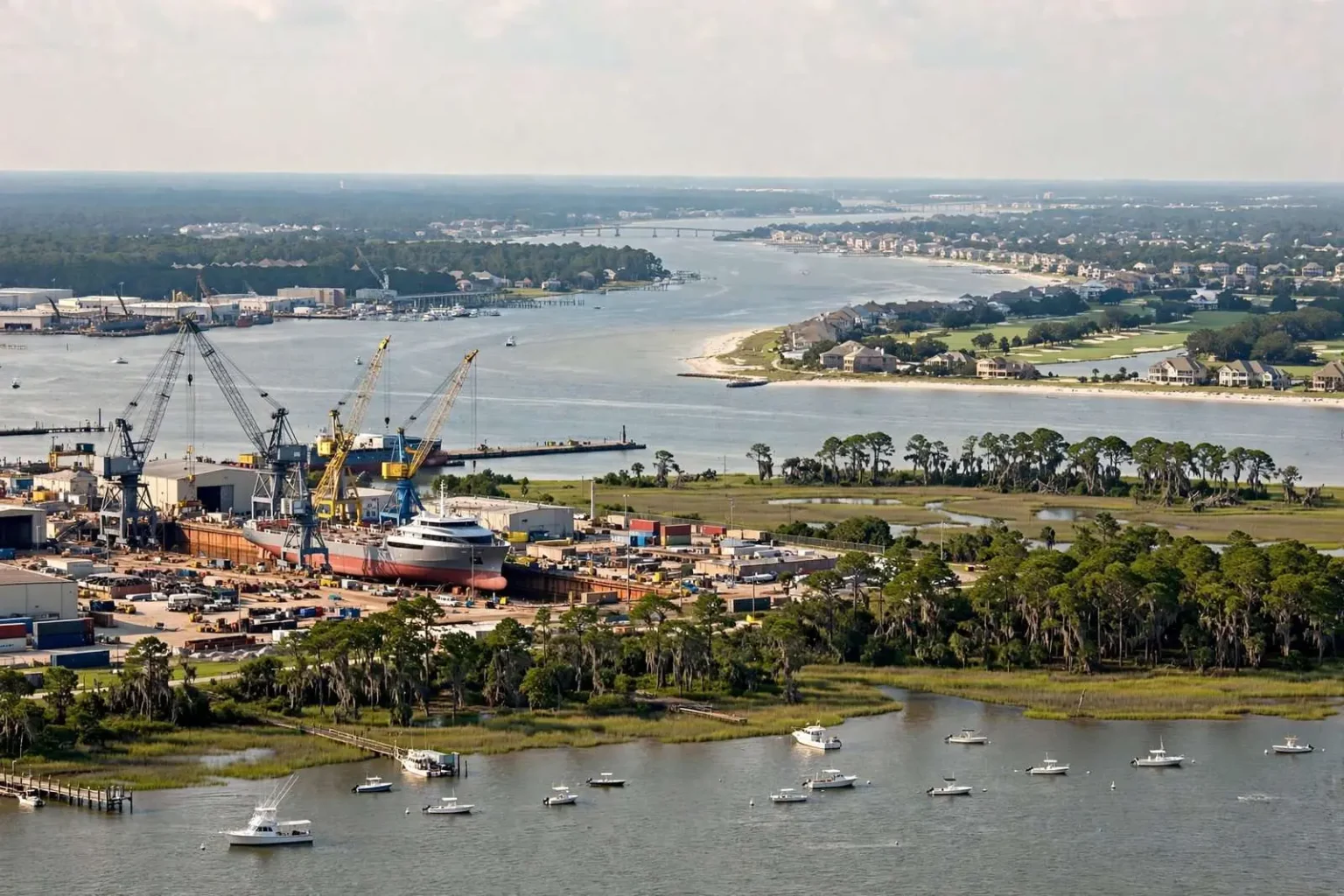
The report connected the investment interest to anticipated activity around ThyssenKrupp, Northrop Grumman, the EADS tanker competition, Austal and the State Port. Each name carried weight in the regional economy. ThyssenKrupp’s steel mill under construction in north Mobile County ranked among the largest industrial investments in the country; Northrop Grumman and EADS were assembling an aircraft manufacturing presence on Mobile Bay contingent on winning the U.S. Air Force tanker contract; Austal’s shipyard on the Mobile River was expanding around combat vessel programs; and the Alabama State Port Authority continued to anchor decades of maritime commerce at the mouth of the Mobile River.
Investors were particularly interested in land suitable for multifamily housing and rental properties expected to serve an expanding construction and industrial workforce. The logic was straightforward: thousands of construction workers and permanent employees would need places to live, and rental demand in communities near the industrial sites — from north Mobile County down to the city and across the bay into Baldwin County — was projected to tighten. Speculators and development groups accordingly looked at apartment sites, townhome tracts and mixed-use parcels, betting that the workforce wave would arrive faster than the housing stock to serve it.
The University of South Alabama’s real estate center was also fielding calls from consultants and investors around the country. Its director said the volume of inquiries made it difficult to estimate the total value of potential investment, but described it as reaching into the multimillions. Academic real estate centers serve as neutral points of contact in moments like this one — national investors who lack local connections reach out for data, market studies and introductions, and the volume of those calls functions as a rough barometer of outside attention. By that measure, South Alabama in July 2008 was registering sharply.
Baldwin County’s appeal in the same period drew on a parallel set of strengths. The county’s beaches, golf communities and water-oriented lifestyle had fueled residential growth for two decades, and the arrival of industrial jobs just across Mobile Bay added a new class of buyers: workers and investors who wanted proximity to employment but the schools, neighborhoods and lifestyle of the Eastern Shore. Communities along the Interstate 10 and Highway 98 corridors — Daphne, Fairhope, Spanish Fort, and down toward Gulf Shores and Orange Beach — were the frequent subjects of the investor inquiries Realtors described.
A buyer-beware reminder
Local real estate professionals also cautioned out-of-state buyers that Alabama’s disclosure rules differed from those in some other states. Where buyers in certain markets might rely on detailed statutory disclosure forms from sellers, Alabama’s practices placed a heavier burden on the buyer’s own investigation. Professionals advised prospective investors to visit properties in person, complete due diligence and work with inspectors before buying — advice that applied with special force to investors purchasing sight-unseen tracts based on newspaper headlines about industrial projects that had not yet been fully built or awarded.
The caution was warranted by the era’s conditions. The 2008 national financial crisis was unfolding in real time, credit markets were tightening, and projects announced with great fanfare did not always proceed on schedule. Prospective buyers weighing decisions on the strength of anticipated industrial growth were effectively making leveraged bets on future announcements — a tanker contract award, construction timelines, shipyard backlogs. The professionals’ counsel to verify before buying reflected both standard prudence and a specific awareness of how quickly the landscape could shift.
This report captures the optimism surrounding South Alabama development in mid-2008. It reflects expectations and investment interest reported at that time, not a measure of later construction, property values or current market conditions. Read with that caution in mind, the July 2008 inquiries nonetheless document a genuine inflection point in the region’s self-image: the moment when Mobile and Baldwin counties began to be discussed in national investment circles as a growth story rather than a footnote.
Parts of that optimism were ultimately vindicated. ThyssenKrupp’s mill was completed and began producing steel, becoming one of the largest private industrial investments in state history. Austal won major Navy contracts and grew its Mobile shipyard into one of the region’s signature employers. Airbus — EADS’s consumer brand and successor entity in the tanker saga — eventually chose Mobile for its first U.S. assembly line, with the A320 family final assembly plant opening years later and anchoring an aerospace cluster along the bay. The State Port continued its expansion with new container and bulk capabilities that tied the region more tightly to global trade.
Other threads of the 2008 narrative resolved less cleanly. The tanker competition that drove so much speculation dragged through years of protests, rebids and reversals before the contract work settled into Mobile, and the national housing downturn suppressed the residential investment wave that July 2008 inquiries anticipated. Multifamily construction did eventually arrive — but on a timeline and at a scale shaped by the recession rather than the boom-year projections. Investors who bought at the 2008 peak in some segments waited years for values to recover, a reminder that even well-founded regional optimism can be overtaken by national events.
For readers today, the episode is a useful case study in how regional economies attract attention. The chain ran from headline industrial announcements to real estate professionals’ phones to university research centers to out-of-state capital — a signal cascade in which each participant amplified the expectations of the others. The professionals’ advice in 2008 remains the standing counsel for out-of-market buyers in any era: visit the property, verify the claims, hire the inspector and treat regional enthusiasm as context rather than as a guarantee. The July 2008 moment passed into history, but the pattern it illustrated — and the caution it counseled — has remained a durable feature of Gulf Coast real estate ever since.
The geography of the investor interest told its own story. California buyers, often seasoned by decades of high-price coastal markets, tended to look at income property and land banking; Florida investors, watching their own state’s correction, sought nearby markets still early in their cycle; and buyers from Tennessee and North Carolina — themselves growing Southeastern metros — looked at South Alabama as an adjacent play on the same regional migration. Realtors reported that some inquiries were exploratory, but others arrived with concrete plans: apartment complexes sited near employment centers, RV parks aimed at the Gulf Coast’s substantial seasonal visitor traffic, and subdivision tracts positioned along the growth corridors that planners had already identified.
Rental housing was the recurring theme because the industrial projects’ labor demands were so visible. Construction employment on a project the scale of ThyssenKrupp’s mill peaks in the thousands, and those workers — many of them specialists who relocate for the build — need temporary and semi-permanent housing long before any permanent workforce settles in. Developers and investors understood that the rental market absorbs that first wave, which is why multifamily land drew such concentrated interest. The same reasoning applied to shipyard and aerospace employment, which brings skilled tradespeople and engineers whose salaries support higher-end rental and for-sale product.
How the region’s leaders read the moment
Local economic development officials had spent years courting exactly this attention. The recruitment of ThyssenKrupp, the pursuit of the tanker program and the growth of Austal’s orders were the products of sustained effort by state and regional organizations, and the investor inquiries of July 2008 were, in a sense, the market’s endorsement of that work. A region that once competed for basic manufacturing jobs now found national capital asking about apartment sites and subdivision tracts — a shift in the quality of attention that leaders noted even as they urged patience about the timeline.
The university center’s role in the episode also illustrates how regional research institutions function as economic infrastructure. Consultants calling a university real estate center are typically evaluating markets for clients who want credible, locally grounded analysis; the center’s market studies and data give those clients a starting point, and its ties to local practitioners give them a path into the market. The multimillions in potential investment the director described — unquantifiable precisely because inquiries were arriving faster than they could be tallied — represented the leading edge of capital that would take years to fully materialize, if it materialized at all.
The buyer-beware counsel from local professionals carried an additional practical dimension for out-of-state purchasers: Alabama’s real estate customs, title practices and zoning frameworks differ from those in the states where most investors were based. Lot sizes, utility availability, permitting timelines and homeowners’ association structures can all surprise buyers working from assumptions formed elsewhere. That is why the professionals’ advice to visit properties and engage local inspectors was more than boilerplate — it was the difference between an investment grounded in the actual parcel and one grounded in a headline.