University of South Alabama Mobile
Rising Food Costs Pressured Mobile Catering Businesses in 2008
A 2008 report examined how higher food and fuel prices raised costs for a Mobile catering business, prompting changes to pricing and more work to protect its bottom line.
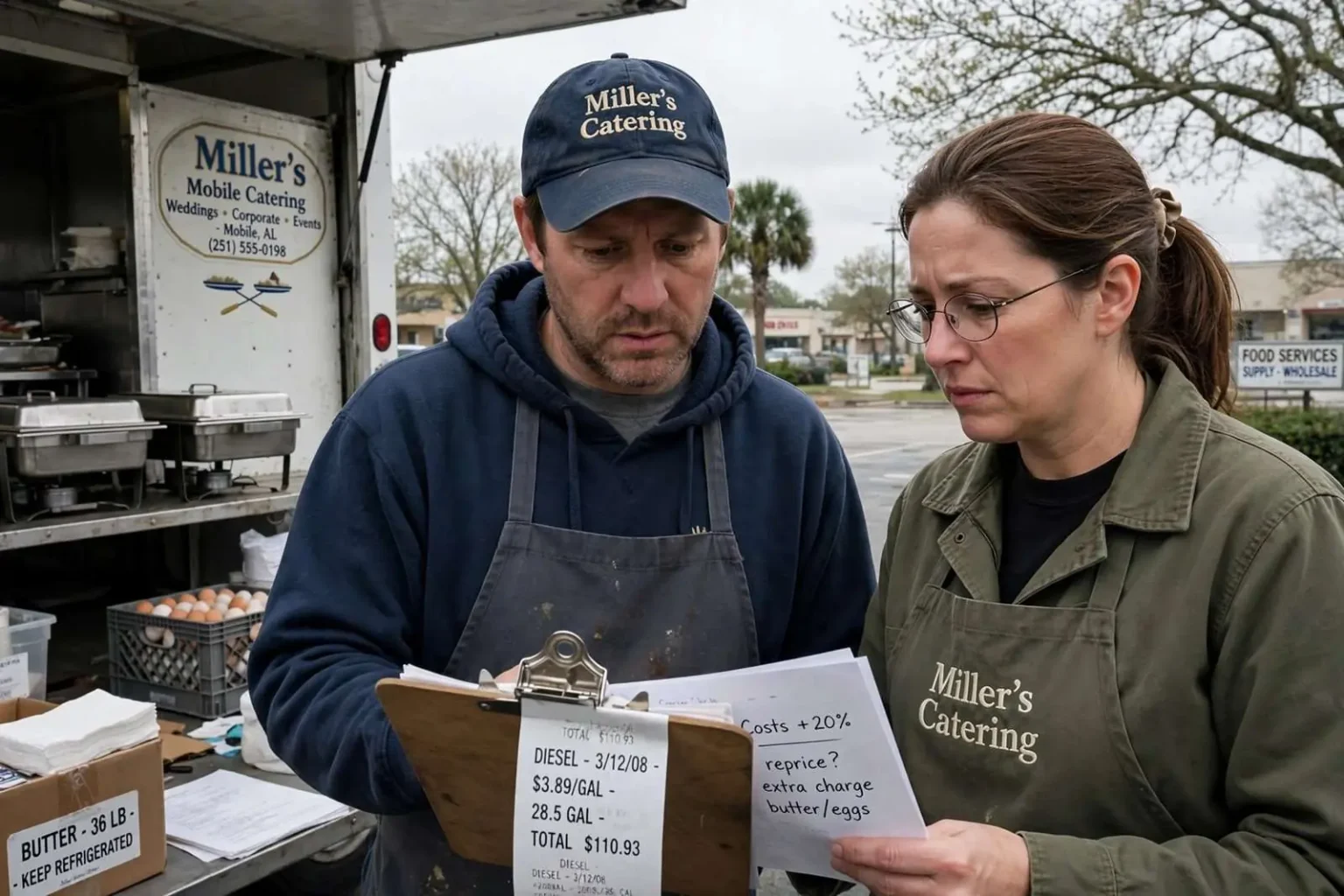
Rising food and fuel costs put pressure on Mobile catering businesses in early 2008, forcing one local team to reconsider its pricing and seek additional work. Chris and Carla Miller said their overhead had increased by about 20 percent, a jump that came out of the margin on every job they booked and left them scrambling to keep their operation solvent.
Higher prices for basics such as butter and eggs affected the food they prepared, while fuel costs added to the expense of reaching catering jobs. For a catering business, the squeeze comes from both directions at once: the ingredients cost more before the first pan goes in the oven, and every mile to the venue costs more than it did the year before. The Millers’ experience in March 2008 was echoed in kitchens across the Gulf Coast, where small food businesses operate on thin margins that a 20 percent overhead increase can erase.
Price Changes Reached Customers
The Millers said some additions that had previously been included in a per-person price now carried an extra charge. That shift marks one of the most visible ways food inflation moves through a service business: rather than raising the headline price of a catered event — a move that can cost a caterer future bookings in a competitive market — operators begin unbundling, charging separately for items clients once received as part of the package.
They described accepting more catering engagements as one way to offset the effect on their business. Volume becomes the lever a small operator can still pull. If each event produces less profit than it once did, booking more events preserves the total. That strategy carries its own costs — longer hours, more staff strain and a schedule stretched across weekends — but for a family-run operation like the Millers’, it beats the alternative of raising prices so sharply that clients start shopping elsewhere.
The squeeze on caterers in 2008 tracked broader pressures on the food industry. Grocers, restaurants and bakeries all reported the same pattern: wholesale prices for staples climbing faster than menu prices could follow, forcing businesses to absorb costs, trim portions or restructure their pricing. Caterers felt it acutely because their contracts are typically signed weeks or months before an event — a quote offered in winter could be executed in spring with ingredient prices far above those assumed when the deal was struck.
The Economic Backdrop
University of South Alabama marketing department chairman Mohan Menon pointed to several factors behind rising prices, including a weaker dollar, consumer-price increases and demand for corn used in fuel production. Each factor worked through the food system in a distinct way, and together they explain how the cost of a stick of butter or a carton of eggs could climb fast enough to reorder a small business’s budget.
The weaker dollar played out on the global stage. When the dollar loses value against other currencies, American commodities — grain, meat, dairy — become cheaper for foreign buyers, and export demand pulls product out of the domestic market. Less supply at home means higher prices on the shelf, and the effect lands hardest on staple foods whose prices are set in national and international markets rather than by local producers.
Corn demand tied to fuel production was the newest of the pressures Menon cited. The expansion of ethanol production, which converts corn into fuel, tied the price of corn to the energy markets it now competed with. Because corn feeds livestock and sweetens and thickens a vast array of processed foods, its rising price rippled outward — into the cost of beef, pork, chicken, eggs and dairy — touching nearly every aisle of the grocery store and every catering kitchen that drew from it.
Fuel Costs on the Road
For a catering business, fuel is not an incidental expense — it is part of every quote. Trucks loaded with chafing dishes, serving lines, tables and prepared food travel to weddings, corporate lunches, reunions and receptions across the Mobile area, and diesel and gasoline prices in early 2008 were climbing toward levels the region had never seen. Each mile added cost to a job whose price may have been set months earlier.
The Millers’ decision to take on more engagements reflects a common small-business response to rising transportation costs: spread the fixed costs of a trip across more revenue. A truck already rolling to a venue can sometimes serve a second stop nearby; a crew already hired for an evening can prep an additional morning event. The approach works until the schedule saturates, at which point the operator faces the pricing decision all over again.
Fuel costs also compounded the ingredient problem in less obvious ways. Food moves to Mobile by truck and rail, and wholesale suppliers pass their own fuel expenses along in their pricing. The diesel bill shows up twice — once in the price of the butter and eggs, and again at the pump when the caterer drives them to the party.
How Small Food Businesses Adapt
The responses available to a catering operation in the Millers’ position form a familiar playbook. Operators can adjust menus toward less expensive ingredients, negotiating with clients on substitutions that hold the price point. They can reduce portion sizes or streamline service. They can unbundle formerly inclusive items, as the Millers did. And they can chase volume, booking additional engagements to keep revenue rising while margins shrink.
None of these choices is painless, and each tests the relationship with customers. Weddings and large receptions — the bread and butter of catering — are emotionally charged, budget-sensitive events, and clients comparison-shop. An operator who raises prices faster than the market risks losing bookings; one who holds prices while costs climb risks working for nothing. The Millers’ path — extra charges for former inclusions plus more events — split the difference between the two.
Larger institutional food operations had more tools at their disposal: long-term supplier contracts, purchasing cooperatives and the financial depth to ride out a bad quarter. The small, family-run caterer has none of those cushions. What it has instead is flexibility and relationships — regular clients who accept an honest explanation of rising costs, and the willingness of an owner-operator to put in the extra hours that volume demands.
A Snapshot From March 2008
This article records conditions described in March 2008 and does not state later price trends or the business’s subsequent operations. It preserves, however, a clear picture of a moment when the economics of food service shifted underfoot. The 2008 food-price surge was broad enough that the federal government’s consumer price data reflected sharp increases in dairy, eggs and grain-based products, and businesses across the Gulf Coast were adjusting in real time.
Menon’s analysis connected the local experience to global forces — currency markets, commodity demand, energy policy — a reminder that a catering quote in Mobile is an economic document, touched by decisions made in Washington grain-belt ethanol plants and currency trading floors as much as by any local factor. The Millers’ 20 percent overhead increase was, in miniature, the story of that year’s food economy.
For consumers planning events in that market, the changes were visible at the contract level: line items that used to be bundled were now priced separately, and caterers who once absorbed small cost swings began passing them through. The lesson of 2008, repeated whenever input costs spike, is that small food businesses survive by adapting quickly — adjusting prices, menus and schedules — while holding on to the client relationships that keep the phone ringing.
The Local Food Economy
Mobile’s catering market in 2008 mixed wedding and event work with a steady base of corporate and institutional business. Hotels, museums, plantations and event venues across the area relied on caterers to serve receptions and fundraisers, and the port city’s convention and tourism traffic added seasonal demand. Into that market, family operations like the Millers’ competed on personal service and reliability as much as price — an advantage that erodes quickly when costs force price changes that clients notice.
The regional economy of early 2008 gave the squeeze extra bite. Fuel prices were climbing nationwide, and Alabama households were feeling the effect at their own gas pumps and grocery stores, tightening budgets for discretionary spending like parties and receptions. A caterer facing higher costs thus faced them alongside clients who were themselves cutting back — a double pressure that helps explain why the Millers looked to more bookings rather than steeper prices to close the gap.
The experience of the Millers and the analysis from Menon together captured a shift that touched every corner of the food business in Mobile that spring, from the wholesale produce house to the supermarket checkout line. Butter and eggs were the visible markers, but the underlying forces — the dollar, the corn-ethanol connection, the price of diesel — were rewriting the arithmetic of every menu quote in town, and the businesses that survived were the ones flexible enough to keep refiguring the numbers until the market settled.