Former Alabama Coach to Headline Mobile Addiction Ministry Fundraiser
A former Alabama Crimson Tide head coach will headline a Mobile fundraising banquet supporting a ministry that serves addicted men, women and families.
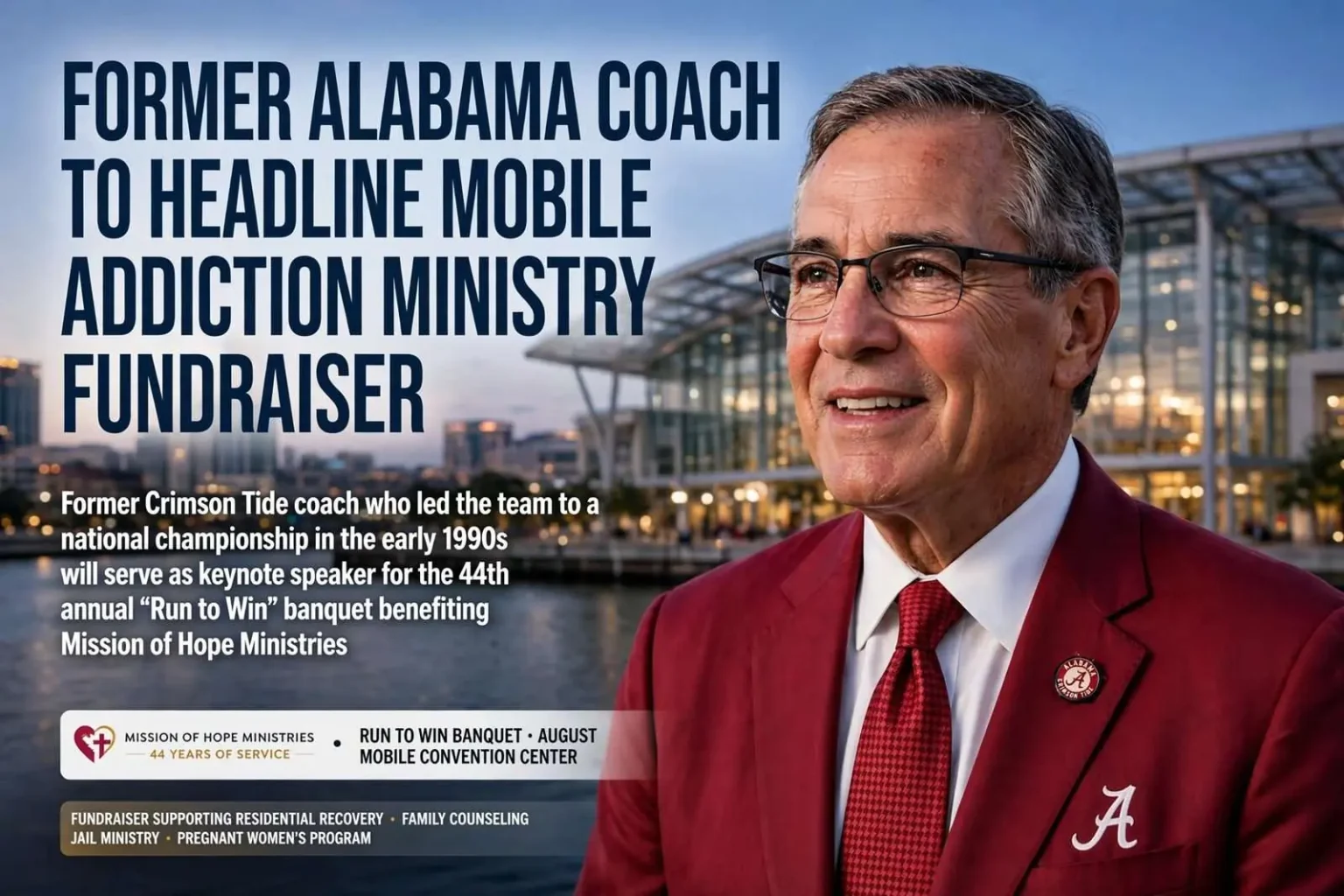
A former Alabama Crimson Tide head football coach will serve as the keynote speaker at an August fundraising banquet benefiting a Mobile-based ministry that has spent more than four decades helping people recover from drug and alcohol addiction. The “Run to Win” banquet will celebrate 44 years of service by Mission of Hope Ministries, a nonprofit Christian organization that runs in-house recovery programs for both men and women, including support for pregnant women struggling with addiction.
The venue itself is a statement about the event’s scale. The evening will open with a silent auction followed by dinner at the Mobile Convention Center, the riverfront facility at the heart of the city’s downtown entertainment district and one of the largest event spaces on the Gulf Coast. Hosting a banquet there reflects how far the ministry’s annual fundraiser has grown — from a church-hall gathering into one of the region’s most significant evenings for those who support faith-based recovery work.
The choice of speaker ties the ministry’s story to one of the most recognizable threads in Alabama public life. The evening’s keynote speaker led the Crimson Tide to a national championship in the early 1990s and was later inducted into the College Football Hall of Fame. In a state where college football commands a devotion that borders on civic religion, a headliner with that résumé brings an audience that a typical charity dinner could never draw on its own. Organizers have long understood the pairing: the banquet’s very name — “Run to Win” — borrows the language of athletics to describe the discipline and perseverance that long-term recovery demands.
A ministry four decades in the making
Mission of Hope Ministries has operated in the Mobile area for decades, building a reputation among local churches and social service agencies as one of the region’s primary resources for long-term addiction recovery. Its model is residential and intensive: instead of offering counseling sessions a few hours a week, the ministry takes people in, houses them, and walks them through a structured program of recovery, work and faith that can reshape daily life from the ground up.
The breadth of that work shows up in the ministry’s own year-end figures. Proceeds from the event go directly toward sustaining the ministry’s outreach work, which in the most recent full year of operation included serving more than 600 men and women battling addiction, with more than 300 completing the program. For a nonprofit relying on donations rather than government contracts, those numbers represent a sustained presence in a fight that many organizations enter and leave within a few budget cycles.
The ministry’s reach extends well beyond its residential beds. It also ran a family counseling initiative that served roughly 200 families, more than half of whom completed the program, along with tens of thousands of free meals and overnight stays for people in crisis. That family counseling component reflects a conviction common among long-running recovery ministries: addiction is rarely a one-person problem, and the people who love someone in active addiction need structured support of their own.
Volunteers also led hundreds of chapel and worship services, including regular services inside the Mobile Metro Jail. That jail ministry places Mission of Hope inside one of the most difficult corners of the region’s addiction crisis, reaching men and women whose struggles with drugs and alcohol have already carried them into the criminal justice system. For many participants, the first contact with the ministry comes not at its front door but from a chaplain’s visit behind the walls of the jail on Congress Street.
Support for women and mothers-to-be
Among the ministry’s most distinctive commitments is its support for pregnant women struggling with addiction — one of the most medically delicate populations in the recovery field. Expectant mothers who are dependent on drugs or alcohol face simultaneous risks to their own health and their baby’s, and few residential programs along the Gulf Coast are equipped to take them in. By opening its women’s program to them, Mission of Hope fills a gap that hospitals, emergency shelters and short-term clinics in the area are rarely positioned to fill themselves.
The women’s program, like its counterpart for men, is built around the same in-house model: a safe place to live, a daily structure, counseling and pastoral care, and enough time for recovery to take hold. Organizers say the approach reflects the ministry’s founding purpose — to treat addiction not as a moral failure to be judged but as a condition from which people can recover when someone offers them structure, community and hope.
Why the fundraiser matters
The evening’s keynote speaker will draw the crowd, but the budget realities are what the banquet exists to address. Guests purchasing premium table packages will have the opportunity to meet him during a pre-dinner reception, while individual tickets are also available at a lower price point for those hoping to attend the dinner and program. The tiered pricing lets businesses and churches sponsor at higher levels while keeping the doors open to individual supporters who simply want to be part of the night.
A Christian music artist and instructor will serve as master of ceremonies for the evening, which organizers say has become one of the ministry’s most important annual fundraising events. The auction, the dinner and the sponsor tables together produce a large share of the revenue that carries Mission of Hope through the rest of the year — revenue that arrives without strings attached, which matters for an organization whose services are offered free of charge.
Organizers say community support through events like the banquet remains essential to keeping the ministry’s programs free for the people who rely on them. That model — free residential care funded by donors — shapes every other decision the ministry makes. Men and women arriving at Mission of Hope are frequently at the lowest point of their lives: unemployed, estranged from family, sometimes fresh out of jail or the emergency room. Requiring payment up front would put help out of reach for the very people the ministry exists to serve, so the financial burden shifts to the community that supports it.
The August banquet is the year’s centerpiece in that effort, but it also serves a second purpose that organizers value just as much: it puts recovery stories in front of the public. Annual banquets of this kind traditionally feature graduates of the program alongside the headliner, giving supporters a firsthand look at the men and women whose lives the donations fund. For churches and civic groups across Mobile and Baldwin counties, the event doubles as a report card on four decades of work.
Addiction in the Mobile region
The ministry’s longevity is best understood against the scale of the problem it confronts. Like port cities across the Gulf Coast, Mobile has battled high rates of drug and alcohol abuse for generations — a product of its history as a working port, its highway connections, and the economic dislocation that follows the region’s boom-and-bust cycles. Emergency rooms, detox units and court dockets across Mobile County carry the daily evidence of the crisis that Mission of Hope and organizations like it work against.
Public agencies have long struggled to keep pace. Government-funded treatment tends to be short, means-tested and overcrowded, and the wait for a state-funded residential bed can stretch for weeks — precisely the window in which a person ready to change can slip back into addiction. That is the gap private, faith-based programs like Mission of Hope occupy. A person who walks in seeking help can often be admitted far faster than the public system can respond, and can stay for the months that genuine recovery typically requires.
The partnership with churches and social service agencies across the region works in both directions. Pastors refer congregation members and their families; probation officers and court officials point people toward the program as an alternative to incarceration; hospital social workers recommend it to patients who would otherwise return to the environments that fed their addictions. In return, the ministry’s volunteers and graduates become part of the fabric of support that other agencies draw on.
The speaker and the message
The keynote speaker’s own biography is part of the draw. A man who reached the top of his profession, fell and rose again — the arc that marked the head coach’s public life — carries a message about second chances that maps directly onto the ministry’s work. National championship coaches are judged by their ability to rebuild teams, and the same leadership themes that filled stadiums in Tuscaloosa translate readily into a ballroom full of supporters hearing about lives rebuilt in Mobile.
His induction into the College Football Hall of Fame cemented a standing that extends beyond Alabama, and appearances like this one are relatively rare for figures of his stature. Organizers secured the appearance for an anniversary year — the banquet marking 44 years of the ministry’s work — a milestone that gives the evening both a celebratory tone and a fundraising urgency. Reaching 44 years means surviving recessions, changes in the drug landscape and the constant turnover of any residential program, and the banquet is framed as both a thank-you to longtime supporters and an appeal to new ones.
How to attend
Those interested in attending, sponsoring a table or donating a silent auction item are encouraged to contact the ministry directly for pricing and registration details ahead of the August event. Table sponsorships include the pre-dinner reception with the keynote speaker, while individual tickets cover the dinner and program at a lower price point. Donated auction items — from Gulf Coast vacations and fishing trips to restaurant gift cards and locally made goods — form a significant part of the evening’s proceeds, and donors receive recognition in the event program.
For the ministry, the night at the Mobile Convention Center is both a milestone and a launching point: 44 years behind it, and a year of residential care, family counseling, jail ministry and free meals ahead of it, funded in large part by the tables filled and bids placed on a single August evening. Supporters of faith-based recovery work across the Gulf Coast have few better opportunities to see the need, hear the stories, and contribute directly to the programs that meet them.