University of South Alabama Baldwin County
2008 Report Described Growing Investor Interest in Mobile and Baldwin Counties
A 2008 WKRG report said investors from around the country were looking at property in Mobile and Baldwin counties amid major industrial-development expectations.
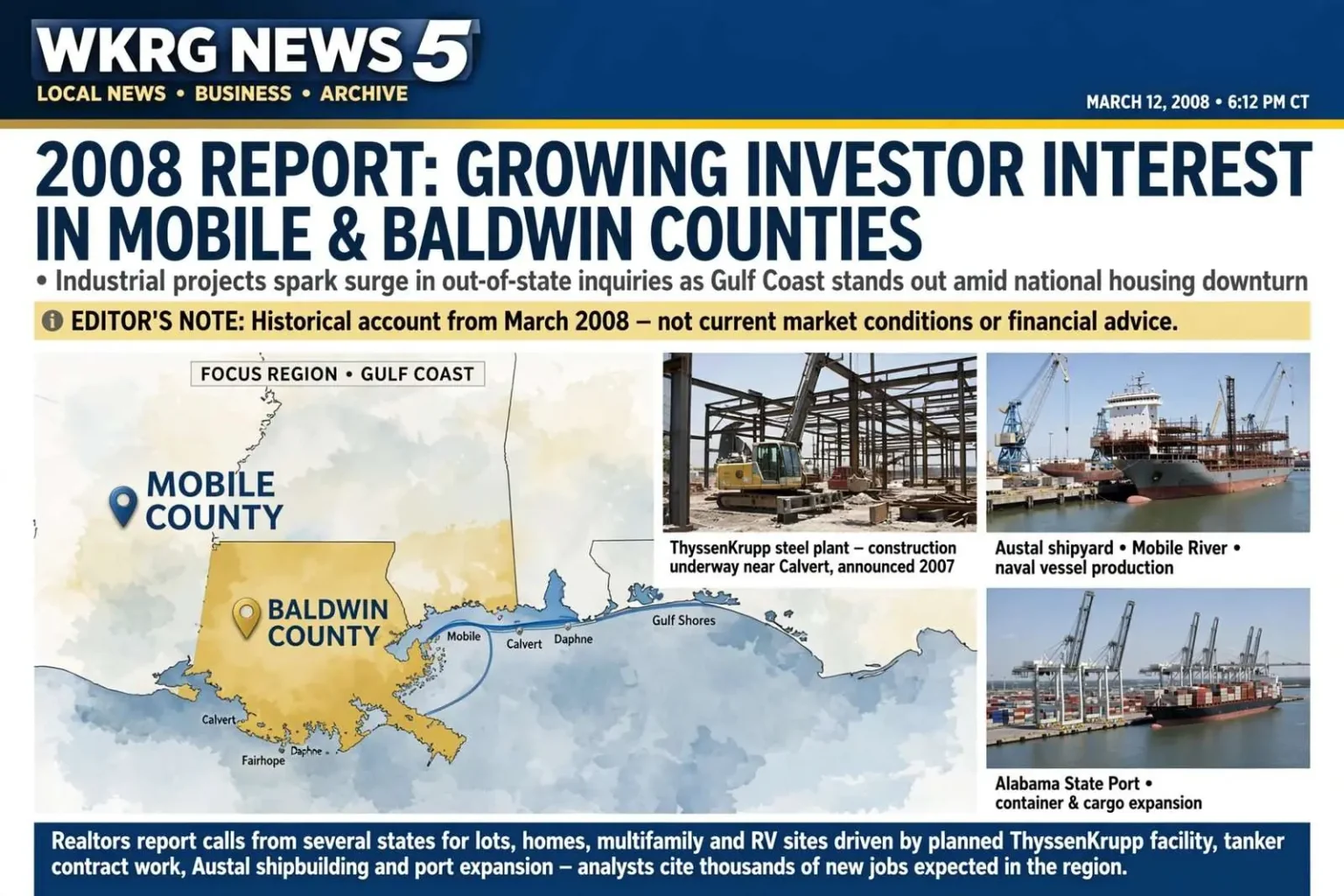
Editor’s note: This is a historical account from a March 2008 local news report. It does not describe current investment conditions or provide financial advice.
The station reported in March 2008 that real-estate professionals were seeing growing interest from investors in property across Mobile and Baldwin counties. Realtors told the station that callers from several states were exploring purchases ranging from small lots and single-family homes to larger development tracts, multifamily projects and RV centers. The inquiries arrived at a moment when the national housing market was sliding into its worst downturn in decades, making the Gulf Coast’s apparent resilience all the more striking to the professionals fielding the calls.
The report connected that interest to expected construction and industrial growth, including the planned ThyssenKrupp plant, the tanker-contract competition involving Northrop Grumman and EADS, Austal and activity at the State Port. Each of those projects had the potential to move thousands of workers into the two counties, and investors who had watched the pattern before — in cities that landed major industrial facilities — were attempting to position themselves ahead of the arrival.
University of South Alabama Real Estate Studies Director Don Epley told the station that his office was fielding inquiries from prospective investors around the country. Epley’s center tracked real-estate conditions across the Gulf Coast and advised both public officials and private clients, so the volume of out-of-state interest his office observed served as a barometer for the region as a whole. The assessment and projects named here reflect the outlook reported in 2008, not current market conditions.
The ThyssenKrupp announcement that reshaped expectations
The single largest force behind the investor interest was the steel mill. ThyssenKrupp had announced in 2007 that it would build a multibillion-dollar carbon steel and stainless facility in north Mobile County near Calvert, one of the largest industrial investments in Alabama history. Site preparation and construction were ramping up as the March 2008 report aired, and the project’s scale — thousands of construction jobs during the build-out and a permanent workforce of more than two thousand — dwarfed anything the region had seen in generations.
Investors understood what such a project does to nearby real estate. Construction workers need housing close to a rural site like Calvert, which has few apartments and limited hotels, and permanent hires bring families who need schools, shopping and homes. Land in northern Mobile County and along the corridors leading to the site — U.S. 43, Alabama 158 and Interstate 65 — drew attention from buyers who recalled similar run-ups around automotive plants in Tuscaloosa, Lincoln and other Alabama industrial sites, where property values near new facilities climbed steadily once construction began.
The mill also anchored expectations for the broader regional economy. Suppliers were expected to locate nearby, trucking and marine transport along the Tombigbee River would increase, and the tax base growth promised new infrastructure spending. For real-estate professionals in Mobile and Baldwin counties, the plant’s story gave them a concrete answer to the question every investor asked: why this market, and why now.
The tanker contest and the shipyard economy
The second thread was aerospace. Northrop Grumman and its European partner EADS had proposed assembling the U.S. Air Force’s KC-45 aerial refueling tanker in Mobile, a project that promised tens of thousands of jobs across the assembly plant and its supply chain if the contract were won. Mobile had built a purpose-drawn case for the work, and the pending Air Force decision kept the region in national headlines throughout 2007 and 2008. Investors weighing Mobile property were, in part, weighing the odds of that contract, and the possibility of a massive aerospace workforce arriving downtown and at the Brookley field area gave commercial and residential buyers alike a reason to look closely.
Austal, the Australian shipbuilder, added a third pillar to the outlook. The company had established operations in Mobile and was competing for and winning U.S. Navy and Coast Guard vessel work, including the Littoral Combat Ship program that would later define the city’s modern shipbuilding identity. Austal’s presence at the Mobile River waterfront meant steady, skilled employment that did not depend on a single contract decision, and it reinforced the narrative that Mobile’s industrial economy was diversifying in ways that would sustain demand for housing and commercial space.
The fourth element was the State Port itself. The Alabama State Port Authority’s facilities on the Mobile River handled coal, forest products, container cargo and more, and the port was pursuing expansion projects — including the Montgomery inland terminal and plans connected to the widening of the Panama Canal — that positioned Mobile for growth in international trade. Port activity supported thousands of jobs directly and indirectly, and investors who studied the region saw the combination of a growing port, two expanding shipyards and a pending aerospace decision as unusually broad momentum for a metro of Mobile’s size.
What the investors were buying
The purchases described in the report ranged across every property type in the two counties. Small lots and single-family homes appealed to individual investors riding the rental market; multifamily projects targeted the worker housing that industrial growth would require; development tracts in Baldwin County anticipated the residential boom that had already made it one of the fastest-growing counties in Alabama; and RV centers spoke to the transient construction workforce that projects like ThyssenKrupp’s would bring. Each type told the same story from a different angle: an expectation that more people were coming to the Gulf Coast.
Baldwin County’s side of the bay carried its own logic. The county’s population had grown continuously for decades, drawing retirees and families to communities such as Foley, Fairhope, Daphne, Gulf Shores and Orange Beach, and its eastern-shore and beach markets had long attracted out-of-state buyers. The March 2008 report’s callers from several states fit a pattern Baldwin County realtors knew well, even as the national housing collapse made buyers elsewhere hesitant — coastal Alabama’s relative affordability gave it a measure of insulation from the subprime excesses that hammered other Sun Belt markets.
Don Epley’s University of South Alabama center sat at the intersection of those trends. Real-estate studies programs at regional universities frequently publish market surveys and forecasts, and Epley’s office had spent years documenting the gap between Mobile’s industrial prospects and its real-estate fundamentals. The inquiries his office fielded from around the country confirmed what the realtors told the station: the region had appeared on the national investment radar, driven not by speculation alone but by identifiable, large-scale projects with dates and dollar figures attached.
Reading the 2008 outlook today
The report captured a moment of maximal expectation. Within months of the March 2008 broadcast, the national financial crisis deepened, credit markets froze, and even resilient regional markets felt the chill. The tanker competition took years of reversals before work finally arrived in Mobile in a different form, and the ThyssenKrupp plant itself was later sold to new owners — outcomes the 2008 report could not foresee. That is precisely why the archived account carries its editor’s note: it documents what professionals believed and reported at the time, not a forecast that was guaranteed to hold.
What the record preserves is valuable nonetheless. It shows a regional economy positioning itself around heavy industry, shipbuilding, aerospace and port trade, and it shows national investors recognizing that positioning before the downturn obscured it. The callers from several states, the range of property types and the specific projects named — ThyssenKrupp, the tanker competition, Austal, the State Port — form a portrait of the central Gulf Coast in early 2008 that remains useful context for anyone tracing how the region’s modern economy took shape, and a reminder that real-estate reports, like the markets they describe, belong to their moment.
How the market actually worked in early 2008
The national backdrop sharpened the significance of the Gulf Coast’s numbers. Home sales in much of the country had stalled, foreclosure filings were climbing monthly, and national media treated real estate as a story of collapse. Against that picture, Mobile and Baldwin county realtors describing inbound calls from several states were describing a genuine anomaly, and the March 2008 report gave viewers the explanation the professionals themselves offered: the region’s growth was tied to industrial projects with long timelines, not to the speculative financing that had inflated other markets.
Rental dynamics illustrated the point. A metro gaining thousands of construction workers over several years experiences immediate pressure on apartments and short-term housing long before permanent homes are built. Multifamily buyers cited in the report were positioning for exactly that squeeze, and in markets around the country similar plays had paid off around other major industrial build-outs. RV centers, likewise, served crews who moved from project to project and needed staging space near a rural construction site such as Calvert’s.
Commercial realtors tracked the same signals on the retail side. Each new industrial payroll produces spending that follows rooftops: grocery stores, restaurants, service businesses and medical offices. Development tracts near the growth corridors of west Mobile, along Alabama 158, and in Baldwin County’s population centers were purchased with those tenants in mind, and the report’s mention of larger development tracts indicates that the buyers included players planning on multi-year horizons rather than quick flips.
The region behind the report
Mobile and Baldwin counties anchored the only part of Alabama that touches the sea, and their economies had always moved with the water. The port, the shipyards, the seafood industry and the tourism economy of Baldwin County’s beaches gave the two-county region a diversity that many similar-sized markets lacked, and each addition — a steel mill, a tanker line, a growing Navy shipbuilder — compounded the effect. The professionals quoted in the 2008 report were describing a region they believed was on the edge of a generational transformation, and the investor interest they reported was the earliest, most sensitive indicator of that belief.
For local readers, the report also explained changes they could see on their own streets: sold signs on lots that had sat unsold, apartments filling near industrial corridors, and out-of-state plates in neighborhoods where they had been rare. Real-estate interest of the kind described by Epley and the realtors does not stay abstract — it converts into construction, sales and, eventually, the population growth the projects promised. The March 2008 account preserves the moment when that conversion was still ahead, and when the central Gulf Coast’s prospects looked, to buyers around the country, like the best-kept secret in Southern real estate.