Baldwin County Pursuit Ended in Fairhope Arrest in 2008
A Baldwin County man was arrested after a March 2008 police pursuit from Loxley into Fairhope, according to WKRG.
Originally reported March 26, 2008.
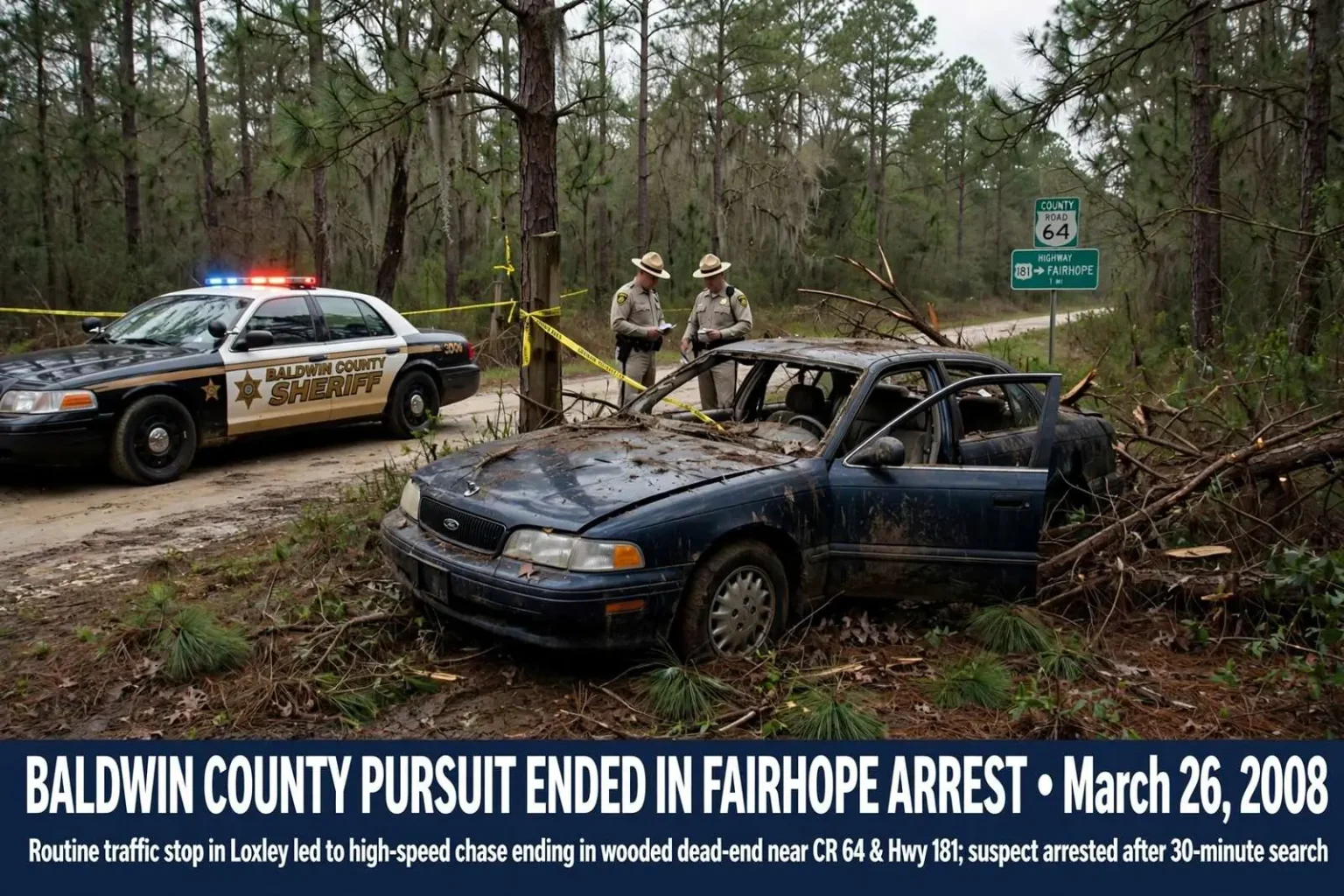
A Baldwin County man was arrested after a police pursuit that began with a routine traffic stop in Loxley and reached Fairhope in March 2008, according to an archived local news report. The report said the driver passed other motorists and forced some off the road before reaching the County Road 64 and Highway 181 area. After entering a wooded dead-end area, he left the vehicle and was caught about 30 minutes later. This article records allegations and an arrest reported at the time; it does not state later court outcomes.
The incident began in Loxley, the growing Baldwin County town that sits along the Interstate 10 corridor west of Robertsdale, when an officer initiated a traffic stop for what the archived report described as a routine violation. Rather than pulling over, the driver accelerated away, transforming a routine stop into a pursuit that would cross a wide swath of south-central Baldwin County. Pursuits that begin with minor stops are among the most unpredictable events in policing: within seconds, the decision of one driver sets in motion a chase whose path, duration and ending no one controls.
From Loxley, the pursuit pushed toward the Fairhope area, where the report said the fleeing driver escalated the danger by passing other motorists and forcing some off the road. That detail, more than any other in the account, describes the hazard a high-speed chase creates for the public. A driver running from police at speed on rural Baldwin County highways passes on curves, shoulders and in oncoming lanes, and the vehicles he passes have no warning. Forcing motorists off the road turns bystanders into victims and is among the most serious behaviors an officer can observe from a fleeing vehicle.
The route carried the chase into the area of County Road 64 and Highway 181, a crossroads of rural routes southwest of Fairhope where the landscape turns to pine woods, pastures and residential drives set back from the pavement. Highway 181 runs north-south through the heart of that part of the county, linking communities from Fairhope toward Summerdale and beyond, while County Road 64 threads east-west through the countryside. It was in this area, according to the report, that the pursuit reached its end.
The end of the chase
The driver entered a wooded dead-end area, a location that offered concealment but no exit. Rather than continuing by vehicle, he left the car and fled on foot into the woods, setting up the next phase of the incident: a ground search in wooded terrain, with officers converging on the area and a perimeter designed to keep the fleeing man contained. The search ended about 30 minutes later when officers caught him, closing out a chase that had run from Loxley through the Fairhope area and deep into the county’s rural roads.
A 30-minute foot search in a wooded dead-end area is a familiar conclusion to Gulf Coast pursuits. The terrain of south Alabama — dense pines, thick underbrush, drainage cuts and property fences — slows a fleeing driver’s escape on foot and gives officers a real chance to contain a small area. Once the vehicle is abandoned, the pursuit shifts from a high-speed emergency to a methodical search, with officers coordinating on the ground until the suspect is in custody. In this case, that coordination produced an arrest without further escalation, as far as the archived report indicates.
The arrest brought the incident into the criminal justice system, where the charges stemming from the pursuit would be weighed. The archived report recorded the arrest and the allegation of the flight itself, along with the danger posed to other motorists, but it did not state later court outcomes — a limitation the article preserves. Pursuit cases in Alabama courts typically involve the charge of attempting to elude, along with any traffic violations, reckless endangerment counts tied to the driving, and any additional charges arising from the original reason for the stop.
Baldwin County’s road network shapes how its pursuits unfold. The county is Alabama’s largest by land area, a patchwork of highways, county roads and growing municipalities spread over terrain that gives a fleeing driver room to run. Interchanges along Interstate 10 feed traffic onto routes like Highway 181, Highway 59 and Highway 98, while the county roads between them carry the local traffic of farms, subdivisions and small towns. A chase can cross multiple jurisdictions in minutes, drawing in municipal officers, sheriff’s deputies and occasionally state troopers before it ends.
Pursuits and the questions they raise
Technology has changed the balance since 2008. Departments increasingly use technology-driven alternatives to high-speed chases — GPS tracking tags that can be deployed onto a fleeing vehicle, aerial support that follows from above without joining the speed, and license plate reader networks that locate a vehicle hours later rather than minutes. The goal, policy experts say, is to trade the immediate pursuit for a safer, delayed apprehension whenever the underlying offense is not violent. In 2008, though, the tools available on a Baldwin County roadside were the pursuit itself and the officers’ judgment.
The consequences of forcing motorists off the road also carry legal weight. Alabama’s reckless endangerment statute reaches driving that creates a substantial risk of serious physical injury to others, and a fleeing driver who passes other vehicles and runs them toward the ditch is providing prosecutors a textbook set of facts. Combined with the eluding charge, the driving behavior observed during a chase often becomes the most serious part of the case — more serious, in many instances, than whatever the original traffic stop was about.
Loxley and Fairhope: the geography of the chase
The two towns at either end of the pursuit tell the story of Baldwin County’s growth. Loxley, where the routine traffic stop began, has transformed over the years from a small agricultural crossroads into a hub of warehouses, retail and growth along the Interstate 10 corridor, its population climbing as the county’s boom draws new residents. Fairhope, where the chase ended in the surrounding rural area, sits on the bluffs of Mobile Bay and ranks among the county’s most recognizable communities, its downtown a destination while its outskirts stretch toward Highway 181 and the countryside beyond.
The distance between them — roughly fifteen miles by the direct route — gave the fleeing driver a long stretch of county road on which to run. In that stretch lie the communities and crossroads of south-central Baldwin County, where two-lane highways carry traffic between the bay and the agricultural land east of it. Motorists on those roads on a weekday in March 2008 had no role in the incident except to encounter it, which is why the report’s detail about drivers being forced off the road stands as the incident’s most alarming element.
Archived reports like this one preserve the local history that would otherwise fade. A pursuit that lasted minutes, crossed a dozen miles and ended in the woods near County Road 64 was, for the officers and residents involved, a memorable day; for the county’s growing population, many of whom arrived long after 2008, it is unknown history. Recording the facts as they were reported at the time — the stop in Loxley, the flight toward Fairhope, the dangerous passing, the dead-end woods, the 30-minute search, the arrest — keeps that history accurate without embellishment.
The article’s disclaimer matters in that record. An arrest is an allegation, not a conviction, and the archived report did not follow the case into the courts. Baldwin County’s judicial system — with its circuit and district courts handling the county’s caseload — would have adjudicated whatever charges the pursuit produced, but the record here stops at the arrest. Readers should understand the account in those terms: what was reported, what was observed, and what the article does not claim to know.
What the incident left behind
For the motorists who were forced off the road, the episode was a frightening few minutes on an ordinary drive, the kind of encounter that lingers long after the police reports are filed. For the officers involved, the chase demanded the full sequence of modern pursuit work — the decision to chase, the coordination across jurisdictions, the containment of the dead-end area and the ground search that ended in an arrest. For the man arrested, it converted a routine traffic stop into a criminal case with far more serious stakes than the original violation carried.
Every police pursuit walks a line between enforcement and public safety, and departments across Alabama balance that line through pursuit policies. Officers weigh the seriousness of the suspected offense against the danger the chase itself creates, and the calculus changes the moment a fleeing driver begins passing other motorists or forcing them off the road. Incidents like the 2008 chase in Baldwin County illustrate both sides: the suspect’s behavior was dangerous enough to demand a response, and the pursuit itself put the public in harm’s way until the wooded dead-end brought it to a stop.
The incident also stands as an example of how pursuits end well: with the vehicle abandoned, the suspect contained in a limited area, and the arrest made without reported harm to officers or the public beyond the danger the driver himself created. The 30-minute search in the woods off County Road 64 concluded with the man in custody, and the highways between Loxley and Fairhope returned to the ordinary traffic of a March morning.
Eighteen years later, the account remains what the archived report made it: a Baldwin County man arrested after a pursuit that began with a routine traffic stop in Loxley and reached the Fairhope area, with dangerous passing along the way and an arrest in a wooded dead-end near County Road 64 and Highway 181. The allegations were reported; the courts did their work beyond the reach of this record. The roads where it happened still carry their daily traffic, as they did before and after one driver chose to run.