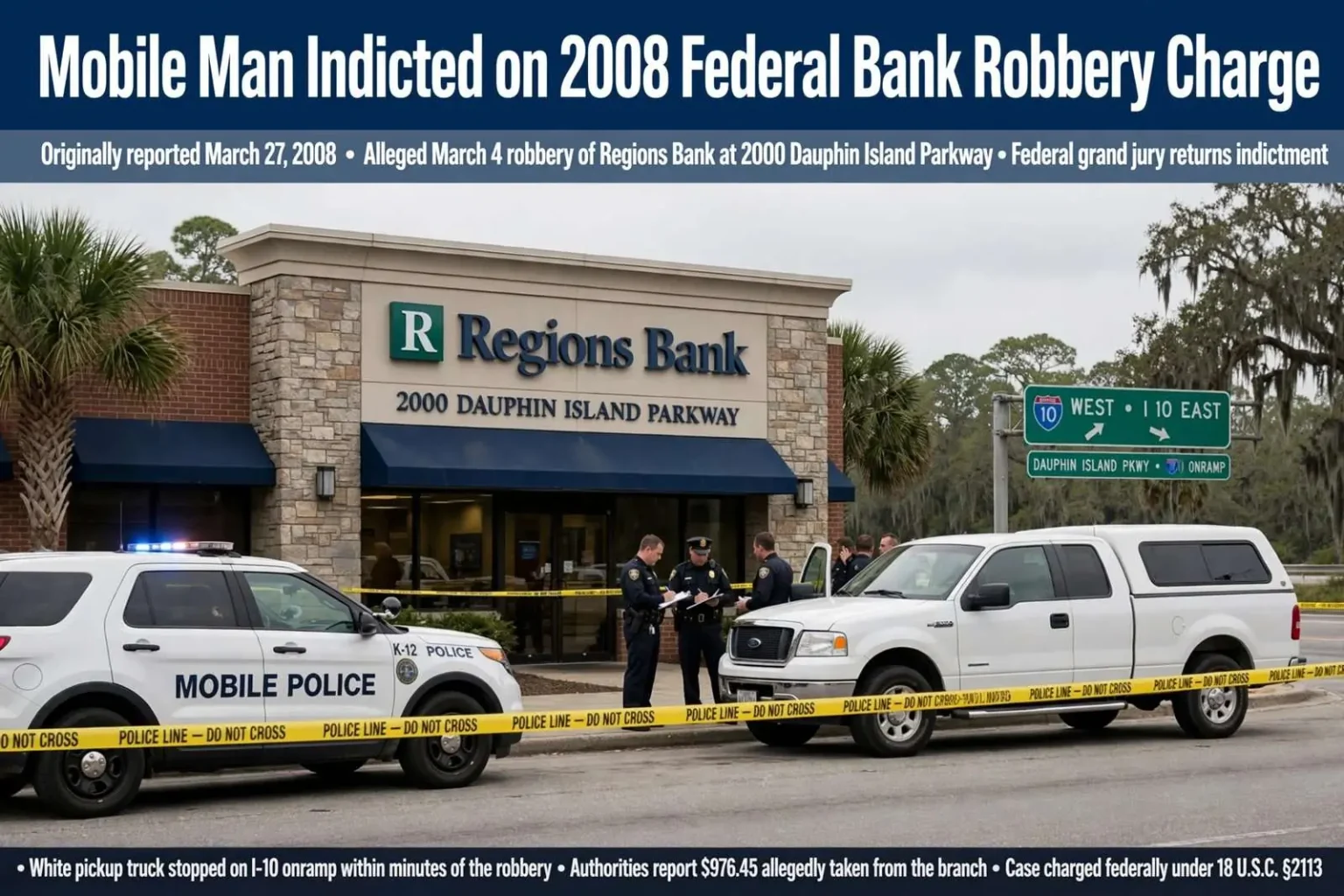
Mobile Man Indicted on 2008 Federal Bank Robbery Charge
A federal grand jury indicted a Mobile man in March 2008 in connection with the robbery of a Regions Bank on Dauphin Island Parkway, according to WKRG.
Originally reported March 27, 2008. This is a historical account of allegations reported at the time; it does not state any later plea, trial result, or sentence.
A federal grand jury indicted a Mobile man in March 2008 on a bank-robbery charge connected to the March 4 robbery of a Regions Bank at 2000 Dauphin Island Parkway, according to an archived local news report. The indictment moved the case from the city’s police docket into the federal court system, where bank robbery is prosecuted as a federal crime because the insured deposits of a national bank fall under federal jurisdiction.
Police alleged that the man jumped over the counter during the robbery, took cash, and left the scene in a white pickup truck. An officer later stopped the truck as it entered the interstate, the report said, a quick stop that suggested police had a description of the vehicle within minutes of the holdup. Authorities said $976.45 was taken — a modest sum, as bank robbery amounts often are, and one that stands in stark contrast to the potential penalty facing a defendant convicted of the charge.
The report noted that a conviction could carry a sentence of up to 20 years in federal prison. As with all indictments, the charges were allegations at the time of the report, and every defendant is presumed innocent unless and until proven guilty in court. This article reflects the indictment and allegations reported at the time. It does not state any later plea, trial result, or sentence.
How a bank robbery becomes a federal case
Bank robbery occupies a distinctive place in American criminal law. While most robberies are prosecuted in state court, robbing a bank brings the federal government into the case, because banks insured by the Federal Deposit Insurance Corporation are federal instrumentalities under 18 U.S.C. Section 2113, the federal bank robbery statute. In practice, that means the FBI investigates the holdup, a federal grand jury hears the evidence, and the case is prosecuted by the U.S. Attorney’s Office for the Southern District of Alabama rather than by the Mobile County District Attorney.
The federal grand jury process differs from a preliminary hearing in state court. A grand jury meets in secret, hears only the prosecution’s evidence, and decides whether probable cause exists to return an indictment — a true bill. Defendants have no right to appear or present evidence at that stage. Indictment is not a finding of guilt; it is the formal charging document that moves the case toward trial in U.S. District Court in Mobile, where the federal courthouse on St. Louis Street handles criminal dockets for the southern half of the state.
The practical consequences of the federal route are significant for a defendant. Federal sentencing operates under the guidelines system, in which offense levels and criminal history combine to produce a recommended range, and federal defendants serve the overwhelming majority of their sentences — parole was abolished in the federal system in 1987. The 20-year maximum cited in the 2008 report was the statutory ceiling for ordinary bank robbery; the realistic sentence in most cases falls well below it, but even a guidelines-range sentence in a federal bank robbery case typically dwarfs what a comparable state robbery prosecution would produce.
The Dauphin Island Parkway branch
The Regions Bank branch at 2000 Dauphin Island Parkway sat on one of Mobile’s most storied corridors. Dauphin Island Parkway — DIP to generations of Mobilians — runs south from downtown toward the causeway and Dauphin Island itself, lined with a mix of neighborhoods, storefronts, restaurants, and the auto dealerships and boat shops that serve the bay communities. Bank branches along the corridor serve a working stretch of the city, and a midday robbery at one of them draws immediate attention from nearby businesses and residents who have long memories for crime on the parkway.
Bank robberies in Mobile follow a pattern familiar to police departments everywhere: most are committed by individuals, most involve demands for cash rather than weapons displayed, and most involve take amounts far smaller than the public imagines. The figure authorities reported in this case — $976.45 — fits that pattern precisely. The precise amount mattered in the case file because federal prosecutors must prove the taking of money from a bank by force or intimidation, and the exact sum anchors the account of what happened inside the branch that March day.
The alleged flight from the scene — over the counter, out the door, and into a white pickup truck, with a police stop coming as the truck entered the interstate — reads like the compressed timeline that bank robbery investigations often produce. Banks in the corridor sit minutes from Interstate 10 and the George Wallace Tunnel, and officers familiar with the on-ramps can position themselves quickly when a description goes out over the radio. The interstate stop described in the report is the kind of fast coordination that determines whether a bank robbery case is resolved the same day or becomes a months-long hunt for a suspect at large.
Jumping the counter: the holdup inside the branch
The allegation that the man jumped over the counter is a detail that bank robbery investigators weigh carefully. Counter-jumping robberies involve a physical breach of the teller line — the barrier that separates customer space from the cash drawers — and they carry greater risk of violence than verbal-demand robberies, both because the robber is inside the tellers’ workspace and because the employees are close enough to be grabbed or hurt. Teller training across the industry is built around this reality: comply, stay calm, activate silent alarms when it is safe, and remember details. Money is insured and replaceable; people are not.
For the employees and customers inside the branch that day, the moments while a robber came over the counter and emptied a drawer are remembered long after the case files close. Bank branches on the parkway in 2008 typically staffed a handful of tellers on a weekday, and the robbery would have unfolded in well under two minutes from entry to exit — long enough for the terror that survivors of such holdups describe, short enough that most details come from what people noticed in fragments.
The federal system treats the human toll of bank robberies seriously even in cases where no weapon is displayed and no one is hurt. Victims of federal crimes are notified of court proceedings under the Crime Victims’ Rights Act, and bank robbery enhancements in federal sentencing can attach when a defendant threatens force. The 20-year statutory maximum reflected in the 2008 report can climb higher still when a weapon is involved or someone is injured — a structure that reflects Congress’s judgment that the sanctity of the banking system and the safety of its employees deserve special protection.
The white pickup and the interstate stop
The description of the getaway vehicle — a white pickup truck — is the detail that made the rapid stop possible. Pickup trucks are so common on Mobile’s roads that a bare description is almost useless, which suggests the officer who made the stop had more to go on: a direction of travel, a plate number or partial plate, or a match to a suspect description broadcast in the first minutes after the alarm. Trucks entering the interstate from the Dauphin Island Parkway area funnel onto a small number of ramps, and a patrol car positioned along that route can screen vehicles as they pass.
Vehicle stops in bank robbery cases are handled with care, because officers must assume the robber may be armed until the stop is complete. The stop described in the report — as the truck entered the interstate — put the arrest at the hinge point between the city’s street grid and the highway system, in the stretch of Mobile where parkway traffic merges toward I-10. If the traffic stop recovered the stolen cash and connected the driver to the holdup, the evidence chain from teller drawer to roadside seizure would form the spine of the federal prosecutors’ case.
Recovery of the money matters in another respect as well: federal indictments in bank robbery cases routinely seek restitution of the exact amount taken, down to the cents. The oddly precise figure of $976.45 in the report is the kind of number that follows a case through sentencing and into a restitution order, where a defendant remains obligated to repay the bank in full regardless of the sentence imposed.
The case file, seventeen years on
What became of the case after the March 2008 indictment — whether it ended in a plea, a trial verdict, or some other disposition — is not reflected in the archived report, and this account deliberately makes no claim about the outcome. Federal criminal cases in the Southern District of Alabama typically move from indictment to resolution within a year, and the public record of the case would show the disposition in the district court’s docket. What the archive preserves is the initial picture: a holdup on Dauphin Island Parkway, an indictment returned by a federal grand jury, a quick arrest on the interstate, and a maximum penalty that made the $976.45 at issue one of the most expensive handfuls of cash ever taken from a Mobile bank counter.
For the neighborhood around the branch, the case was one entry in the long ledger of crime along the parkway, noted and discussed for a week and then folded into the corridor’s ordinary life. For the agencies involved — Mobile police, the FBI, and the U.S. Attorney’s Office — it was the system working the way it is drawn on paper: local patrol, federal charge, and a defendant in custody within hours of the alarm.