Historical report preserved from an archived 2008 local news story.
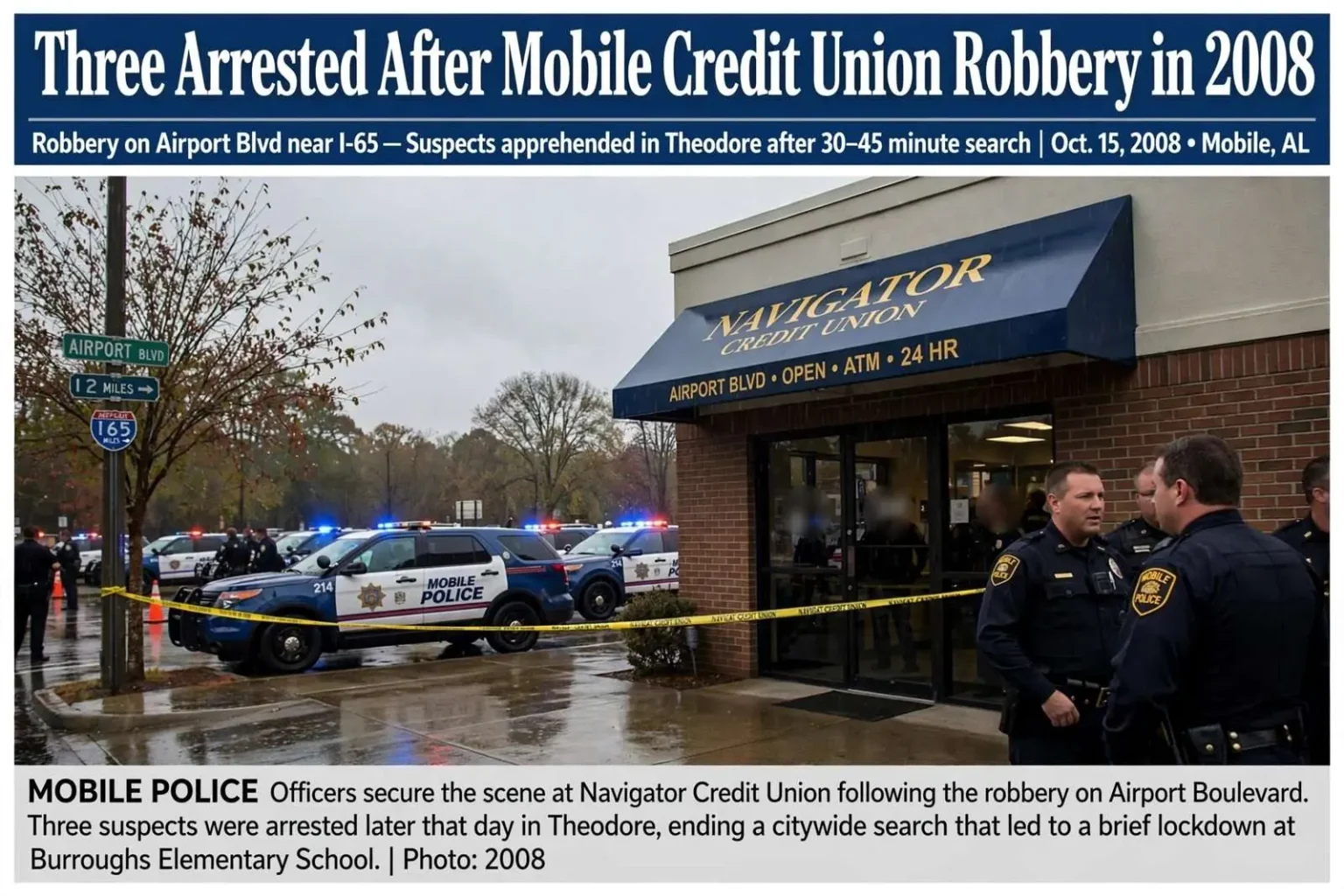
Mobile Police said three people were arrested after a robbery at the Navigator Credit Union on Airport Boulevard near Interstate 65 in 2008. According to the report, police said two men entered the credit union with guns and covered faces, demanded money and left. Investigators said a third person drove the getaway vehicle, and the search that followed stretched across a wide swath of the city before it ended in Theodore.
The robbery unfolded at one of the busiest commercial intersections in west Mobile. Airport Boulevard carries heavy traffic between downtown and the western suburbs, and the credit union sits near the Interstate 65 interchange, in a corridor of shopping centers, restaurants, and bank branches. That location cut both ways for the robbers: it offered fast access to the interstate for an escape, but it also placed the crime in the middle of a zone that Mobile Police patrol heavily and that dozens of witnesses were passing through on a business day.
The Search and the Theodore Arrests
The search lasted about 30 to 45 minutes from the time the robbery was reported, according to police. A manhunt of that speed and scope typically involves patrol units saturating the area around the crime scene, checking vehicles matching descriptions, and working from any direction information or evidence left behind. In this case the trail led investigators south, down Airport Boulevard and toward the Theodore community, where two suspects were located at a residence on Pope Street.
Arrests that follow a robbery within the hour are the product of fast work on the fundamentals: descriptions broadcast to patrols, witness accounts collected at the scene, and the getaway route itself, which fleeing robbers usually select for speed rather than discretion. Airport Boulevard’s connection to the interstate and to the south-of-the-city neighborhoods gives fleeing suspects options — and gives pursuing officers the same road network in return. The movement from the credit union to a Pope Street address in Theodore traced one of those routes in real time.
Police said two suspects were found at a home on Pope Street in Theodore and that later investigation led to a third arrest. The later investigation that produced the third arrest is standard in robbery cases involving getaway drivers. The two men taken in Theodore provided investigators with the thread, and building the case against the driver typically requires interviews, surveillance, and evidence connecting the vehicle or the planning to the person behind the wheel. Getaway drivers sometimes believe their distance from the armed entry insulates them, but Alabama law treats a participant in a robbery as fully liable for the entire crime, whatever role they played.
Burroughs Elementary and the Lockdown
Burroughs Elementary School was briefly placed on lockdown after staff saw police activity in the neighborhood. The school resumed normal operations shortly before the end of the day, and the lockdown ended without any incident at the school itself. The episode illustrated how often school operations intersect with nearby police activity: Theodore is a residential community, and Pope Street sits within reach of the school, so staff moved the campus into lockdown as a precaution, holding students in classrooms away from exterior doors until the situation was clear.
No threat to the school was ever reported; the lockdown was a protective response to uncertainty, the kind schools practice for and execute without drama. The disruption amounted to a portion of one afternoon. For parents arriving at dismissal, the incident passed as a brief notice and a story their children told at dinner. School lockdowns prompted by nearby police activity are common in urban and suburban districts alike, and Mobile County Public Schools’ procedures call for exactly this response — secure the building, account for students, and lift the lockdown when police give the all-clear.
Burroughs Elementary serves the Theodore area of Mobile County, one of the public schools whose campuses sit in the mixed residential-commercial landscape south of the city, where neighborhoods back up to the commercial strips along the major roads. That geography is why a police search unfolding a few streets away registers immediately at the school office: the staff’s view of the neighborhood is direct, and their protocols are built around the possibility that outside events will arrive at the property line. In this case the protocols worked as designed, the students stayed secure through the uncertainty, and the afternoon returned to normal before the buses ran.
The Charges and What Followed
The three people were charged at the time with first-degree robbery; this archived account does not state any later court outcome. Under Alabama law, first-degree robbery — robbery committed while armed with a deadly weapon, or causing serious physical injury to another — is a Class A felony, the most serious class short of capital crimes, carrying a potential sentence of twenty years to life in prison. An armed robbery of a financial institution, with two gunmen covering their faces and demanding money from tellers, presents the classic profile of that charge.
Robbery cases from 2008 would have moved through the Mobile County court system on the timeline typical of felony prosecutions: grand jury review, arraignments, and — unless resolved by plea agreements, which dispose of the large majority of felony cases — trial dates set months or years out. This archived account preserves the arrests and charges as they were reported at the time and does not attempt to reconstruct what happened in the courtroom afterward. Readers researching the outcome would need court records from Mobile County’s circuit court docket for the case dispositions.
Bank and Credit Union Robberies in Mobile
Armed robberies of financial institutions were a persistent category of violent crime in Mobile during the late 2000s, and the police response to them followed a well-worn playbook. Branches along Airport Boulevard, Government Street, and the other commercial arteries were hit in clusters, often by offenders who struck in daylight, presented or displayed weapons, and fled in vehicles staged nearby. The FBI joins local police in investigating bank robberies as a matter of course — robbery of an FDIC-insured institution is a federal crime — though credit union cases can proceed in state court depending on the institution’s insurance structure and the agencies’ charging decisions.
The typical sequence in a daytime armed branch robbery puts a premium on the first minutes after the suspects leave. Tellers activate alarms, witnesses stream out of the parking lot with descriptions, and the first patrol units on scene seal the immediate roads while the description goes out to every unit in the district. Most armed robbers who are caught are caught in that window, within a few miles of the scene, because the getaway vehicle and route are chosen for speed and the net closes faster than the escape. The 30-to-45-minute search that ended at a Pope Street home in Theodore fits that pattern precisely.
The Geography of the Case
The case’s geography tells the story of how Mobile County works as a single policing region. Airport Boulevard near I-65 sits in the middle of west Mobile’s commercial spine, inside city limits and Mobile Police jurisdiction. Theodore, where the Pope Street arrests happened, lies south of the city in the unincorporated county, an area patrolled by the Mobile County Sheriff’s Office — but the suspects’ flight from the city into the county did not create a jurisdictional gap, because area law enforcement agencies coordinate through mutual aid and radio interoperability in exactly these chases.
The road network made the pursuit possible at all. Airport Boulevard runs east-west across the entire city, feeding into I-65 north-south, and from the interchange the southern routes — including the highways toward Theodore — offer a direct line out of the commercial district into residential neighborhoods. The robbers’ route from the credit union to a residential street in Theodore followed that logic, and the police pursuit that ended at the Pope Street home covered several miles of it in well under an hour.
For the neighborhoods along the route, the afternoon’s events passed as the ordinary texture of a crime story in a mid-sized Southern city: sirens on the commercial strip, a knot of police activity on a residential street, a school briefly locked down, and by evening the report of three arrests. The credit union branch reopened and the case moved to the courts. This account, preserved from the archived 2008 report, records the robbery, the search, and the arrests as they were reported at the time — with the court outcomes left where the original story left them, unstated.
How Branch Security Changed the Era
The robbery also belongs to the security context of its era. Financial institutions in the late 2000s operated with the full complement of deterrents that had become standard by then: surveillance cameras covering the counters and parking lots, silent alarms wired to both the police and the institution’s security contractor, time-delay access to cash drawers, and dye packs or tracked currency in the teller drawers themselves. Bandits who covered their faces and displayed guns could still get out the door with cash, but the cameras and the alarm bought the police the response time that made a 45-minute resolution possible.
Credit unions, in particular, had spent the prior decade upgrading security after a period in which smaller branches were seen as softer targets than the big banks. The industry’s trade associations pushed standardized training for tellers — comply with the demand, observe without confronting, protect the activated alarm — and that training is why armed branch robberies rarely produce injuries when no customer intervenes. The two gunmen in the Navigator case left with the money and no reported injuries, following the grim choreography these robberies usually take.
The arrests in Theodore also demonstrated the case-making value of that security investment. Camera images from the branch gave investigators faces, clothing, and build even with the robbers’ covered features, and the surveillance from businesses along Airport Boulevard filled in the getaway route. In the era before ubiquitous cell phone cameras, branch surveillance was often the decisive evidence in armed robbery prosecutions, and its product here supported the charges against all three participants, driver included.