Police Investigated Fatal Shooting at Mobile Car Wash in 2008
A historical WKRG report said Mobile police investigated a fatal shooting at a car wash off Airport Boulevard in April 2008.
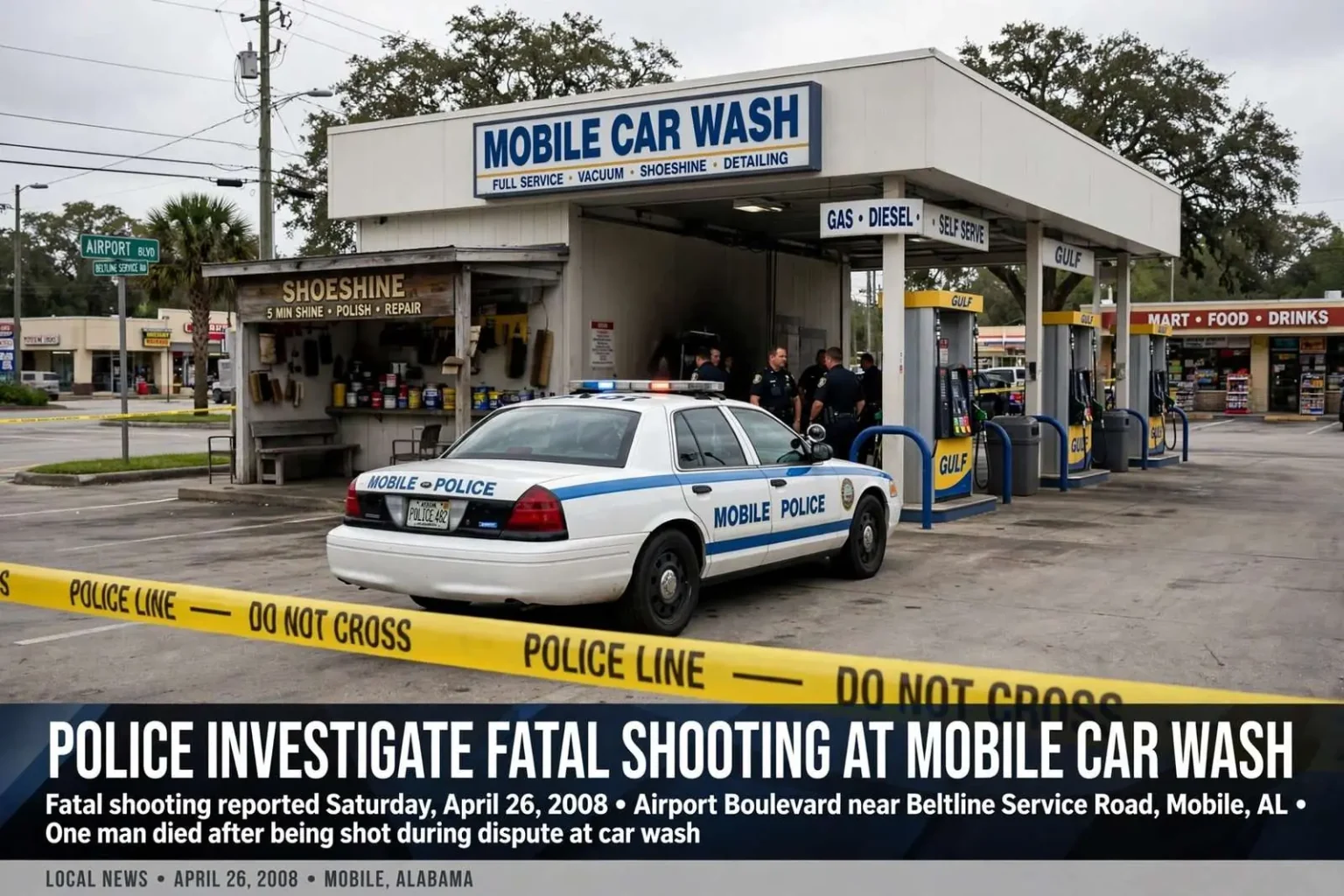
Mobile police investigated a fatal shooting at a car wash on Airport Boulevard near the Beltline Service Road on Saturday, April 26, 2008, according to a local news report from that day. Officers who responded to the scene that afternoon found a man suffering from a gunshot wound to the chest. The victim was rushed to a nearby hospital, where he later died from his injuries. The case became one of the homicide investigations worked by the Mobile Police Department that year, and it unfolded at a commercial stretch of Airport Boulevard that has long mixed automotive businesses, convenience stores, gas stations and small retail shops serving travelers and West Mobile residents alike.
According to the archived report, investigators said the shooting grew out of an argument that began at the business. The dispute involved a man who worked at a shoeshine stand at the car wash and two other men who were near the gas pumps at the property. Shoeshine stands are a familiar feature at full-service car washes along busy corridors like Airport Boulevard, where drivers stop for a wash and a quick shine while they wait, and customers and workers mix in close quarters for extended periods. Police said the argument escalated from there.
How the Shooting Unfolded
Investigators alleged that after the argument, the car wash worker walked to a vehicle, retrieved a gun, returned and fired, striking a passenger inside the other vehicle. Police did not publicly detail what triggered the confrontation or what words were exchanged before the shooting, and the archived report did not identify the victim or the suspect by name. What authorities described was a dispute that moved within minutes from a verbal confrontation in a parking lot to a fatal gunshot on a busy Saturday afternoon.
Mobile police said a suspect had been booked into custody following the investigation. Officers cautioned at the time that the man might have used other names, a detail that suggested investigators were still working to confirm his identity. Aliases and multiple identities are a recurring complication in booking and charging decisions, particularly when a suspect has prior arrests under different names, and police flagged the issue publicly so that reporters and the public would understand the name on record might not be complete.
The Airport Boulevard Corridor
The shooting occurred along one of Mobile’s busiest east-west thoroughfares. Airport Boulevard runs for miles through the city, from the area near the Mobile Regional Airport in the west through dense commercial districts, residential neighborhoods and older shopping centers as it approaches Midtown and continues toward the eastern part of the city. The Beltline Service Road, which the report cited as the reference point, sits along a stretch where the road carries heavy daily traffic and where businesses like car washes, service stations and restaurants line both sides of the highway.
Commercial corridors of that kind see steady foot traffic throughout the day, and disputes that begin in parking lots are a familiar pattern for urban police departments. In the years surrounding 2008, Mobile’s Police Department was working through a period of shifting staffing levels and evolving neighborhood-based enforcement strategies, and homicide detectives routinely carried heavy caseloads. Fatal shootings that grew out of sudden arguments, rather than planned attacks or robberies, accounted for a meaningful share of the city’s killings during that era, a pattern reflected in cases across the Gulf Coast.
The report’s account of the sequence, based on what investigators said at the time, laid out the elements that would matter in any prosecution: who was involved in the argument, who went to the vehicle, who retrieved the weapon and who fired the fatal shot. Under Alabama law, a killing that occurs in the course of a sudden dispute can be charged in a range of ways, from murder to lesser homicide offenses, and prosecutors weigh the evidence of what happened in the minutes before shots were fired. Because the archived report does not establish any later court outcome, what became of the case after the booking was not documented in the material that survives.
Mobile police emphasized at the time that the matter remained under investigation, even with a suspect in custody. Detectives would have been reconstructing the timeline through witness interviews with customers and employees who were at the car wash that afternoon, and through the physical evidence collected at the scene. Busy parking lots present particular challenges for investigators: multiple people may have seen fragments of the argument, but their accounts can differ on the details that matter most, such as who moved first and whether anyone saw the weapon before it was fired.
What the Record Shows and What It Does Not
This account is a historical one, drawn from a 2008 local news report and reflecting what Mobile police and investigators said on the day of the shooting. The archived report does not establish whether charges were ultimately filed as initially alleged, how any court proceedings concluded, or what disposition the case reached. Criminal cases routinely change shape between an initial arrest and a final outcome: charges can be refiled under different statutes, evidence can alter the theory of the case, and defendants may enter pleas or proceed to trial months or years after the underlying events.
Readers reviewing the case years later should keep that distance in mind. The names on a booking record can be revised when identities are confirmed, and the account authorities give in the first days after a killing is by nature preliminary. What the 2008 report preserves is the basic outline: a fatal shooting at a car wash on Airport Boulevard near the Beltline Service Road on April 26, 2008; a victim wounded in the chest who died at a hospital; an argument involving a shoeshine stand worker and two men near the gas pumps; and a suspect booked on allegations that he retrieved a gun from a vehicle and shot a passenger in another vehicle.
Saturday Afternoon Violence and Community Impact
Fatal shootings in busy commercial areas on weekend afternoons tend to reverberate through the surrounding neighborhoods in ways that differ from late-night violence. Businesses are full of families, employees witness the events firsthand, and the location remains a daily landmark for everyone who drives the corridor. In the weeks after the 2008 shooting, the car wash and its neighboring businesses continued to operate along Airport Boulevard, as they do along commercial strips across Mobile where such incidents have occurred.
For the Mobile Police Department, cases like this one also illustrated the importance of the first hours after a shooting. Officers secured the scene, canvassed for witnesses and coordinated with hospital staff when the victim was transported. The department’s homicide unit, working with crime scene technicians, handled the physical documentation that would support whatever charges prosecutors eventually pursued. None of that later work is captured in the surviving report, which is precisely why the account carries its editor’s note: it documents what authorities said on April 26, 2008, and nothing more.
Shootings arising from parking-lot arguments were a persistent feature of Alabama’s larger cities in the 2000s, and Mobile was no exception. Prosecutors and police in the region repeatedly warned that disputes over small matters, money, insults, parking spaces or perceived disrespect, could turn deadly within seconds when a firearm was within reach. Alabama’s firearm laws at the time allowed adults to carry pistols in vehicles without a concealed-carry permit, which meant that a person who left an argument to walk to a car could plausibly return armed. That dynamic shaped how investigators approached cases like the one at the Airport Boulevard car wash, because the question of whether the shooter retrieved the weapon from a vehicle became central to the account police gave publicly.
The detail that the suspect “might have used other names” also reflected a broader reality in the criminal justice system of that era. Identity verification depended on fingerprint records that were shared between agencies with uneven speed, and defendants with records in multiple counties or states could be booked under names that later proved incomplete. When police flagged the possibility of aliases at booking, it was a signal to the courts, to jailers and to the press that the record attached to the arrest was provisional until confirmed.
The Car Wash Setting
Full-service car washes occupy a particular niche in the commercial life of corridors like Airport Boulevard. Customers hand over their keys, wait in a lobby or on a bench for ten or twenty minutes, and interact with attendants, vacuum crews and, in some operations, a shoeshine operator who works from a stand near the entrance. The setting brings strangers into repeated, close contact, often in warm weather when tempers run shorter and more people are outside. An argument at a shoeshine stand, where a worker and customers stand face to face for the length of a service, can draw onlookers quickly, and by the account police gave in 2008, the dispute in this case drew in two men near the gas pumps before it escalated.
Gas pumps add another layer to such scenes. Vehicles come and go constantly, and a confrontation near the pumps can unfold in front of dozens of passersby within minutes. In this case, the vehicle from which the worker allegedly retrieved the gun and the vehicle containing the victim’s passenger were both at the property, meaning the shooting occurred with the participants only steps apart. Emergency calls would have reached Mobile’s dispatch center from multiple sources, and officers arrived to find a wounded man and a scene crowded with potential witnesses.
Remembering a 2008 Case Today
More than a decade and a half later, the case stands as a record of a specific afternoon in Mobile’s recent history. The victim, whose name the archived report does not preserve, was one of the homicide victims recorded by Mobile police in 2008, a year in which the city, like other mid-sized Alabama cities, tracked shootings closely as an indicator of public safety trends. The Airport Boulevard corridor where the shooting occurred has continued to develop since then, with businesses opening and closing along the strip, but the reference points in the report, the car wash, the shoeshine stand, the gas pumps, the Beltline Service Road, remain the anchors for anyone trying to locate the event in the city’s geography.
For readers who remember the incident or who are researching Mobile’s homicide cases from that period, the report’s limits are as important as its facts. It identifies the date, the location, the sequence of events as police described them and the fact of a booking, and it explicitly declines to speak to anything that followed. That is the standard by which historical accounts of pending-era crime reporting should be read: an accurate snapshot of what was known on the day, preserved so that the record of the event itself is not lost, while leaving open every question about what the courts ultimately decided.