Bayou La Batre Mayor’s Wife, City Magistrate, Stabbed Inside Her City Hall Office
Marcia Barnes, Bayou La Batre's magistrate and the mayor's wife, was stabbed in her City Hall office. A 47-year-old man faces attempted murder charges.
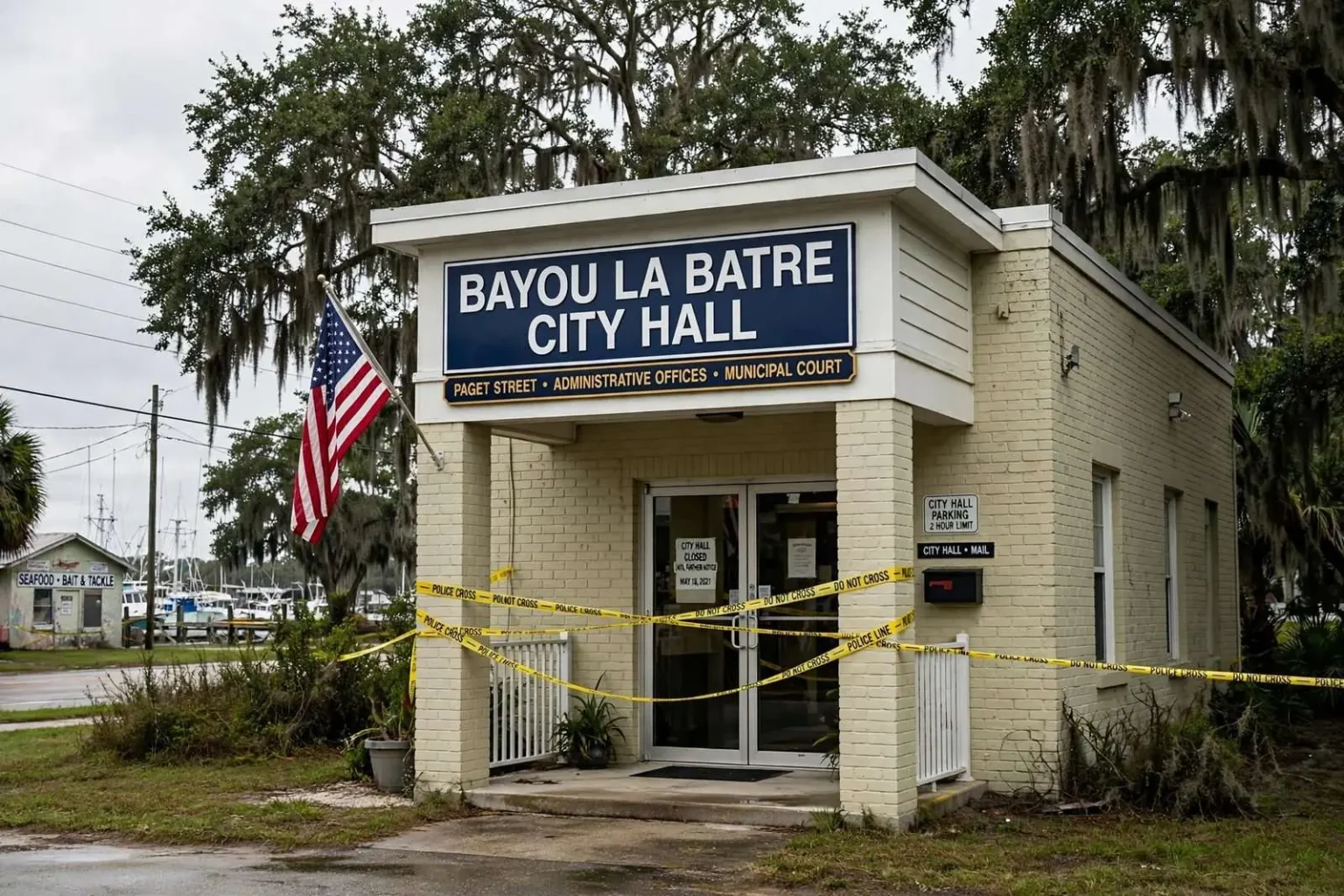
BAYOU LA BATRE, Ala. — The wife of Bayou La Batre’s mayor was stabbed inside her office at Bayou La Batre City Hall on Tuesday morning, according to Mayor Henry Barnes. Marcia Barnes, who serves as the city’s magistrate, was working in her office around 11 a.m. on May 18, 2021, when she was attacked and stabbed in the leg — a rupture of the routine safety of a small-city government building that few communities of this size ever experience.
The mayor said two other city employees were also attacked during the incident, but Marcia Barnes was the only person injured. Her wound required four stitches. For a city where the mayor, his wife and the small municipal staff are neighbors and fellow church members, an attack inside City Hall carried a weight beyond the physical injuries — it struck the building where the community conducts the ordinary business of daily life.
What happened inside City Hall
City Hall on Paget Street serves as the administrative center for the small seafood-producing community of roughly 2,000 residents on Mobile County’s coastline. On an ordinary morning, the building handles a steady flow of routine business: utility payments, court matters before the magistrate, permits and the paperwork of a working waterfront town. The 11 a.m. attack came during those working hours, when the building and its staff were fully engaged with the public.
Small-city offices like Bayou La Batre’s typically operate without the screening checkpoints and secured lobbies that larger courthouses maintain. Staff know most of the people who walk through the door, and the open access that makes such offices welcoming is the same feature that leaves them exposed when someone arrives with harmful intent. Municipal employees across south Alabama have long worked in that balance, and the events of May 18 showed how quickly it can collapse.
A suspect charged
The Mobile County District Attorney’s Office identified the suspect as 47-year-old Pho Xay Keomanizang. According to the District Attorney’s office, Keomanizang has been charged with attempted murder as well as third-degree escape. The pairing of charges is unusual and consequential: attempted murder alleges a deliberate intent to kill, while the escape charge indicates an alleged incident connected to custody at some point in the case’s handling.
Under Alabama law, attempted murder is a Class A felony — the state’s most serious classification short of murder itself — carrying a potential sentence of decades in prison upon conviction. Third-degree escape, a lesser felony, covers a person who escapes or attempts to escape from custody or lawful detention. Prosecutors with the District Attorney’s Office will handle the case through the Mobile County court system, where grand jury review is the next formal step for felony charges.
The magistrate’s role in a small city
As the city’s magistrate, Marcia Barnes holds one of the most public-facing jobs in Bayou La Batre’s government. Municipal magistrates handle the front line of the municipal court — accepting filings, scheduling appearances, processing fines and interacting daily with residents whose names, faces and family situations they come to know. The position requires a working knowledge of court procedure and, more than that, the temperament to deal with residents on some of the worst days of their lives, from traffic stops to disputes that end up before the judge.
The mayor’s office confirmed Barnes was working in that capacity when the attack occurred. City Hall houses both the administrative offices and the court functions, meaning the magistrate’s office sits at the intersection of the city’s two most frequent points of public contact. Employees in such buildings routinely handle frustrated or upset visitors without incident; the events of that Tuesday morning are what happens when one does not.
The investigation continues
The investigation remained active in the days following the attack, with authorities working to establish the full sequence of events inside the building and the circumstances that brought the suspect there. Agencies involved in cases of this kind coordinate evidence collection, witness interviews from the city employees present, and a review of any surveillance footage from the building before the complete picture is released publicly.
Bayou La Batre is a close-knit community where the seafood industry — shrimp boats, oyster houses and processing plants — forms the backbone of the economy and the identity of the town. The city has weathered hurricanes, the Deepwater Horizon oil spill and the economic pressures of a changing fishing industry, and it has done so with the kind of institutional continuity that comes from longtime public servants like the Barnes family. An attack on the city’s magistrate and its City Hall staff touched the people at the center of that continuity.
Security in small-city government buildings
Incidents like the one in Bayou La Batre prompt familiar questions in municipal buildings across the region: whether small cities can afford court security officers, whether offices should be arranged so that staff can signal for help, and whether access points should be limited. State support for municipal court security is limited, and cities of 2,000 people operate with budgets that rarely stretch to metal detectors and screened lobbies — leaving awareness, proximity to law enforcement and the quick response of nearby officers as the practical safeguards.
For now, the immediate facts stand as the mayor and the District Attorney’s Office have laid them out: an attack around 11 a.m. on May 18, 2021, two other city employees attacked but unharmed, a stab wound treated with four stitches, and a 47-year-old suspect charged with attempted murder and third-degree escape. The case now moves through the Mobile County court system, where its resolution will be watched closely by the small coastal community it struck.
Third-degree escape charges arise more often than the public might expect in cases that begin with an arrest elsewhere in the process. The offense covers a range of conduct — walking away from unsecured custody, slipping from a holding area or fleeing during transport — and its presence alongside the attempted murder charge means prosecutors allege an additional act during the timeline authorities are reconstructing. Details of the alleged escape had not been released as the investigation remained active, and prosecutors generally reserve such specifics for court proceedings.
For the city employees who were present, the aftermath involves more than returning to their desks. Witnessing violence in the workplace, in a building they had regarded as safe, leaves effects that small-city employers rarely have formal programs to address. Municipal governments of Bayou La Batre’s size rely on informal support — colleagues, family, the community itself — to absorb those impacts, and in a town this size the community knew within hours who had been inside the building that morning.
Bayou La Batre’s city government
The city operates under a mayor-council form of government, with a small staff handling police, fire, public works and the municipal court. Henry Barnes, the mayor, confirmed the attack and identified his wife’s injuries publicly — a level of transparency that small-city government can offer and that larger institutions often cannot. In municipalities like Bayou La Batre, the mayor’s family frequently works in public roles, and the lines between public service and personal life run close together.
The city’s officials are accustomed to crisis of a different kind: the coastal location that defines the community also exposes it. Hurricane recovery and the long aftermath of the 2010 oil spill put City Hall at the center of relief administration for years, and the staff there developed a reputation for steady management through upheaval. That history made the May 18 attack all the more jarring for a workforce that had handled natural disasters without injury to its own people.
The court system ahead
Felony cases in Mobile County begin with a preliminary proceeding before the case reaches a grand jury, which determines whether the evidence supports formal indictment. Attempted murder cases carry extensive pretrial litigation — competency evaluations, bond disputes and evidentiary motions can stretch the timeline to resolution across many months. The Mobile County District Attorney’s Office prosecutes thousands of felony cases a year, but cases arising from attacks on public employees and court officials receive close attention because of what they represent: violence directed at the machinery of local government itself.
Whatever the eventual outcome, the charge sheet already records what Bayou La Batre experienced on May 18, 2021 — an ordinary Tuesday morning at City Hall interrupted by an attack that injured the mayor’s wife, endangered two more employees, and left a small coastal city rethinking the safety of the building where it conducts its public life.
The response from surrounding communities came quickly, as it usually does along the coastline south of Mobile. Law enforcement agencies in south Mobile County maintain working relationships built on mutual aid — the Bayou La Batre Police Department is a small force, and incidents that overwhelm a municipal department draw deputies from the Mobile County Sheriff’s Office and support from neighboring jurisdictions. The active investigation in the days after the attack reflected that coordination, with the District Attorney’s Office publicly attached to the case from the charging stage.
Residents of the city have continued their routines around City Hall in the weeks since, but the incident lingers in the conversations of a community where the municipal court is a familiar gathering place and the people who work there are neighbors. The four stitches that closed Marcia Barnes’s wound closed as well the question of whether anyone else would be hurt that morning — the only serious physical injury of the incident — while the legal process moves ahead to address the rest.
The case stands, for now, on the public record the city and prosecutors have released: a magistrate attacked in her own office on May 18, 2021; two colleagues attacked and unharmed; a suspect identified by the Mobile County District Attorney’s Office as 47-year-old Pho Xay Keomanizang, facing attempted murder and third-degree escape charges; and an investigation that remained active as the community waited for the courts to take the next step. For a city of roughly 2,000 people whose economy and identity are built on the water, the morning of May 18 became a part of its history that no storm prepared it for — an act of violence inside the building that represents the city itself.