Mobile Police Investigated 2008 West Mobile Homicide
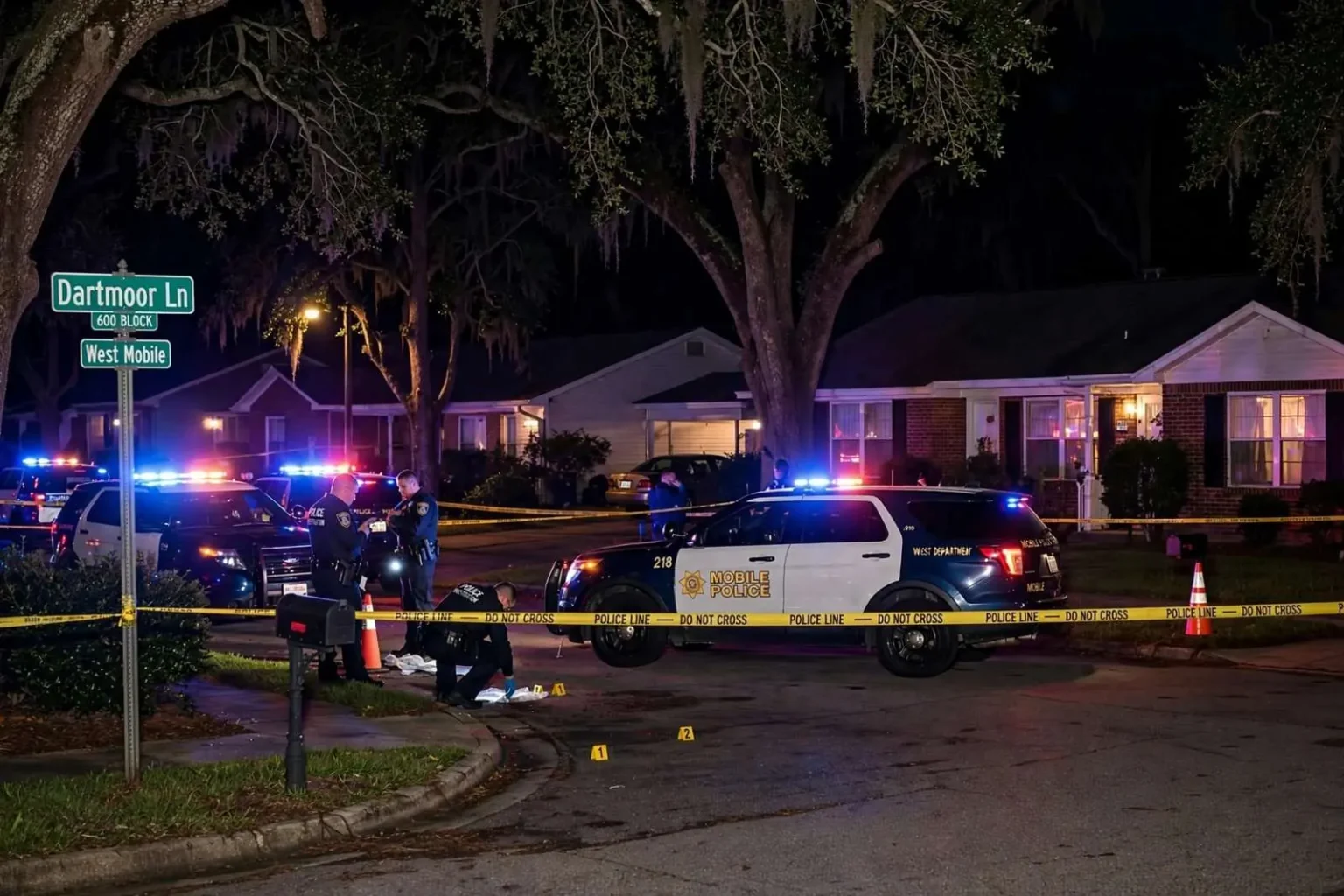
Mobile Police investigated the May 2008 shooting death of a 53-year-old man on Dartmoor Lane in West Mobile, according to an archived WKRG report.
Originally reported May 8, 2008.
Mobile police investigated the shooting death of a 53-year-old man in West Mobile in May 2008, according to an archived local news report from the time.
Officers responded just before 1 a.m. to the 600 block of Dartmoor Lane, near the intersection of Cottage Hill Road and University Boulevard, after reports of gunfire in the neighborhood. When police arrived, they found a man suffering from gunshot wounds. He was taken to USA Medical Center, where he later died from his injuries.
The victim was 53 years old. His name was released through official channels at the time, and investigators said they were still working to determine a motive and identify the person responsible for the shooting.
The overnight shooting in a quiet residential block startled residents of the area, a neighborhood of single-family homes west of the city center where violent crime of this kind was unusual. Neighbors described waking to police lights and the activity of investigators working the scene into the early morning hours.
This historical article avoids graphic detail and does not state any later arrest, charge or court outcome. It preserves the account of the initial investigation as it was reported in May 2008.
The investigation in its early hours
Homicide investigations in the first hours after a death concentrate on the scene itself. Detectives document where the victim was found, collect shell casings and any other physical evidence, and begin canvassing the block for anyone who heard or saw something — a car idling, raised voices, footsteps, the shots themselves. On a street like Dartmoor Lane, where homes sit close together and residents were home at 1 a.m., investigators hoped someone had heard enough to give them a starting point.
The victim was still alive when officers reached him, and his transport to USA Medical Center meant the case was initially handled as a shooting with a wounded victim. Only after his death at the hospital did it become a homicide investigation, shifting the response from emergency care to the collection of evidence, notification of next of kin and the launch of the police department’s investigative work.
USA Medical Center, now known as USA Health University Hospital, is the region’s major trauma center, and it received the most serious gunshot patients from across Mobile County. For investigators, deaths at the hospital add a layer of medical evidence to the case — treatment records, wound documentation and the timing of the victim’s death all become part of the record that prosecutors would eventually review.
Determining a motive is often the central challenge in shootings like this one. Investigators look at the victim’s life — his relationships, work, routines and recent contacts — to understand who might have wanted to harm him and why. In cases where there is no evidence of a robbery or a random attack, detectives examine personal connections first; where robbery is suspected, the scene and the victim’s belongings tell that story. At the time of the initial report, police had not determined which circumstances applied, and they were asking for the public’s help.
The 600 block of Dartmoor Lane sits in the larger West Mobile area, a broad expanse of residential neighborhoods stretching west from the city toward the county line. Cottage Hill Road and University Boulevard frame the area, carrying shopping centers, schools and churches that serve the surrounding subdivisions. For residents, the shooting was a jarring event in an ordinary setting — the kind of place where evening walks and kids playing outside are the norm.
The community’s role
Mobile police asked for the public’s help in the days after the shooting, a standard step in homicide cases where witnesses may be reluctant or unsure of what they saw. The original report included a request for information, which was a time-limited 2008 notice and is not reproduced here as a current alert. What remains relevant is the broader point that detectives made at the time: tips from residents, even fragmentary ones, often provide the first real direction in a homicide investigation.
In the years since, Mobile has developed more channels for anonymous tips, including the Crime Stoppers program that allows callers to pass information to investigators without giving their names. Those channels grew out of the long-standing challenge that homicide detectives face in neighborhoods where people may have seen something but fear involvement.
For the family of the 53-year-old victim, the days after the shooting were consumed by grief and by the practical aftermath of a sudden violent death — funeral arrangements, notifications and the long wait for answers from investigators. Homicide cases can take months or years to resolve, and some never produce an arrest. The uncertainty is itself a burden that victims’ families carry alongside their loss.
The May 2008 shooting was one of a number of homicides Mobile police worked that year, part of a period when the department’s homicide unit was handling a steady caseload across the city. West Mobile’s residential neighborhoods saw fewer such cases than parts of the city core, which made this shooting stand out locally and prompted sustained attention from area residents and news outlets.
Police work on the case continued after the initial report, with detectives following leads developed from the scene, from the victim’s background and from tips that came in as the news spread. What became of the investigation — whether anyone was ever identified, charged or convicted — is not recorded in this account, which reflects only the reporting available from May 2008.
Looking back from today
Archived reports like this one serve a purpose beyond the day they were published. They preserve the factual record of what happened in a community’s past, and they remain a reference point for anyone researching the history of the area, the work of the Mobile Police Department or the broader story of violent crime on the Gulf Coast in that era.
They also matter to the people who remember. Residents of Dartmoor Lane and the surrounding neighborhoods carried the memory of that May morning, and for the victim’s family, the passage of time does not close the question of what happened and why. A historical account like this one documents the facts as they were known at the time: a 53-year-old man, shot on Dartmoor Lane before 1 a.m., taken to USA Medical Center, dead within hours, and an investigation working for answers.
Anyone with historical information about the case can still contact the Mobile Police Department, which keeps cold case investigations open indefinitely. Advances in forensic technology, including DNA analysis methods unavailable in 2008, have allowed departments across the country to revisit old homicide cases with new tools, and tips that seemed minor at the time can take on new significance years later.
The geography of West Mobile shaped the investigation in practical ways. The area’s subdivisions interconnect through a web of residential streets, with multiple routes in and out of most blocks — a layout that gives a fleeing vehicle many options and makes witness accounts of a single car’s direction of travel harder to translate into a search. Detectives instead leaned on the canopy of houses facing the 600 block, hoping that a light on, a dog barking or a glance out a window had captured something usable.
The timing of the shooting, shortly before 1 a.m., narrowed the field of likely witnesses to residents who were still awake or lightly asleep, along with anyone passing through the area at that hour. Overnight workers, late drivers and early risers sometimes provide the only independent observations in such cases, and investigators pursue those possibilities through canvassing and follow-up interviews in the first days after a killing.
The archived report from May 2008 captured the case at its beginning, when facts were still being established and every detail mattered. Such initial accounts typically include only what police can confirm in the first hours: who was found, where, when, and what the immediate condition of the victim was. Everything else — motive, suspects, the course of the investigation — comes later, if it comes at all.
What the report also preserved was the department’s request for community help, a reminder that in Mobile, as in cities across the country, homicide investigations depend on the cooperation of the public. The detectives who worked the case in 2008 did so with the tools of their era — scene evidence, interviews, early databases — and their successors retain the ability to act on new information no matter how much time has passed.
The death of the 53-year-old man on Dartmoor Lane remains, in the public record, an unresolved chapter of West Mobile’s history: a death investigated, a family left to grieve, and a neighborhood that still remembers the morning the police lights came to their street.