Masked Men Robbed Mobile Subway Restaurant in 2007
Two masked men, at least one armed, robbed a Subway restaurant near Cottage Hill Road in December 2007, according to WKRG. No injuries were reported.
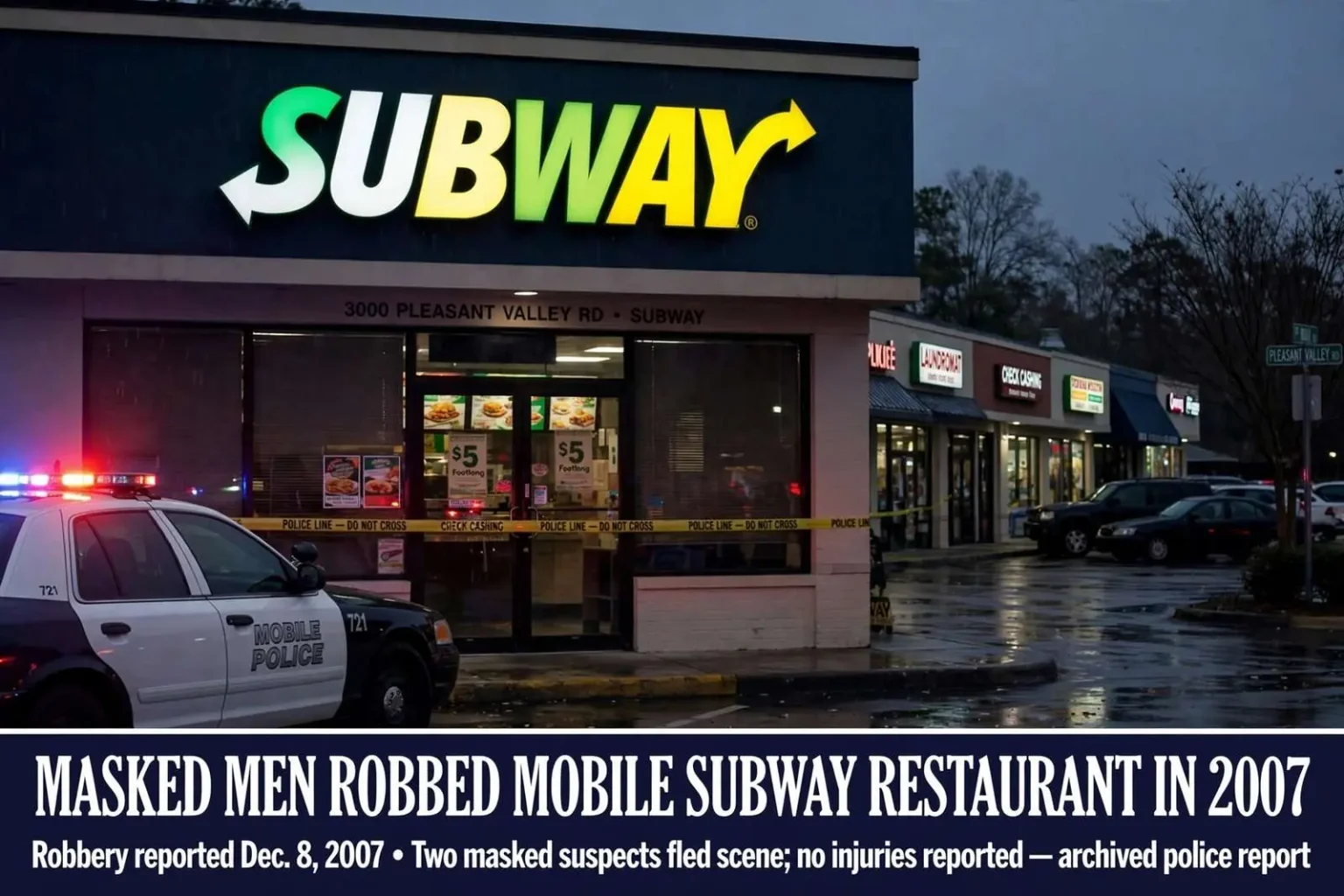
Originally reported December 8, 2007. This article is retained as a historical account of the incident.
Two masked men, at least one of whom was armed, robbed a Subway restaurant near Cottage Hill Road in Mobile in December 2007, according to an archived local news report. The restaurant was in the 3000 block of Pleasant Valley Road, in the West Mobile commercial area that feeds off Cottage Hill Road. Employees saw the men approaching with shirts covering their faces and left through the rear exit before the robbery, a quick-thinking move that kept them out of the path of the armed pair.
Two customers who were inside described being frightened, but no one was injured in the holdup. Police had not said how much money, if any, was taken from the register, and the report did not state whether suspects were later identified or arrested. What the account preserves is the shape of the incident: an ordinary evening at a sandwich shop in West Mobile, two robbers masking their faces as they walked in, employees slipping out the back, and customers left inside to watch the robbery unfold.
The scene in West Mobile
The 3000 block of Pleasant Valley Road sits among the dense commercial development around Cottage Hill Road, one of West Mobile’s principal retail corridors. The area’s fast-food restaurants, strip malls, and shopping centers serve the surrounding neighborhoods of modest homes and growing subdivisions, and they stay busy into the evening with families, students from nearby schools, and shift workers grabbing dinner. A sandwich shop on such a block keeps modest amounts of cash in its register and sees a steady turnover of customers who would have been inside at the counter when the masked men walked in.
Robberies of fast-food restaurants follow a grim logic that police and business owners know well. The cash drawers are accessible, the stores stay open into late evening, staffing is often thin, and the layout — one counter, a register, rear exits — offers little resistance. Across south Alabama in the 2000s, quick-service restaurants were frequent robbery targets, and owners responded with cameras, drop safes, time-delay locks, and staff training that emphasized compliance over resistance: no meal or drawer of cash is worth a confrontation with an armed robber.
The employees’ escape
The most striking detail in the archived account is the employees’ decision to flee through the rear exit the moment they saw the men pulling shirts over their faces. Their instinct matched the training that robbery-prevention programs teach: if an exit is available and safe, take it, and let the property go. It also removed the possibility of the robbery turning into a hostage situation or a confrontation behind the counter, likely sparing the store a far worse outcome than the loss of its drawer.
The two customers left inside did not have that option, and their descriptions of being frightened capture what witnesses to an armed robbery experience: the moment of realizing what is happening, the fear of the weapon, and the long minutes of waiting for it to end. Neither was hurt, and no one in the restaurant was injured, but witnesses to armed robberies frequently describe lasting anxiety, and victims’ services in Mobile offer support to those who need it after such encounters.
How police work a restaurant robbery
A robbery response at a restaurant in progress brings patrol officers to the scene within minutes, but in this case the robbers were gone by the time police arrived, as is typical. Detectives then took over the work: interviewing the employees who escaped and the customers who stayed, collecting the store’s surveillance footage, and canvassing neighboring businesses for cameras that might have caught the men arriving or fleeing along Pleasant Valley Road or Cottage Hill Road. The amount of money taken — if any — remained unstated in the report, sometimes because a count is impossible until registers are audited and sometimes because investigators withhold details that only the robber would know.
Investigators would also look for connections. Masked, armed robberies of food stores and restaurants tend to cluster, and detectives compare notes across jurisdictions — Mobile police, the Sheriff’s Office, and departments in Prichard, Saraland, and across the state line — to see whether a similar pair was working the same kind of target elsewhere. Tips from the public, called in after media coverage, often provide the break in such cases, though the archived report closes before any identification or arrest was reported, and the historical record does not preserve the outcome.
The December 2007 context
The robbery came at the busiest and most pressured time of the retail year. December in Mobile brings holiday shopping traffic to corridors like Cottage Hill Road, extended store hours, registers full of seasonal cash flow, and — in every city — a seasonal rise in robberies of businesses that stay open late. Police departments across the region traditionally add patrols in commercial districts during the holidays and publicize the increased presence as a deterrent, while retail associations remind members to keep registers light and cameras running.
The December 2007 report also reflects the way local news covered such incidents in the era: a same-day account with the address, the suspects’ description, the witnesses’ accounts, and a note that the investigation was continuing. There was no follow-up coverage preserved in the archive, which is common for robberies without injuries — the story recedes unless an arrest follows quickly. The result is a historical record that documents the crime but not its conclusion, a limitation this article makes explicit.
Robbery safety: what the account teaches
The Pleasant Valley Road holdup is remembered here not for its damage — there was none beyond the money and the fright — but for what it shows about surviving such encounters. The employees who left through the rear exit did exactly what robbery-response training advises: they recognized the threat early, avoided the confrontation, and reached safety. The customers who complied and stayed out of the robbers’ way did the same in their circumstances, and everyone walked out unhurt.
Public safety guidance on robbery remains consistent: comply with demands, avoid sudden movements, keep hands visible, and observe what can be observed safely — height, clothing, direction of flight — rather than resist. Business owners are advised to keep sightlines clear, maintain working cameras, use drop safes so employees cannot access large sums, and rehearse what staff should do. Those measures do not make a robbery impossible, but across thousands of such incidents they make the difference between a frightening minute and a tragedy, which is precisely the outcome the December 2007 West Mobile robbery avoided.
The neighborhood since then
West Mobile’s commercial corridors have kept growing in the years since the robbery, with new retail, restaurants, and medical offices filling in along Cottage Hill Road, Schillinger Road, and the roads between them. The neighborhoods around Pleasant Valley Road have grown with them, and the quick-service restaurants of 2007 have turned over owners and menus repeatedly, as such businesses do. For most residents today, the December 2007 robbery survives only in archives like this one — a moment when masked men walked into an ordinary sandwich shop and an ordinary evening turned dangerous.
The account is retained as a historical record of the incident as reported at the time. It does not assert that the suspects were ever identified or arrested, that the case remains open, or that the restaurant as it operated then still operates today. Readers researching the incident — for background, genealogy, or the history of the corridor — should treat the December 2007 report as a snapshot: two masked robbers, at least one armed, an empty register of uncertain loss, two frightened but unharmed customers, and a staff that escaped through the back door with the kind of composure that robbery training hopes for. The report’s restraint about the outcome reflects the reality of archived crime coverage, which preserves the incident without preserving the investigation that followed it.
The passage of time has also softened the practical warnings such cases carried. West Mobile businesses that operated without cameras in 2007 now run high-definition systems connected to their owners’ phones, and the anonymous tip lines of that era have become smartphone apps. What has not changed is the human geography of the incident: the employees at a back door, the customers at a counter, and the thin margin between a frightening minute and a lasting tragedy.
That snapshot has value. It documents how a West Mobile business and its people responded to an armed robbery, how Mobile Police worked the case in the hours after, and how a near-miss on Pleasant Valley Road ended without injury. For the community that lived through it, the memory was of a scare that could have been much worse; for the record, it stands as a small, complete story of a crime, a response, and an escape.