University of South Alabama Mobile County
2007 Report Said Mobile Housing Market Was Holding Up
A 2007 WKRG report said University of South Alabama researchers viewed the Mobile-area housing market as comparatively healthy despite a national slowdown.
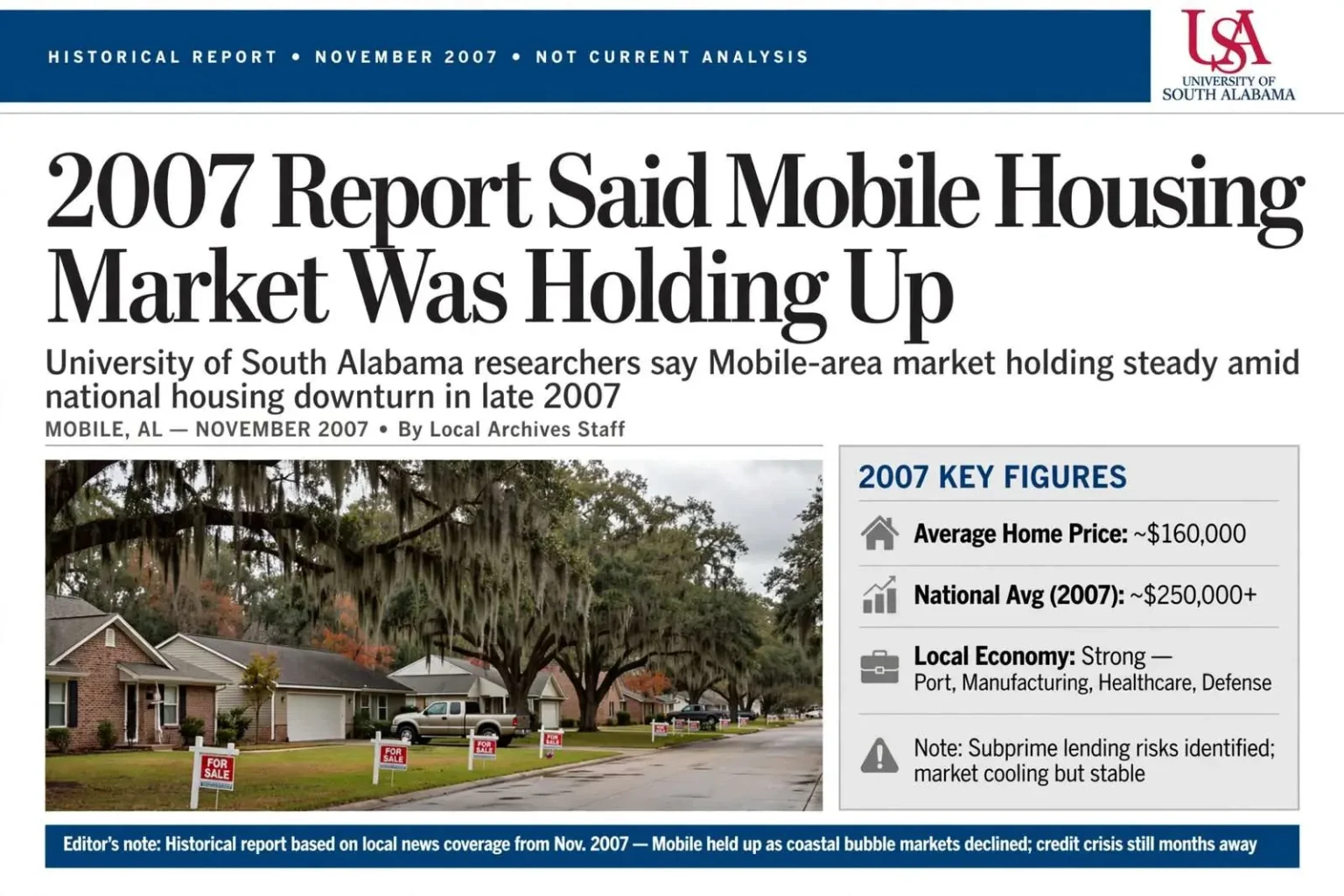
Editor’s note: This is a historical report based on local news coverage from November 2007. It is not current housing-market analysis or financial advice.
University of South Alabama researchers said in late 2007 that the Mobile-area housing market was holding up comparatively well, even as more homes displayed for-sale signs across the area. The assessment, reported in archived local news coverage, came at the precise moment the national housing bubble was beginning to deflate — a period when markets in Florida, Nevada, Arizona, and California were already posting steep price declines while many Gulf Coast communities had not yet felt the full force of what was coming.
According to the archived report, university officials described the local economy as strong and put the average home price at about $160,000. They also pointed to the job market as a factor that helped residents afford to buy or sell homes. The university’s real-estate studies director said national interest-rate changes and problems in subprime lending could affect Mobile, but that the longer-term local trend remained upward despite a slowdown and recent price changes. Real-estate agents interviewed for the report said a slower market at that time of year was not unusual, pointing to the seasonal rhythm of home sales rather than any local collapse.
The national backdrop in November 2007
To understand what the report was measuring, it helps to recall where the country stood in November 2007. The subprime mortgage crisis had already begun: lenders specializing in high-risk loans were failing, adjustable-rate mortgages written during the boom years were resetting to higher payments, and national home prices had turned negative on a year-over-year basis for the first time in decades. Foreclosure filings were climbing sharply in the bubble markets, credit markets were tightening, and within a year the financial system itself would tip into crisis.
Against that backdrop, a Sun Belt metro area reporting that its market was merely slowing — rather than falling — was genuinely notable. The University of South Alabama researchers were describing a market that had not participated in the extreme run-ups of the coasts, and therefore had less speculative excess to unwind. Mobile’s housing stock, its price levels, and its growth patterns had followed a more moderate trajectory, and the researchers’ message was that moderation was now working in the city’s favor.
What the $160,000 average meant locally
The average home price of about $160,000 reported by the researchers placed Mobile well below the national averages of the era, which had been pushed into the mid-$200,000s by coastal appreciation. For local buyers, that gap meant affordability: a household earning the area’s median income could plausibly qualify for a mortgage on an average-priced home, which was already becoming impossible in many metropolitan markets. For sellers, the same figure reflected the flip side — decades of modest, steady appreciation rather than boom-time gains.
The researchers tied the market’s health directly to the local job market, citing employment as a factor that helped residents afford to buy or sell. Mobile’s economy in 2007 rested on a diverse base — the Port of Mobile and its growing container operations, chemical and paper manufacturing, healthcare systems, retail and service sectors, and a defense presence at sites including the Coast Guard Aviation Training Center — and unemployment in the metro area remained comparatively low. Housing demand, the argument went, follows paychecks, and the paychecks were still coming.
Subprime risk in a moderate market
The university’s real-estate studies director struck a cautionary note within the optimism, saying national interest-rate changes and problems in subprime lending could affect Mobile. That caveat proved prescient. Subprime lending was not confined to the bubble states; lenders had extended high-risk mortgages in every market, including the Gulf Coast, and as those loans reset and borrowers defaulted, the resulting foreclosures added inventory to markets regardless of how moderate their price history had been.
The director’s longer-term view, as reported, was that the local trend remained upward despite a slowdown and recent price changes. That formulation — a slowdown within an upward trend — described a market cooling from sustainable levels rather than collapsing from speculative ones. Recent price changes in the Mobile area in 2007 had been modest adjustments, and the director’s assessment treated them as part of a normal correction rather than the leading edge of a crash. The years that followed would test that judgment harder than anyone reporting in November 2007 could have anticipated, as the national financial crisis of 2008 deepened into a recession that eventually reached every American housing market.
Seasonality and the for-sale signs
The real-estate agents interviewed for the report offered a simpler explanation for part of what observers were seeing: a slower market in late November was normal. Home sales in the United States follow a pronounced seasonal cycle, peaking in late spring and summer when families prefer to move between school years, and bottoming in the winter holidays when moving ranks low on anyone’s list. A November market with fewer transactions and more lingering listings was, in the agents’ experience, the market doing what it did every year.
The growing number of for-sale signs that caught the researchers’ attention reflected both that seasonality and genuine new inventory. A market cooling from its boom-era pace naturally accumulates listings as homes take longer to sell, and sellers who would have found buyers in days during 2005 and early 2006 were waiting weeks or months. The agents’ point was not that nothing had changed — it clearly had — but that the change looked, from inside the local market, like a return to ordinary rhythms rather than the distress visible elsewhere.
Mobile’s position in the regional market
Mobile’s housing market in 2007 also carried a distinctive regional dynamic that the national narrative missed entirely. The Gulf Coast was still rebuilding from Hurricane Katrina, which struck in August 2005, and damage and displacement in coastal Mississippi and in south Mobile County had reshuffled housing demand across the whole region. Rental markets remained tight, insurance costs had risen sharply along the coast, and construction capacity was stretched. Those pressures supported prices and rents in ways unrelated to the national boom, complicating any simple comparison between Mobile and the bubble markets.
The university’s research operation, based at a campus that sits in the western part of the city and serves as the region’s primary public university, has long tracked the local economy through faculty analysis of real-estate and economic data, and its observations in the November 2007 report reflected that local vantage point: researchers watching their own community’s market through the first months of a national crisis that had not yet arrived on their doorstep.
What the report got right — and what no one could see
Reading the November 2007 report today, the balance of its assessments holds up well as a description of that moment. Mobile’s market was, in fact, comparatively resilient through 2007 and into 2008; its average prices did not undergo the collapse seen in Florida’s bubble metros; and the local economy’s diversity cushioned the downturn relative to construction-dependent markets. The researchers’ identification of the job market as the local market’s foundation was the correct diagnostic, and it remained the correct one through the recession that followed.
The caution about subprime lending and interest rates was equally well-founded, though the scale of what followed — a global financial crisis, a deep national recession, and years of foreclosure distress — exceeded any warning in the archived report. Even moderate markets eventually felt the crisis, as credit tightened for all borrowers and the national economy shed jobs. The report’s honest framing — that national forces could reach Mobile, while local fundamentals remained upward — captured as much as anyone could responsibly say in November 2007.
The figures and outlook in this article reflect conditions and opinions reported in 2007, not present-day market conditions. Mobile’s housing market has changed substantially in the years since, through the recession, the recovery, the growth of the Airbus assembly plant at Brookley, and the run-up in prices that accompanied the pandemic-era housing boom. Nothing in this historical report should be read as guidance for buying, selling, or financing a home today.
Why historical market reports matter
Reports like the one the University of South Alabama researchers offered in late 2007 serve as local benchmarks. They record what a community’s market looked like at a specific moment — an average price of about $160,000, a slowdown attributed to season, an economy described as strong — and they let later readers measure how far the market, and the region, have traveled since. They also document the local experience of national events, reminding readers that a crisis discussed as an abstraction in the national media arrived in each community on its own schedule and in its own terms.
For Mobile, the archived report captures the last autumn before the crisis arrived in full: a market holding up comparatively well, researchers watching the national storm from a moderate market’s vantage point, agents telling reporters that November was always slow, and an academic’s caution about subprime lending proving the quietest — and most accurate — note in the whole account.