Mobile County Reported Suspected West Nile Case in 2007
A Mobile County health report described a Semmes woman recovering at home while officials evaluated a suspected West Nile virus case in 2007.
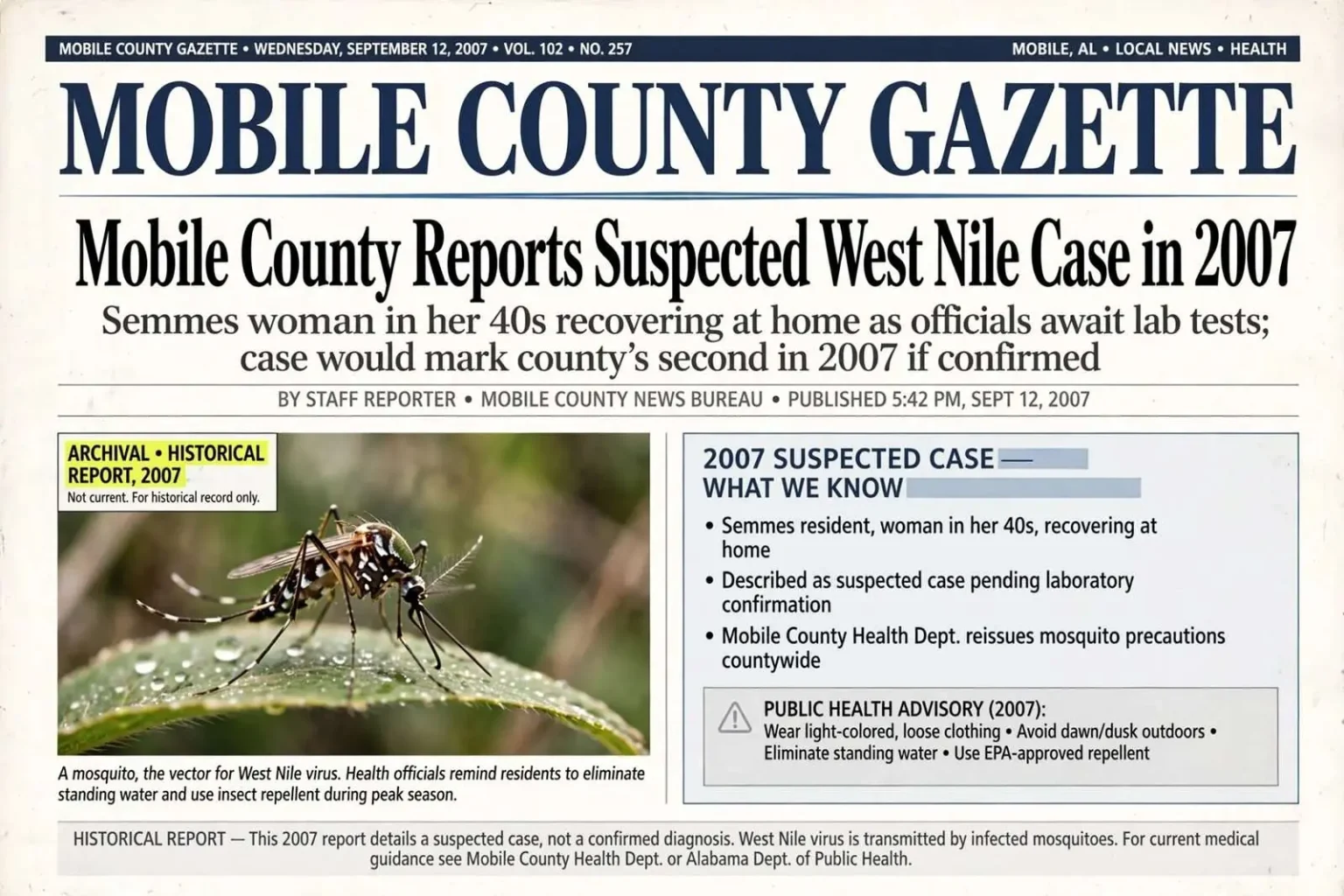
Historical report preserved from an archived 2007 local news story. This article records historical reporting about a suspected West Nile virus case in Mobile County in 2007. It is not current medical advice, and readers should rely on current guidance from public-health authorities when evaluating mosquito-borne illness today.
A Mobile County health report in 2007 described a Semmes woman in her 40s who was recovering at home while officials evaluated what was then a suspected case of West Nile virus. According to the report, if the case had been confirmed, it would have marked the county’s second case of that year. Health officials at the time described the illness as mosquito-borne and potentially serious, and the report underscored how routinely the region’s health agencies track, test, and confirm such cases during the long Gulf Coast mosquito season. The woman’s recovery at home, rather than in a hospital, suggested an illness on the milder end of a spectrum that can run from minor flu-like symptoms to serious neurological disease.
The distinction between a suspected case and a confirmed one matters in public health reporting. A suspected case is typically identified when a patient shows symptoms consistent with the illness and a physician orders laboratory testing to look for the virus or for antibodies the body produces in response to it. Confirmation generally requires laboratory results, a process that can take days to complete, and until those results return, health departments report the case only as suspected while their evaluation continues. That was the stage officials had reached in the Semmes woman’s situation when the 2007 report was issued, and the final determination was left to the testing process rather than to early descriptions of her symptoms.
Understanding West Nile virus
West Nile virus is transmitted to people through the bite of an infected mosquito, most commonly mosquito species that first feed on infected birds and then bite humans. The virus had only reached the United States in 1999, appearing first in New York, and it spread steadily across the country in the years that followed, reaching Alabama in the early 2000s. Most people who are infected never develop any symptoms at all, while others experience fever, headache, body aches, joint pain, vomiting, and fatigue that can linger for weeks. In a smaller share of cases the virus causes severe neurological illness, including inflammation of the brain or of the tissue surrounding the spinal cord, which is why health officials consistently described it as potentially serious rather than as a routine summer nuisance.
Older adults and people with weakened immune systems face the highest risk of severe illness, and there has never been a specific antiviral treatment for West Nile; care for those who fall ill is generally supportive. Because treatment options are limited, public health agencies across the Gulf South have long emphasized prevention as the primary defense against the virus. That emphasis shaped the way local reports like the 2007 Semmes case were handled: even an unconfirmed case became an occasion for the health department to reissue practical precautions to the entire county, since the mosquito population that carries the virus does not respect city limits or neighborhood boundaries.
The precautions officials shared
In connection with the 2007 report, the Mobile County Health Department shared a set of practical precautions that residents could take to reduce their own risk. Among them were wearing loose, light-colored clothing, covering arms and legs whenever possible, and avoiding strongly scented products such as perfumes and fragrant lotions that can attract mosquitoes. The advice reflected long-standing guidance from state and federal health agencies, which have consistently recommended protective clothing and the use of insect repellent during peak mosquito activity. Light-colored fabrics make mosquitoes, which are drawn to dark colors, easier to spot before they land, while loose clothing creates a barrier that is harder for the insects to bite through.
Health officials in the region have also traditionally urged residents to attack the problem at its source by reducing mosquito breeding around their own homes. That means emptying containers that hold standing water — flower pots, buckets, birdbaths, clogged gutters, wading pools, and old tires among them — since even a small amount of water left undisturbed for a week can support mosquito larvae. Staying indoors at dawn and dusk, when many mosquito species are most active feeding, and keeping window and door screens in good repair have been recurring elements of public health messaging across Mobile County for decades. Pet owners and livestock keepers were regularly reminded to change outdoor water bowls frequently as well.
Mosquito season on the Gulf Coast
Mobile County’s humid subtropical climate gives the area one of the longest mosquito seasons in the United States. Warm temperatures can arrive as early as March and persist well into November, and the region’s frequent rain leaves standing water in ditches, low-lying yards, drainage swales, and construction sites for days at a time. That combination means mosquito surveillance is a nearly year-round undertaking for local agencies rather than a brief midsummer project. Human cases of West Nile tend to be reported from late summer into fall, when virus activity in mosquito and bird populations has built up over the season and peaked.
The Mobile County Health Department has operated mosquito control and surveillance programs that monitor populations, test mosquito pools and sentinel animals for viruses, and conduct spraying operations in areas where activity is found. Statewide, the Alabama Department of Public Health coordinates the reporting of human cases and issues advisories when activity increases, and county departments feed their findings into that system. In 2007, as in other years, local news coverage of individual suspected and confirmed cases served a second purpose beyond informing the public: it reminded residents that the threat was present in neighborhood backyards and drainage ditches, not just in distant headlines, and that simple household measures genuinely reduce exposure.
The Semmes community
Semmes, located in western Mobile County along Moffett Road, was incorporated as a municipality in 1996 and grew rapidly in the decades that followed as suburban development spread west from the city of Mobile. The area has long blended residential neighborhoods with nurseries and greenhouse operations, a legacy of its history as a center of the nursery industry in south Alabama. That mix of homes, wooded lots, greenhouses, and drainage channels is typical mosquito habitat, and for residents of communities like Semmes the precautions described in the health department’s report have long been a routine part of outdoor life through the warm months. Yard work, gardening, evening walks, and youth sports all happen during the hours when mosquitoes are most active.
The 2007 report also reflected the way local news outlets and health agencies worked together in that era. A suspected case in one part of the county prompted the health department to reissue its precautions countywide, using the attention generated by the report to remind every household — not only the one affected — that wearing protective clothing, avoiding scented products, and eliminating standing water lowers risk for the whole community. Public health depends on that kind of broad participation, because an individual household cannot control the mosquitoes that breed on the next property over.
Why historical reports still matter
Archived reports like this one preserve a record of how West Nile virus moved through Gulf Coast communities after its arrival in the United States and its spread into Alabama. Each year’s cases, both suspected and confirmed, form part of the long-term picture that health agencies rely on to understand seasonal patterns, identify areas where control efforts should be concentrated, and plan surveillance for the following year. Local news coverage from the period, preserved in archives like this one, is often the only public-facing record of how individual communities experienced those seasons.
It is also worth remembering how the information environment of 2007 differed from today’s. Residents learned of suspected cases through evening broadcasts and the next morning’s newspaper, and health departments relied on those same channels to spread their precautions. A single report about a recovering Semmes woman could reach thousands of households in a day and shape behavior across the county, even before any laboratory confirmation had arrived.
For the family involved, meanwhile, a suspected-case report carried its own weight. Neighbors learned that someone in their community was ill before anyone knew whether laboratory testing would confirm the cause, and the woman’s privacy depended on the careful, limited way such reports were written. Health departments and newsrooms alike generally avoided identifying patients in these situations, describing them instead by age range and community, which is why the archived account says so little about the individual and so much about the precautions everyone else should take.
This article records historical reporting and a suspected diagnosis; it does not offer current medical advice, does not state whether the 2007 case was ever confirmed, and does not reflect present-day case counts or conditions. Anyone with questions about mosquito-borne illness today should consult current guidance from the Mobile County Health Department, the Alabama Department of Public Health, or a licensed health care provider.