Historical report, published from archived local news coverage.
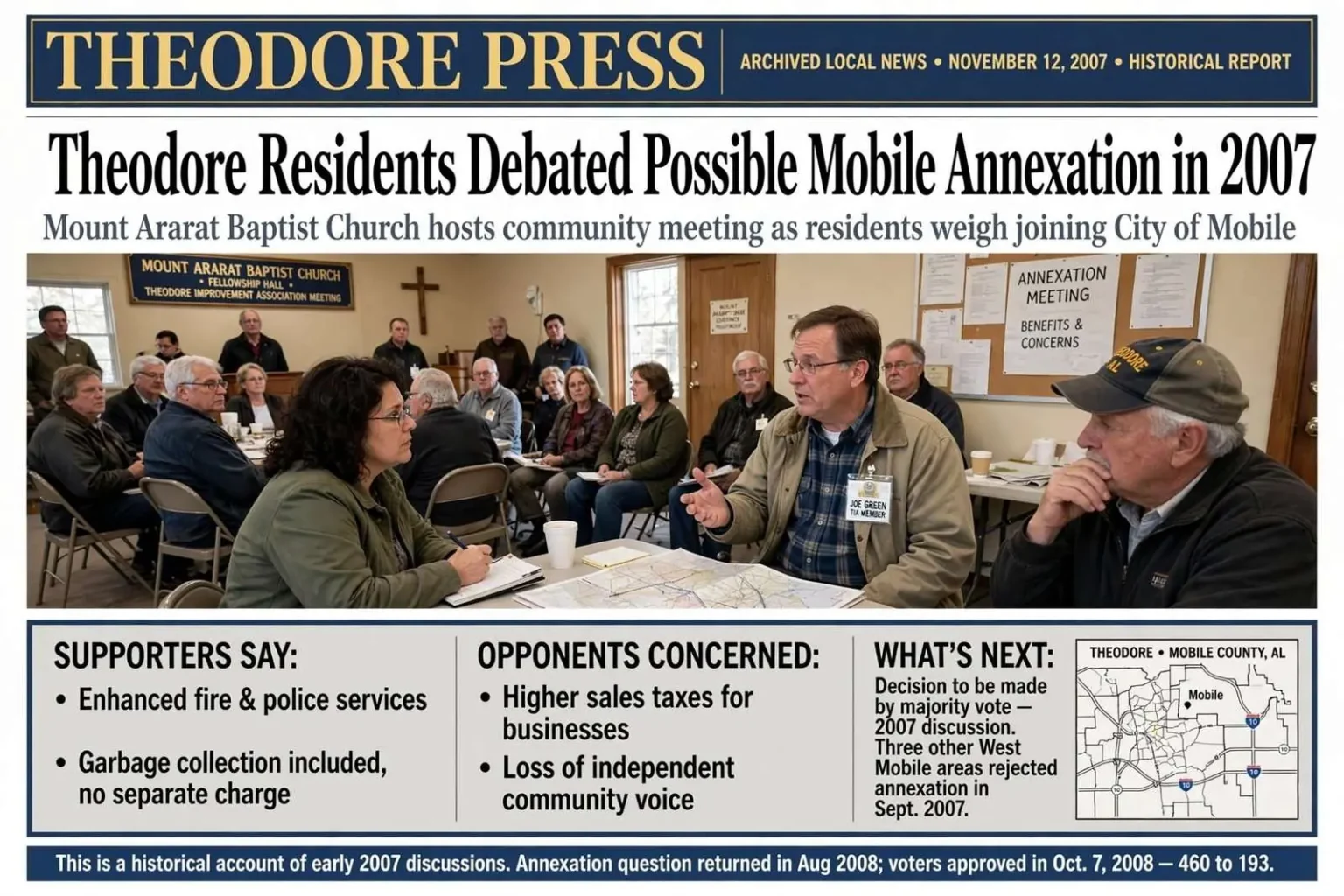
In 2007, Theodore residents were discussing the possibility of annexation into the City of Mobile, according to an archived local news report. Theodore Improvement Association members had met at Mount Ararat Baptist Church to discuss possible benefits of joining the city, and the meeting drew enough interest that residents interviewed on camera were willing to attach their names to their positions. The discussion placed Theodore — one of the largest unincorporated communities in Mobile County — at the center of a question that had surfaced repeatedly across the county for decades: whether its sprawling suburbs should become part of the city whose boundaries nearly surround them.
Supporters cited enhanced fire and police services as the principal benefits of annexation. Mobile’s police department offered around-the-clock precinct coverage, and its fire department operated from staffed stations with city-funded equipment, while unincorporated Mobile County relied on the Sheriff’s Office for patrol and on volunteer and combination fire departments funded largely through county fees and subscriptions. Association members who favored joining the city argued that annexed neighborhoods would move up the priority list for services that Theodore residents already paid for indirectly through taxes that did not bring city-level response.
Opponents raised concerns about higher sales taxes for Theodore businesses. Mobile’s city sales tax added a point on top of the county and state rates, and for a community whose retail corridors along U.S. 90 and Theodore Dawes Road anchored much of its commerce, any increase was seen as a threat to local merchants competing with businesses just outside a future city line. Opponents also questioned whether the promised services would materialize at the level supporters predicted, pointing to the experience of other neighborhoods that had joined the city over the years.
Association member Joe Green said the decision should be made by a majority vote. His position framed the annexation question as one for the whole community rather than for the association’s leadership, and it echoed the procedures Alabama law requires: annexations proceed through petitions signed by a majority of property owners in the territory, through legislative action, or through a vote of the affected residents themselves. No path forward short of a community-wide decision would settle the matter.
How residents saw the choice
Residents interviewed by a local station expressed different views: some opposed an increase in taxes, while others supported annexation in hopes of receiving services such as garbage collection without a separate charge. The divide reflected practical household math as much as philosophy. Theodore homeowners paid fees for county sanitation service and fire protection that city residents saw folded into city taxation, and for families on fixed incomes the question was whether the city’s tax rate would cost more or less than the stack of separate bills they already paid.
Those who supported joining the city often pointed to day-to-day services rather than grand projects. Garbage collection stood out in the interviews because it was the service residents touched every week, but street lighting, drainage maintenance and code enforcement entered the conversation as well. Unincorporated communities in Mobile County had long complained that county government, spread across thousands of square miles, could not respond to neighborhood-level concerns as quickly as a city department responsible for a compact territory.
The station reported that three other West Mobile areas had rejected annexation in a September vote. That result weighed on the Theodore discussion, giving opponents evidence that their neighbors across the county had examined the same trade-offs and declined the city’s offer. Annexation votes in Mobile County during the 2000s repeatedly followed that pattern — organized by civic associations, argued in community meetings, and decided at the ballot by margins that reflected genuine ambivalence about trading independence for services.
Theodore: a community apart
Theodore occupies a distinctive place in Mobile County’s geography and identity. Bounded roughly by the city of Mobile to the north, Mobile Bay to the east and the industrial corridor of Calvert and Axis inland to the west, it grew from a rural crossroads named for William Theodore Hieronymous into one of the county’s most populous unincorporated communities. Its schools — Theodore High School among them — carry the community’s name into every regional athletic and academic ranking, and its civic institutions, including the Theodore Improvement Association, functioned for decades as the closest thing the community had to a municipal government.
That civic infrastructure is precisely what made annexation a live question rather than an abstraction. Communities with active improvement associations were the ones that organized annexation studies, invited city officials to community meetings and polled residents. Mount Ararat Baptist Church, the site of the 2007 meeting, was one of the neighborhood institutions whose halls regularly hosted such discussions, as churches and civic clubs did across unincorporated Mobile County whenever questions of incorporation, zoning or annexation surfaced.
The community’s commercial base gave both sides their strongest arguments. Theodore’s retail corridors along U.S. 90 included shopping centers, auto dealerships, restaurants and service businesses that served not only the community but surrounding unincorporated areas as far as Grand Bay and Irvington. Supporters of annexation noted that city services and city planning could improve those corridors; opponents replied that a higher city sales tax would push price-sensitive shoppers to competitors in unincorporated areas just minutes away, draining revenue from the very businesses that defined the community.
Annexation politics in Mobile County
The 2007 Theodore discussion fit a long pattern in Mobile County politics. The city of Mobile annexed portions of west Mobile in waves during the late twentieth century, and each wave generated the same debate that Theodore residents were having: services and identity against taxes and autonomy. Areas that joined the city gained access to municipal services and city representation, while areas that stayed unincorporated retained lower sales taxes and freedom from city zoning, relying instead on county government and volunteer institutions.
By 2007, the map of greater Mobile was a checkerboard of incorporated and unincorporated territory that made service delivery and planning complicated on both sides. City planners watched population shift south and west into unincorporated communities, while county commissioners faced growing service demands without a municipal tax base to fund them. Annexation proposals like Theodore’s were the mechanism by which that tension periodically surfaced, and the September rejections by three West Mobile areas showed that voters did not always accept the city’s argument, however sound the services case appeared in a community meeting.
Alabama’s annexation law shaped every such debate. Because the state requires either a majority petition of property owners or a referendum in the affected territory, no annexation could be imposed on Theodore from outside, and organized opposition could always force the question to a vote. That legal reality gave community associations like the Theodore Improvement Association real leverage, and it explains why the 2007 meeting at Mount Ararat Baptist Church mattered: it was the stage on which the community formed the collective position that any eventual petition or vote would require.
This is a historical account of the early discussion and does not describe later annexation actions or outcomes. Theodore remained one of the largest unincorporated communities in Alabama through the period covered by the archived report, and the debate recorded there — police and fire protection against sales taxes, convenience against identity — continued to define annexation conversations across Mobile County long after the meeting at Mount Ararat Baptist Church adjourned.
What was at stake for residents’ wallets
The financial arithmetic at the center of the 2007 debate deserves a closer look, because it drove nearly every opinion quoted in the archived coverage. City of Mobile residents paid the city’s sales tax rate at the register, a rate above what shoppers paid in unincorporated Mobile County. For a family buying groceries, clothing and household goods locally, the difference accumulated across a year of purchases, and annexation opponents argued that raising Theodore’s rate would harm merchants as much as households. Supporters countered that the city rate funded services that Theodore residents were already buying piecemeal — sanitation fees, fire subscriptions and the indirect costs of depending on sheriff’s patrols.
Garbage collection illustrated the piecemeal problem well. In the city, residential trash pickup was a municipal service funded through the general budget, while unincorporated households paid a separate sanitation charge through their county fees. A homeowner comparing bills in 2007 could see the city charge folded into property taxes and the county charge listed on its own line, and residents interviewed by the local station made exactly that comparison in explaining why they favored or opposed joining the city.
Fire and police protection carried the highest stakes of all, because they measured in minutes rather than dollars. Theodore’s volunteer-rooted fire service had served the community for generations, but response times and equipment budgets could not match a fully staffed city department, and sheriff’s deputies patrolling a county of tens of thousands of unincorporated residents could not match a city precinct’s presence. Supporters of annexation argued that those differences were worth the tax increase; opponents answered that the city’s promises had a way of arriving later and smaller than advertised.
The 2007 meeting at Mount Ararat Baptist Church ended without a community-wide decision, as early discussions typically do. What it left behind was a clear record of the community’s concerns on both sides, preserved in the archived news coverage and in the association’s continued role as Theodore’s forum. The question the residents debated — whether becoming part of Mobile would improve their daily lives enough to justify what it would cost — remained the same question every unincorporated community in the county confronted whenever annexation returned to the agenda, and the September rejections by three West Mobile areas showed that answering it either way required a conviction the electorate did not always share.