Mobile County Confirmed Second H1N1 Case in May 2009
Alabama health officials confirmed Mobile County's second H1N1 influenza case in May 2009. The adult patient recovered without hospitalization, according to the county health department.
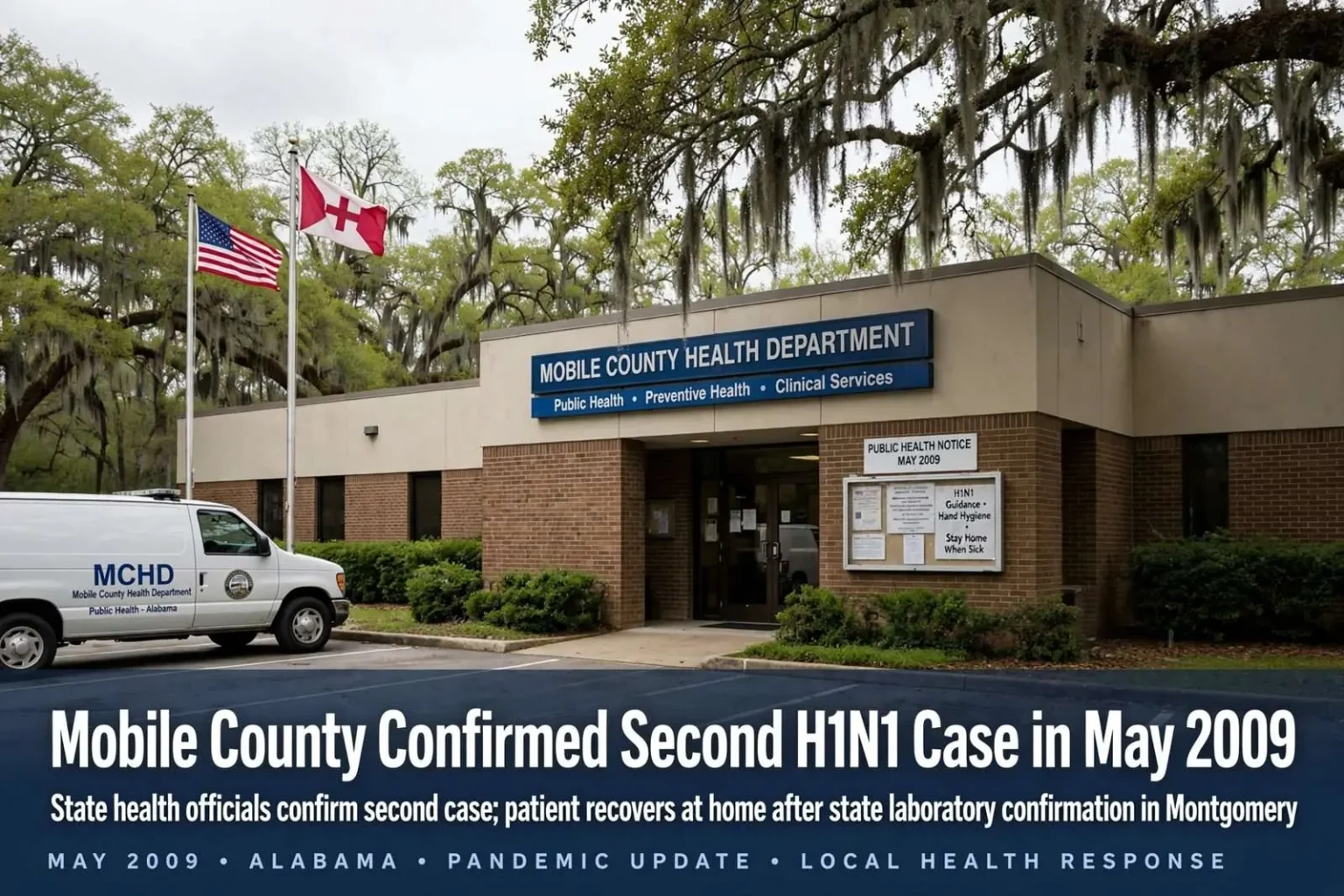
State health officials confirmed Mobile County’s second H1N1 influenza case in May 2009, according to the Mobile County Health Department. A 24-year-old patient had first tested positive for Influenza A at a private physician’s office. A sample sent to the state laboratory in Montgomery was then confirmed as H1N1.
The confirmation process followed the standard path that Alabama established during the outbreak’s early weeks. Because the novel virus was new, routine rapid flu tests in doctor’s offices could flag Influenza A but could not distinguish H1N1 from the seasonal strains then still circulating, so any suspected case required a respiratory sample to be shipped to the state laboratory for specialized testing. The Montgomery lab served as the confirmation point for suspected cases from every county, which meant local results often trailed the initial diagnosis by a day or more while specimens made the trip north and were analyzed.
Patient Recovered Without Hospitalization
The county health department said the patient did not require hospitalization and had fully recovered. Earlier that month, officials had confirmed Mobile County’s first reported H1N1 case.
The pattern — mild illness treated at home, recovery without hospital care — matched what public health officials were seeing across the country in the outbreak’s first months. Early fears that the new virus would produce severe disease on the scale of earlier flu emergencies gave way, through the spring, to a picture of a highly transmissible influenza that for most patients behaved like a bad seasonal flu. Health departments nonetheless tracked every confirmed case closely, because the virus was new enough that scientists did not yet know how it would behave in the fall, or who among the young, pregnant women and people with chronic conditions would prove most vulnerable.
The New Virus That Caught the World’s Attention
The 2009 H1N1 virus emerged in the spring of that year, first identified in outbreaks in Mexico and in the southern United States before spreading rapidly across the country and around the globe. By the end of April 2009 it had prompted a public health emergency declaration in the United States, and school closures followed in some communities as officials worked to slow transmission while they learned more about the virus.
Unlike typical seasonal influenza, which falls hardest on the elderly, the new H1N1 circulated most readily among children and younger adults, a demographic pattern that caught many families off guard. That shift put school systems and college campuses at the center of the response, and it made pediatric and adolescent cases — like the Mobile County patient, at just 24 — the norm rather than the exception in the confirmed-case lists that health departments published through the spring and summer.
For Alabama, the outbreak’s timing mattered. The virus arrived just as the state’s regular flu season was winding down, giving officials a spring and summer to build testing capacity, stockpile antiviral medications and plan vaccination campaigns before a larger fall wave arrived. Confirmed case counts during May represented the visible edge of the outbreak — limited by the pace of laboratory testing as much as by the virus itself — and health officials warned throughout the period that the absence of a confirmed case in a given county did not mean the virus was not there.
How Alabama Health Agencies Responded
The Alabama Department of Public Health coordinated the statewide response, working through county health departments like Mobile County’s, which operates one of the largest local public health systems in the state. County epidemiologists interviewed confirmed patients about their travel, their contacts and the onset of their symptoms, tracing chains of transmission and advising those exposed to watch for fever and respiratory symptoms.
The guidance given to the public in those early months emphasized the basics: frequent hand washing, covering coughs, staying home from work and school while sick, and seeking care promptly for difficulty breathing or other severe symptoms. Antiviral medications were effective against the virus and were reserved primarily for hospitalized patients and those at highest risk of complications, since supplies had to be managed nationally until production ramped up.
Local health departments also walked a careful line on communication. Announcing confirmed cases kept residents informed and reinforced that the virus had reached their community, but officials worked to prevent panic, stressing that most patients recovered fully and that the reported numbers reflected testing rather than the outbreak’s true size. The second Mobile County case was announced in exactly that spirit — a routine confirmation, a recovered patient, and a reminder of the precautions that limited spread.
A Historic Record, Not Current Guidance
It is a historic public-health record: this article documents a local update from the 2009 H1N1 pandemic and is not current medical guidance, and it does not provide individualized health advice. The communities and regions mentioned are part of Alabama’s diverse geographic landscape, where Montgomery, Mobile and surrounding areas share interconnected histories, economic ties and cultural traditions that shape local developments, and where institutions such as county health departments play pivotal roles, providing essential services, employment and civic leadership whose decisions ripple through the region.
Understanding the episode in its era helps clarify what it meant. The spring of 2009 sat in the middle of a recession that strained public budgets just as health agencies were asked to expand their pandemic response, and the H1N1 experience — with its laboratory bottlenecks, its school closure debates and its nationwide scramble for vaccine — went on to inform how Alabama and the rest of the country prepared for the respiratory outbreaks that followed in later years.
What the Mobile County Case Represented
For Mobile County, the second confirmed case was less a turning point than a confirmation of what was already underway: the virus had arrived, was moving through the community, and for this patient had produced a mild, fully recovered illness handled entirely outside the hospital system. The county health department’s public accounting of the case — the Influenza A flag at a private physician’s office, the confirmation at the state laboratory, the recovery without hospitalization — captured the standard script of the outbreak’s early Gulf Coast weeks.
Mobile County’s position as Alabama’s second-largest county, its busy port, and its steady flow of travelers through the Mobile region made early detections there unsurprising to epidemiologists watching the virus spread through the Southeast. By the time larger waves of illness arrived later in 2009, the tracking systems, testing relationships and public messaging channels that agencies had built in the spring — one confirmed patient at a time, beginning with cases like this one — had become the foundation of the state’s ongoing response.
Inside a County Health Department During an Outbreak
The work behind a two-line case announcement was substantial. When a physician’s office flagged a probable Influenza A infection, county staff gathered the patient’s information, arranged the specimen shipment and notified the state lab. When the confirmation came back, disease investigators interviewed the patient about the week before the onset of symptoms — where they had traveled, who they lived with, where they worked — and followed up with anyone who might have been exposed. Every confirmed case generated a file, a timeline and a set of recommendations, and the volume of that paperwork grew with each new case on the list.
The Mobile County Health Department’s role in the episode illustrates how Alabama’s public health structure works from the bottom up. The state agency in Montgomery sets policy, operates the reference laboratory and serves as the channel to the Centers for Disease Control and Prevention, but the county departments are the front line: they answer the calls from worried residents, they brief school administrators, they count the cases and they deliver the prevention message in the communities where it has to land. In a county the size of Mobile, with a population spread from the city’s historic districts to the growth corridors along Airport Boulevard and out to the Mississippi line, that local presence is what turns a statewide strategy into practical instructions for individual families.
The Broader Lesson of 2009
Looking back from the present, the 2009 H1N1 outbreak stands as a dress rehearsal for the large-scale respiratory emergencies that came later. It exposed the value of laboratory surge capacity, showed how quickly public guidance must evolve as new information arrives, and demonstrated that clear local communication — who is sick, how sick, and what residents should do — matters as much as the clinical response itself. The lesson was learned well enough that the spring of 2009, when a 24-year-old Mobile County patient’s sample made its way to Montgomery and came back flagged as the county’s second confirmed case, reads today as an early chapter in a much longer story about how Alabama health agencies confront a new disease.
For the families who lived through those weeks, though, the memory is simpler: a new flu with an unfamiliar name, a county health department posting its count, and the ordinary relief of a patient who stayed home, got better, and needed no hospital bed at all.