Citronelle Fathers Apologize After Postgame Fight, Ask School to Reinstate QB Daylon Edmunds
Two Citronelle football fathers who fought in the stands after a game have publicly apologized, with one asking the school to reinstate suspended quarterback Daylon Edmunds.
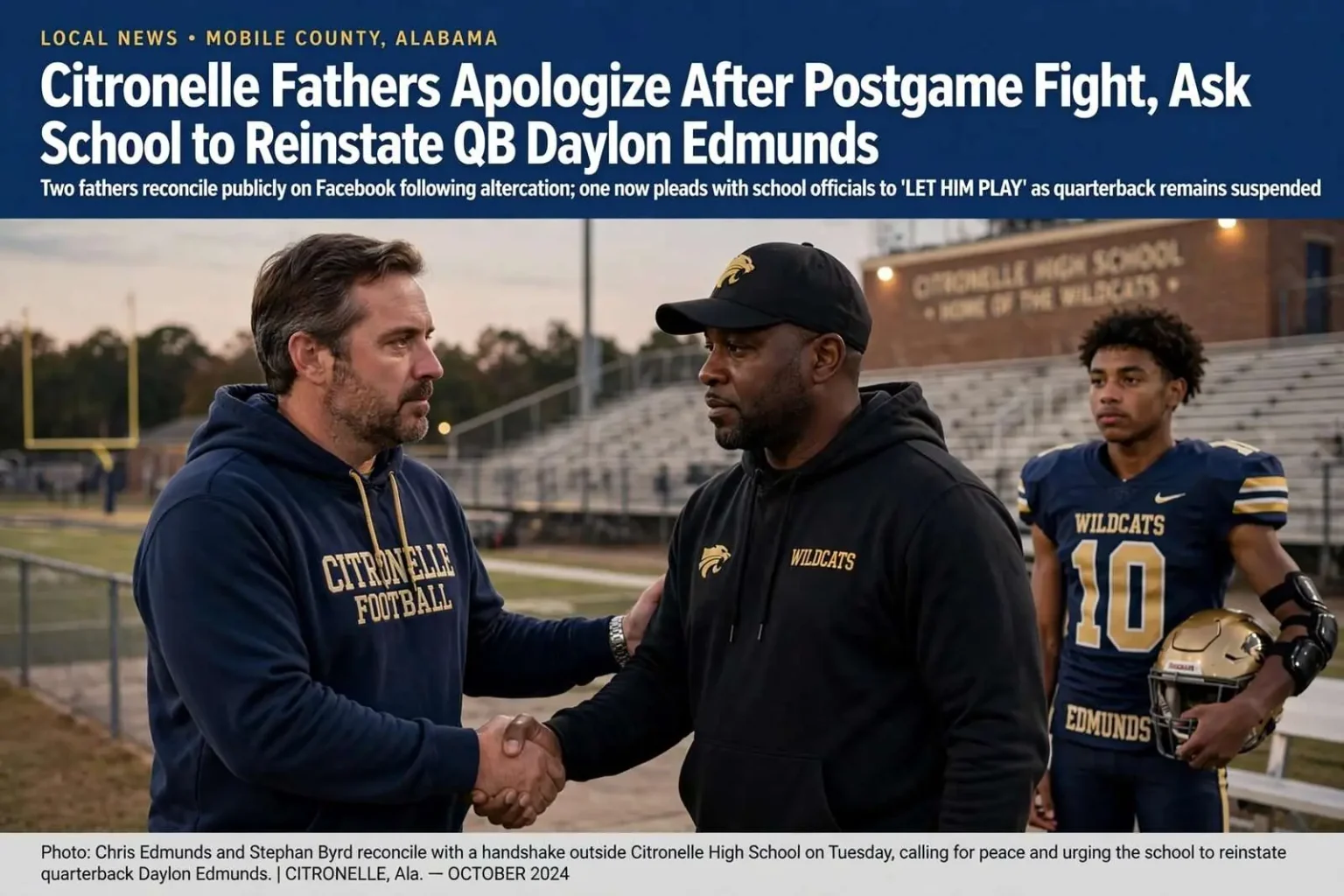
The fathers of two Citronelle High School football players say they have made peace after a postgame fight in the stands last week led to arrest warrants and the suspension of the team’s starting quarterback. The public reconciliation, played out on Facebook rather than in a courthouse hallway, brought a measure of closure to an altercation that had spiraled from a sideline comment into criminal charges, a school suspension and a question mark over one of the Wildcats’ most important players.
Chris Edmunds, father of quarterback Daylon Edmunds, and Stephan Byrd, father of receiver Sye Byrd, both posted public apologies on Facebook this week following the altercation that broke out after Citronelle’s game against UMS-Wright. The two families had been linked for years through their sons’ football careers, with the quarterback-receiver pair among the players Citronelle counted on as its season progressed.
According to Citronelle Police Chief Chris McLean, the confrontation began when one of the fathers accused the other of making a comment about his son, and the disagreement escalated into a physical altercation. McLean said warrants have been issued charging both Chris Edmunds and Stephan Byrd with disorderly conduct.
During the chaos, Daylon Edmunds ran into the bleachers and struck Stephan Byrd. The Citronelle quarterback was suspended from both the football team and school as a result, though Byrd said he does not intend to press charges against the younger Edmunds. The suspension removed the Wildcats’ starting quarterback from practice and games at the same time the criminal process was unfolding for the two fathers, leaving the program to absorb the fallout while the adults involved tried to undo it.
An Apology in Public
In his Facebook post, Byrd said he accepted Chris Edmunds’ apology and acknowledged his own role in letting the situation escalate in front of the boys and their friends. “We all make mistakes and I have made my share,” Byrd wrote. “I accept the apology and in return apologize for putting our kids and friends in a difficult situation. I am embarrassed no matter the reasoning as a adult I know better. Hopefully we all learned a lesson.”
The apology was notable for how directly it confronted the scene the fight created. High school bleachers on a Friday night hold an audience of children, teammates and neighbors, and the spectacle of two fathers brawling after a game — with one player’s son joining in — offered the community the kind of lesson adults usually hope to spare their kids. Byrd’s post, written in his own voice and posted publicly, read as an attempt to give that audience the corrective version.
Byrd went further, saying he sympathized with Daylon Edmunds’ decision to intervene and defend his father, and he called for the suspension to be lifted. “As for Daylon Edmunds, I can’t say that I would not have done the same thing if the tables were turned,” Byrd wrote. “I look at you and only can imagine if this was Sye in your situation, so you and your family can rest easy. I won’t be filing charges on you sir. From now on, let adults handle adult situations.”
He closed the post with a direct appeal — “LET HIM PLAY” — a plea aimed as much at school administrators as at anyone else, since the decision about Daylon Edmunds’ playing future rested with the school system rather than the court system. Byrd’s statement that he would not press charges removed one obstacle to the quarterback’s return, though the school suspension remained a separate process with its own timeline and its own decision-makers.
What the Charges Mean
Disorderly conduct is a misdemeanor under Alabama law, typically charged when a person’s conduct creates a disturbance in a public place. The warrants against both fathers ensured the altercation would not simply be forgotten: each will answer the charge through the municipal or district court process, where the outcome could range from dismissal to a fine. What the charges do not do, in themselves, is resolve the school consequences, which follow a different set of rules entirely.
That split is familiar in school-related altercations. Criminal charges address the public disturbance; school discipline addresses the effect on the school environment, and school officials act on their own findings regardless of what prosecutors decide. A student who intervenes in an adult fight on school property — even at an away game, even in defense of a parent — generally places administrators in a difficult position, since the rules governing student conduct make little allowance for motive.
For Daylon Edmunds, that is the bind his father’s apology and Byrd’s forgiveness cannot fully undo. The suspension from school and football stands until the school system acts, and the voices now advocating for his reinstatement — most prominently the very man he struck — have given administrators a community consensus to weigh alongside the rulebook.
Small Town, Big Stakes
Citronelle sits at the northern edge of Mobile County, a close-knit community where the high school functions as the town’s gathering place and its football program is a shared civic event. Games against Mobile private-school powers like UMS-Wright draw the town out in force, and the stands at a Wildcats game are filled with neighbors who know the players and their families by name. It is exactly the kind of community where a fight in the bleachers cannot stay private — and, as the past week showed, where an apology cannot either.
The rapid public reconciliation also said something about the two families at the center of it. Both fathers have sons on the same roster, and whatever passed between them in the stands, the season continues for the Wildcats with the quarterback and receiver still teammates. Letting the dispute harden into a feud would have poisoned a locker room; the Facebook apologies, whatever their legal effect, were aimed at preventing that.
Whether Daylon Edmunds is reinstated remains the open question of the week, and the answer will come from school officials rather than the courthouse. But the terms of the debate have been set by the people the fight touched most directly: two fathers who say they are done escalating, and one of them telling the school, in writing, that the boy who defended his father deserves to finish the season on the field.
The episode has resonated beyond Citronelle because it compresses several familiar threads of Alabama high school football culture into one Friday night: passionate parents, a small-town stage, the thin line between loyalty and escalation, and a school system that must apply its rules to a case where everyone, including the victim, is asking for leniency.
How Schools Handle Fights at Games
Fights in the stands present school systems with some of their messiest disciplinary calls. Athletic events are extensions of the school day under most student codes of conduct, meaning students are subject to school discipline wherever the game is played — home or away. When a student joins a physical altercation, administrators typically conduct their own review before determining consequences, weighing the student’s account, witness statements and the student’s record.
Unlike the criminal process, school discipline is not bounded by the victim’s wishes. Byrd’s decision not to press charges carries weight as a public statement and as evidence of where the injured party stands, but the suspension decision belongs to school officials applying district policy. The community appeal to “let him play” therefore faces a procedural wall that goodwill alone cannot move — only the system’s own review can.
Administrators also have to consider what reinstatement signals. Every parent in the stands watches how a district handles a case where a popular player crossed a line for a sympathetic reason. The balance schools usually try to strike is accountability with proportion: consequences that teach without ending a season, particularly where, as here, the adult at the center of the injury has publicly asked for the student to be spared.
The Season Goes On
Meanwhile, the Wildcats continue their schedule with the spotlight brighter than any small-town program prefers. The quarterback’s absence changes what the team can do offensively, and the receiver’s family situation places an added emotional weight on a locker room already dealing with the aftermath of seeing the incident spread across social media. Coaches at schools this size are part football staff and part community institution, and the coming weeks will test that second role as much as the first.
UMS-Wright, for its part, emerged from the episode as a bystander: the game itself was not marred by on-field incidents, and the altercation unfolded after the final whistle, in the stands, among spectators. The contrast between the composed ending of the game and the chaos that followed it in the bleachers is precisely the kind of thing athletic administrators across the region point to when they remind fans that the adults in the stands set the tone for the students on the field.
That is the closing irony of the week’s events: the correction came from one of the adults involved. Byrd’s post — embarrassed, self-critical, pleading for a teenager’s season — was an attempt to convert a bad night in the bleachers into something the community’s kids could learn from. Whether Daylon Edmunds gets to put the pads back on is now up to his school. The father he struck has already said what he hopes the answer will be.