Mobile County EMA Director Announced Retirement in 2009
A 2009 WKRG report documented the planned retirement of Mobile County Emergency Management Agency Director Walt Dickerson.
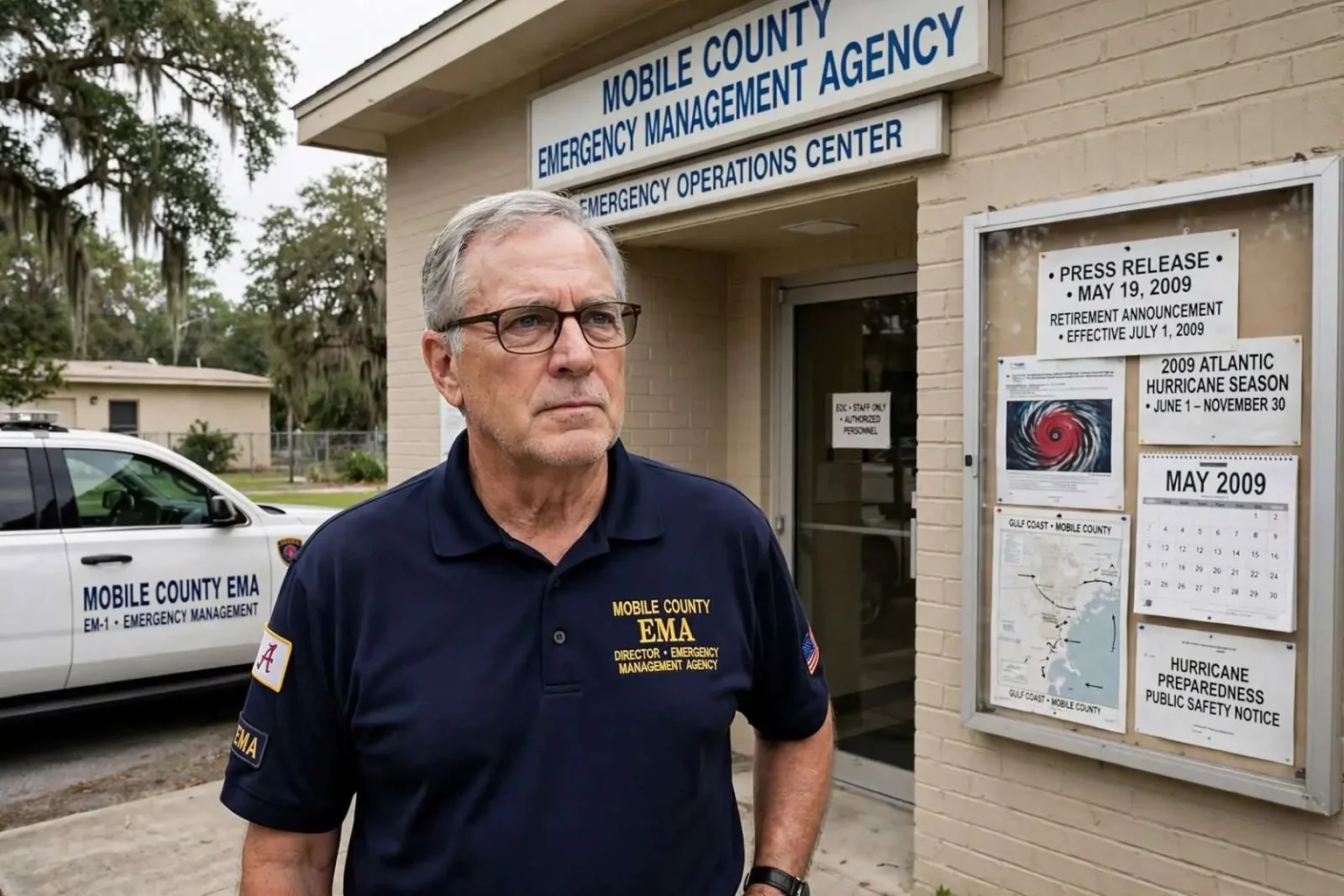
Mobile County Emergency Management Agency Director Walt Dickerson announced in May 2009 that he would retire July 1, before the heart of hurricane season, according to a local station. The timing was no accident. In south Alabama, the six months from June 1 through November 30 mark the Atlantic hurricane season, with the most active stretch typically running from mid-August through late October. By stepping down at the start of July, Dickerson gave the county time to install a successor and settle leadership before the period when Gulf storms historically threaten the Alabama coast.
Dickerson had spent 13 years with the agency, including four years as director. That tenure placed him at the helm of the county’s emergency management apparatus through some of the most demanding years the Gulf Coast has seen, an era bookended by two of the most destructive hurricanes in regional memory. The Mobile County EMA serves as the coordinating body for disaster response across Alabama’s second-most populous county, working with municipal governments, first responders, school systems and state and federal partners when severe weather threatens.
The report said he planned to remain in the Mobile area and open a business focused on emergency-disaster planning, operations, response, preparedness and mitigation. The move kept one of the region’s most experienced emergency managers in the community he had served, and it reflected a broader trend of retired public safety officials turning their operational experience into private consulting work for governments, businesses and institutions that need help preparing for disasters rather than simply reacting to them.
The Agency He Led
The Mobile County Emergency Management Agency operates from the premise that in a major disaster, the first hours belong to local government. State and federal help arrives only after local officials assess damage, declare an emergency and formally request assistance, so the county EMA’s core mission is to make sure Mobile County can stand on its own long enough for that machinery to engage. The agency maintains emergency operations plans, coordinates warning systems, runs training exercises with fire, police and medical partners, and staffs an emergency operations center that activates when a hurricane or other hazard approaches.
For Mobile County, the stakes of that mission are unusually high. The county stretches from the industrial waterfront of the Port of Mobile across Mobile Bay’s eastern shore communities to the growing suburbs near the Baldwin County line, encompassing chemical facilities, one of the nation’s busiest ports, flood-prone neighborhoods along three rivers and a coastline directly exposed to Gulf storm surge. A single major hurricane can threaten every one of those vulnerabilities at once, which is why emergency management leadership in the county is counted among the most consequential public safety jobs in south Alabama.
Dickerson’s 13 years with the agency spanned its evolution from a largely paper-based civil defense successor into a modern operations-oriented organization. Emergency management nationwide was reshaped after the September 11, 2001 attacks and again after Hurricane Katrina in 2005, when failures in coordination at every level of government became a national scandal. Agencies like Mobile County’s absorbed the lessons: better interoperable communications, more disciplined incident command structures, closer pre-storm coordination with the National Weather Service office serving the Gulf Coast, and more realistic assumptions about how long residents might be on their own after landfall.
A Career Shaped by the Gulf’s Worst Storms
Though his four years as director followed the period of the region’s most catastrophic strikes, Dickerson’s career with the agency ran through the recovery era that followed them. Hurricane Frederic, which devastated the area in 1979, remained the benchmark storm for coastal Alabama for a generation. Hurricane Ivan came ashore near Gulf Shores in September 2004, causing widespread damage across Baldwin and Mobile counties, and less than a year later Hurricane Katrina in August 2005 sent destructive surge into coastal Mobile County even though its worst effects fell on Mississippi and Louisiana.
Katrina’s impact on Mobile was a reminder that a storm does not need a direct landfall to be devastating. Storm surge pushed into the downtown area, washing out portions of the Bankhead Tunnel approach and flooding neighborhoods near the bay, while wind damage and extended power outages affected much of the county. For an agency director, managing the aftermath meant coordinating debris removal, supporting displaced residents, working with FEMA on public assistance claims and folding hard-won lessons into the county’s next generation of plans.
The 2009 hurricane season that Dickerson retired ahead of ultimately proved quiet for the Alabama coast, but the years that followed would keep the region on alert. The 2010 BP Deepwater Horizon oil spill — not a storm but an emergency of a different kind — tested the county’s ability to coordinate a response to an environmental disaster unfolding offshore, and hurricanes Irene in 2011 and Isaac in 2012 kept Gulf residents mindful that the threat never fully recedes. Emergency managers in Mobile County built their careers around a simple premise: the next major storm is a matter of when, not whether.
A Business Built on Preparedness
Dickerson’s post-retirement plan put him in step with a specialty that has grown steadily along the Gulf Coast. Private-sector emergency planning has become a significant field in the region, driven by the concentration of industry, shipping and tourism along the shore. Chemical plants and terminals along the Mobile River are required to maintain response plans under federal law, hospitals must document continuity-of-operations strategies to keep accreditation, and school districts review severe weather protocols every year before the season begins. Businesses that survived Katrina and Ivan learned that the cost of preparation is a fraction of the cost of a disrupted reopening.
A consultancy focused on planning, operations, response, preparedness and mitigation covers each stage of that cycle. Planning means writing the documents that govern what an organization does when a warning is issued. Preparedness covers the training and supplies that make those documents real. Response is the execution phase, when the plan meets the event. Mitigation — increasingly the priority for state and federal grant programs — focuses on reducing future losses before the next storm, through measures such as elevation, drainage improvements, hardened construction and redundant communications. An experienced former agency director brings credibility to all four, particularly with small governments and nonprofits that cannot afford a full-time emergency management staff.
His decision to remain in the Mobile area also meant the county did not lose his institutional knowledge. Former directors in Gulf Coast communities commonly continue to participate in training exercises, hurricane conferences and civic preparedness efforts, and south Alabama’s network of emergency professionals is small enough that careers intersect for decades. The relationships built across agencies during a 13-year tenure do not retire with the job title.
Succession and the Work That Continued
A mid-year transition in emergency management leadership always carries risk, which is why Dickerson’s July 1 departure date mattered. Agencies typically manage the handoff by promoting from within or naming an interim director who inherits a staff already steeped in the county’s plans. Mobile County’s EMA by 2009 was staffed by specialists in operations, logistics and warning coordination, and the county’s emergency operations center protocols were documented well enough that the machinery could function through the change. County commissioners, who oversee the agency, faced the task of deciding whether to conduct a national search or elevate a deputy — a decision that would shape the agency for years.
The timing also fell within a period of transition for the broader emergency management community in Alabama. The Alabama Emergency Management Agency, which coordinates federal disaster programs from the state level, had spent the post-Katrina years rebuilding its own capabilities and pushing counties to maintain the plans and exercises required to remain eligible for federal mitigation and assistance funding. County directors answer to their local commissions but work daily with the state agency, the National Weather Service’s Mobile office, the Alabama Law Enforcement Agency’s predecessor organizations and county-level partners such as the Mobile County Health Department and the school system.
This is a historical summary of a 2009 local government report. Agency leadership and operations may have changed. What has not changed is the county’s exposure. Mobile County remains a community where emergency management is woven into everyday governance: building codes reflect wind requirements, flood insurance maps shape development, and every June brings a fresh season of preparedness campaigns urging families to stock supplies and know their evacuation zones. The retirement of a 13-year veteran of that work marked the end of one career, but the county’s long apprenticeship with the Gulf went on. The communities and regions mentioned in this report are part of Alabama’s diverse geographic landscape, where coastal geography, river systems and a working port keep preparedness a permanent local concern rather than a seasonal one.
For residents of Mobile County, the practical meaning of that continuity is straightforward. The EMA’s work shows up in the sirens and alerts that precede severe weather, in the shelter and debris plans that activate after it, and in the mitigation projects — drainage upgrades, elevation grants, hardened public buildings — that quietly reduce the cost of the next disaster. A director’s retirement changes the signature on those plans, not the need for them. Two hundred miles of Gulf-facing watershed between the Mississippi line and Mobile Bay guarantees that whoever holds the office will spend every hurricane season the way Dickerson spent 13 years: preparing for a storm that has not yet formed, against a calendar that never pauses.