Mobile Coast Guard Aviation Training Center in 2009
A 2009 WKRG report explored Coast Guard pilot training at Mobile's Aviation Training Center.
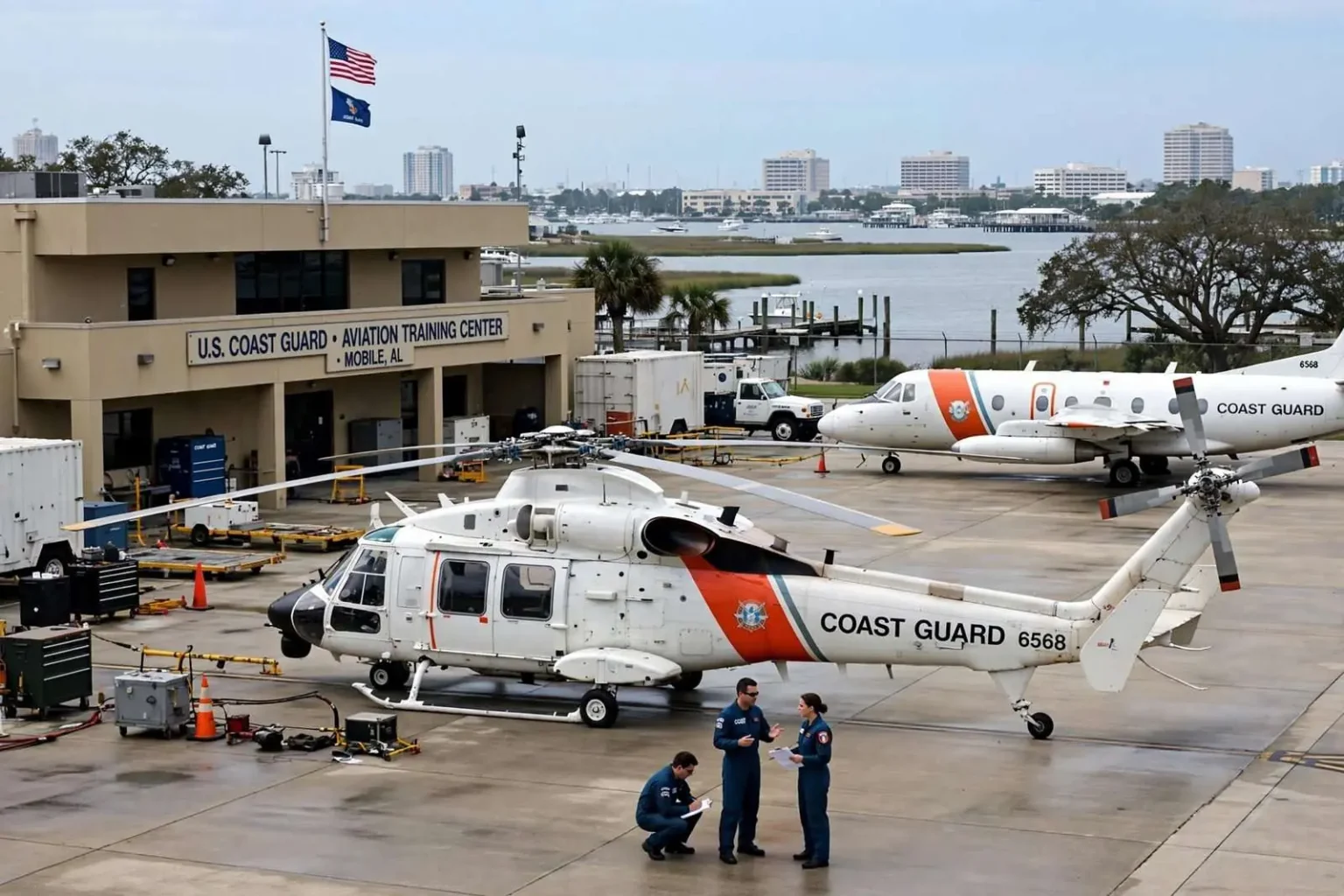
A 2009 local news report showed how the Coast Guard Aviation Training Center in Mobile prepared pilots for service. Instructors described a program combining classroom work, simulators and flight training — a three-pronged approach that turns newly minted Coast Guard officers into the aviators who fly rescue missions across the Gulf of Mexico. Officials said Mobile’s climate allowed for many training days and that the center typically had about 160 officers at any given time, making it one of the busiest training installations in the Coast Guard’s aviation community.
The Aviation Training Center, perched alongside Mobile’s downtown waterfront, serves as the Coast Guard’s premier aviation training hub. In the 2009 report, instructors walked viewers through the pipeline that every student aviator follows: intensive classroom instruction in aircraft systems and procedures, hours in sophisticated simulators that replicate emergencies too dangerous to practice in the air, and finally the flight training that puts it all together over Mobile Bay and the Gulf waters beyond.
That combination, instructors said, is what makes the program work. Classroom time builds the knowledge base, simulators allow students to fail safely — engine failures, instrument emergencies, night rescues — and flight time cements the skills until they become instinct. By the time a student completes the program, he or she is ready to report to an operational unit and begin flying real missions: search and rescue, law enforcement patrols, and drug interdiction flights across the Gulf Coast region.
Training on the Mobile Waterfront
Mobile’s location is no accident. The center sits on the Mobile waterfront with immediate access to the bay, the Gulf Intracoastal Waterway, and the open Gulf of Mexico — an ideal training environment for a service whose missions are overwhelmingly maritime. The 2009 report highlighted the advantage that officials said the location provides: Mobile’s climate, with its mild winters, allows for many flyable training days throughout the year, keeping students on schedule and aircraft in the air.
Weather matters enormously in flight training. A training program that loses weeks to snow and ice falls behind, while one that can fly through most of the year keeps students progressing steadily. South Alabama’s winters rarely ground aviation for long, and though summer thunderstorms and the occasional tropical system interrupt the schedule, the Gulf Coast climate gives the center one of the most reliable training calendars in the country.
The center’s aircraft filled the ramps and the skies over the bay in 2009 as they do today. Students trained in the helicopters and fixed-wing aircraft that form the backbone of the Coast Guard’s aviation fleet, learning the peculiar demands of maritime aviation — hovering over a pitching boat, locating a person in the water, navigating long overwater legs with no landmarks. The downtown skyline provided a recognizable backdrop for residents who grew used to the sight and sound of training flights overhead.
Inside the Student Experience
The 2009 report captured the demanding rhythm of a student aviator’s life. Days began with classroom academics — aerodynamics, aircraft systems, meteorology, and the regulations that govern Coast Guard flight operations. Afternoons might move to the simulators, where instructors could dial up a hurricane-force crosswind or a sudden engine failure and watch how the student responded, debriefing every decision in detail afterward.
Simulator training has transformed aviation instruction, and the center’s instructors emphasized how much it contributes to safety. Students can experience catastrophic failures in the simulator that they would never intentionally duplicate in a real aircraft, learning from mistakes that cost nothing but pride. By the time they face genuine emergencies in operational flying, they have already lived them dozens of times in simulated form.
Flight training brought the lessons together over the waters of Mobile Bay and the Gulf. Students practiced the approaches, hovers, and rescue patterns that define Coast Guard aviation, always with an instructor in the seat and the coastline nearby. The progression from classroom to simulator to cockpit, instructors said, builds competence in layers — each stage reinforcing the last until the student is ready for the fleet.
About 160 Officers at a Time
Officials said the center typically had about 160 officers assigned at any given time — a mix of students moving through the training pipeline and the instructor pilots and support officers who run the program. Those officers represent a significant share of the Coast Guard’s aviation community, and their passage through Mobile makes the city a touchstone for Coast Guard aviators throughout their careers.
Many aviators return to Mobile multiple times over a career: first as students, later for aircraft-specific training as the service introduces new helicopters and planes, and sometimes back again as instructors passing the craft to the next generation. That continuity gives the center an outsized influence on the service’s culture, with the standards instilled on the Mobile waterfront carried to air stations from Cape Cod to Kodiak.
The 2009 report also reflected the center’s operational role alongside its training mission. Coast Guard aviation in Mobile supports real-world missions across the Gulf — the rescues, patrols, and security flights that the training exists to enable. Students train in the same environment where those missions happen, a reminder that the classroom work and simulator hours are preparation for moments when lives hang in the balance.
The Center’s Place in Coast Guard Aviation
The Aviation Training Center in Mobile occupies a distinctive position within the Coast Guard’s structure. While operational air stations around the country fly the service’s missions day to day, the training center is where the service builds its aviation talent from the ground up. Every Coast Guard aviator’s career passes through aviation training, and Mobile’s facilities are central to that process — a fact that has made the center a landmark of the city’s waterfront and a fixture of the region’s military community.
The center’s presence also weaves it into Mobile’s civic life. Coast Guard families live in the city’s neighborhoods, children attend local schools, and the center’s personnel join the broader military community that includes the region’s Army, Navy, Air Force, and Marine facilities. Events at the center, from change-of-command ceremonies to community tours, reinforce a relationship between the service and the city that runs back decades.
For local viewers of the 2009 report, the segment offered a rare look inside an installation many passed daily without fully understanding. The story showed the classrooms where students absorb the theory of flight, the simulators where they practice for disaster, and the flight line where they earn their wings — the full machinery of a training enterprise that turns officers into aviators year after year.
Missions That Training Serves
Everything at the training center points toward the missions. Coast Guard aviation in the Gulf region performs search and rescue for boaters, fishermen, and mariners in distress; maritime patrol flights supporting law enforcement; and security operations protecting the ports, waterways, and offshore energy infrastructure that line the Gulf Coast. Mobile’s own units have responded to hurricanes, missing boaters, and medical evacuations from ships far offshore.
The 2009 report’s timing placed it in an era when the Coast Guard’s Gulf missions were in constant demand. Recreational boating traffic across the northern Gulf was enormous, commercial fishing fleets worked the waters year-round, and the energy industry’s offshore platforms required regular patrol and, in emergencies, rescue support. Training that prepared pilots for those missions had to cover long overwater flights, night operations, and hoist work in demanding sea states.
Instructors told the 2009 report’s audience that the training pipeline existed precisely because those missions allow no shortcuts. A pilot hoisting an injured fisherman onto a helicopter deck in rough seas, or navigating a night search pattern in poor weather, needs skills forged through repetition — in the classroom, in the simulator, and in the air over Mobile Bay.
A Mobile Institution
More than a decade after the 2009 report, the fundamentals it described remain the center’s operating logic: classroom, simulator, and flight training combined, a Gulf Coast climate that keeps the calendar full, and a corps of officers numbering around 160 at any given time passing through the pipeline. The center has grown and modernized with new aircraft and new technology, but the mission — producing Coast Guard aviators ready for operational service — has not changed.
For Mobile, the center is part of the city’s identity as a port city with deep military roots. The sight of training helicopters working the bay, the sound of aircraft over the waterfront, and the presence of Coast Guard families throughout the community all speak to an institution that is both national in purpose and thoroughly local in character.
The 2009 report captured that duality well. Viewers saw a rigorous national training program — classrooms, simulators, flight lines — and behind it a hometown institution whose officers shop in the same grocery stores and coach the same youth teams as their neighbors. In preparing the Coast Guard’s pilots for the missions that save lives across the Gulf of Mexico, the Aviation Training Center in Mobile performs a job of national importance, and it does so as one of the city’s own institutions — training, flying, and serving from the shores of Mobile Bay.