Mobile County Reported Its First H1N1 Death in 2009
Alabama public-health officials reported Mobile County's first H1N1 influenza death in October 2009 as the state announced four deaths linked to the virus.
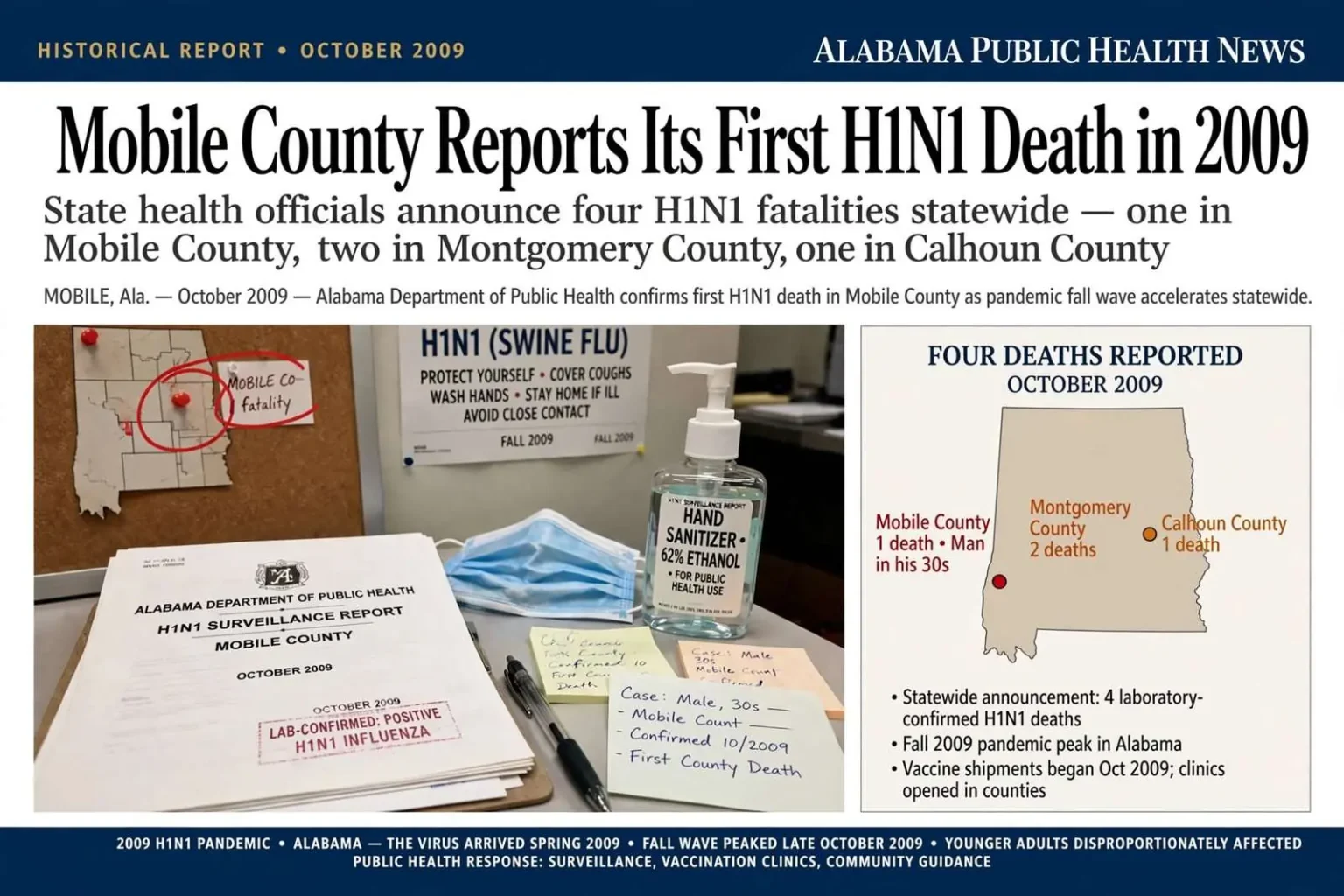
Alabama public-health officials reported Mobile County’s first H1N1 influenza death in October 2009 as part of a statewide announcement of four deaths linked to the virus. The Mobile County death involved a man in his 30s. The state Department of Public Health said specimens from all four people announced that day had tested positive for H1N1 influenza. The other deaths reported at the same time involved two people in Montgomery County and one person in Calhoun County.
The announcement came during the fall wave of the 2009 H1N1 pandemic, the influenza strain that emerged in the spring of that year and spread around the world within weeks. Public-health agencies labeled the new virus — commonly called swine flu because of its genetic similarity to influenza viruses known to circulate in pigs — as a pandemic by June 2009, and by autumn it was circulating in every U.S. state, with Alabama recording its first cases months before the October deaths were reported.
The fall of 2009 marked the period when the pandemic shifted from containment to mitigation. Because the virus spread efficiently from person to person and produced significant illness in younger age groups, health departments across the country tracked hospitalizations and deaths closely, releasing county-level figures as laboratory confirmations came in. The four deaths announced that October day — one in Mobile County, two in Montgomery County, and one in Calhoun County — were part of that regular reporting rhythm, each confirmed through laboratory testing of patient specimens before being made public.
The 2009 H1N1 pandemic in Alabama
H1N1 reached Alabama in the spring of 2009, with the first confirmed cases appearing within weeks of the virus’s identification in the United States. Schools were among the most closely watched settings, since the virus spread readily among school-age children, and state and county health officials issued guidance to schools on when ill students should stay home and when closures might be considered. By the time classes resumed for the 2009-2010 school year, the state was preparing for a substantial fall wave.
One of the distinctive features of the 2009 pandemic was its age pattern. Unlike seasonal influenza, which historically causes the most severe illness in the elderly, H1N1 produced disproportionate illness among children, teenagers, and younger adults — a pattern reflected in the demographics of severe cases and deaths reported across Alabama, including the man in his 30s whose death was announced in Mobile County that October. People with underlying conditions such as asthma, diabetes, pregnancy, obesity, and compromised immune systems faced elevated risk of complications, and public-health messaging emphasized those groups throughout the fall.
The first H1N1 vaccine shipments reached Alabama in October 2009, arriving in the same month as the deaths announced that day. Early supplies were limited and targeted first at the highest-risk groups: pregnant women, household contacts and caregivers of infants, health-care and emergency-medical workers, children and young adults, and people with chronic medical conditions. Vaccination clinics were organized through county health departments, schools, and medical providers as supply increased through the fall and into the winter.
Mobile County’s response
Mobile County, home to Alabama’s third-largest population, reported its H1N1 cases and deaths through the Mobile County Health Department, which coordinates local disease surveillance with the state health department in Montgomery. During the pandemic, the county health department operated vaccination clinics, tracked school absenteeism as an indicator of community spread, and issued public guidance as the fall wave built. The October death of a man in his 30s — the county’s first — underscored for local officials that the virus was producing fatal outcomes among younger adults, not only in the groups seasonal influenza typically claims.
The county’s experience mirrored what was happening across the Gulf Coast that fall. Influenza-like illness crowded clinics and emergency rooms, antiviral medications were used for patients with severe illness and for those at high risk of complications, and health departments worked to keep the public informed week to week. The pandemic’s second wave crested in Alabama in late October and November 2009 before receding, with the virus continuing to circulate at lower levels through the following winter.
Nationwide, the Centers for Disease Control and Prevention estimated that the 2009 H1N1 pandemic ultimately sickened tens of millions of Americans and caused thousands of deaths, with a global death toll estimated in the hundreds of thousands. The pandemic’s legacy included changes in how public-health agencies communicate during outbreaks, expanded vaccine manufacturing capacity, and a generation of planning documents refined in light of what worked and what did not during the fall of 2009.
For the families of the four Alabamians announced that October day, the statistics were personal. Public-health reporting is built on laboratory confirmation and county attribution — the process that tied one death to Mobile County, two to Montgomery County, and one to Calhoun County — but behind each confirmed case was a person whose illness moved from flu-like symptoms to fatal complications within a matter of days or weeks. Health officials used announcements like that one not to alarm, but to make the pandemic’s human cost visible and to reinforce the preventive steps they were recommending.
What the pandemic taught
Among the lessons of 2009 that public-health professionals carry forward: influenza pandemics do not follow the calendar of seasonal flu, with H1N1’s first wave arriving in spring and its main wave hitting in early autumn; younger populations can bear the brunt of a pandemic strain; and the gap between identifying a new virus and distributing vaccine against it is measured in months, during which communication and non-pharmaceutical measures — staying home when ill, hand hygiene, covering coughs — carry the preventive load.
The October 2009 announcement of Mobile County’s first H1N1 death sits within that larger story. It came at the moment the pandemic’s fall wave was accelerating in Alabama, as vaccine was beginning to reach the state, and as health departments balanced daily surveillance with the work of getting vaccinations to the residents most at risk. The four deaths announced that day — in Mobile, Montgomery, and Calhoun counties — were among the state’s earliest confirmed losses to the pandemic strain.
A note on this article: this is a historical record of a 2009 public-health announcement during the H1N1 pandemic. It documents what state officials reported at the time — the death of a Mobile County man in his 30s and three other deaths statewide — and is historical information only. It is not current medical guidance and should not be treated as individualized health advice. For current information about influenza vaccination, treatment, or public-health recommendations, readers should consult the Alabama Department of Public Health, the Mobile County Health Department, or a qualified health-care provider.
That fall, the pandemic reshaped daily routines across Alabama in ways residents still remember. School nurses screened students for fever; high school football games and church services went on with warnings about coughs and handshakes; and employers urged sick workers to stay home. Hand-sanitizer dispensers appeared at entrances that had never had them, and families learned to distinguish the seasonal flu they knew from a strain that behaved differently, striking hard at teenagers and young adults and filling school absentee lists within days of the first cases.
The strain’s unusual profile shaped who ended up in hospitals. Intensive-care units across the state treated H1N1 patients who were, in many cases, decades younger than typical seasonal-flu patients, and some of the most severe cases involved otherwise healthy young adults. That pattern is what made each county-level death announcement — including Mobile County’s first, the man in his 30s announced that October — a signal to clinicians that the fall wave was producing genuinely severe disease, not just widespread mild illness.
Antiviral treatment, stockpiled by state and federal governments in anticipation of a pandemic, became an important tool during the fall wave. Physicians were advised to treat suspected H1N1 promptly in hospitalized patients and in those at high risk of complications, without waiting for laboratory confirmation, since the testing backlog could not keep pace with the volume of illness. Vaccination clinics opened as doses arrived, waited for the next shipment, and adjusted eligibility as supply grew.
Mobile County’s health infrastructure carried a substantial share of that effort. The Mobile County Health Department, one of Alabama’s oldest county health agencies, coordinated with hospitals, school systems, and municipal governments across the county; vaccination sites served residents from downtown Mobile to the county’s growing western suburbs; and the department’s surveillance reports fed the state figures that officials in Montgomery compiled and announced. The county’s first H1N1 death was reported through exactly that channel — specimens tested, results confirmed, and the death included in the state’s announcement alongside the losses in Montgomery and Calhoun counties.
The pandemic in context
Historians of public health place 2009 between two larger events: the 1918 influenza pandemic that remains the benchmark for global mortality, and the COVID-19 pandemic a decade later that drew directly on lessons learned in 2009. Compared with 1918, the H1N1 pandemic was far less lethal; compared with COVID-19, it arrived with existing flu-surveillance systems, an established vaccine-production pipeline, and antiviral drugs already in the arsenal. Those advantages shaped the response, and their absence in 2020 made 2009 an early chapter in the planning documents that followed.
For Alabama specifically, 2009 was an early stress test of the state’s emergency-preparedness investments, which had been built up after concerns about avian influenza and bioterrorism earlier in the decade. Health departments practiced mass-vaccination logistics, exercised emergency communications, and worked with hospitals on surge planning. The October deaths announced that year, including Mobile County’s, were the clearest public evidence of why those preparations mattered, and the vaccination campaign that followed became the largest mobilization many county health departments had ever conducted.
The pandemic’s death toll in Alabama was finalized in the reports state health officials compiled through 2010, with H1N1 continuing to appear in surveillance data even after the pandemic declaration ended in August 2010, when the virus settled into circulation as a seasonal strain. The October 2009 announcement that marked Mobile County’s first loss thus stands at the peak of the state’s fall wave — the moment when laboratory confirmations, county attributions, and public warnings converged to tell residents that the pandemic was no longer a distant story but a local one.
Readers seeking current influenza guidance — vaccination recommendations, treatment options, or county-level activity reports — should look to the Alabama Department of Public Health and the Mobile County Health Department, whose modern surveillance and immunization programs grew out of the experience of pandemics like 2009. This article preserves the historical record of one such announcement: four deaths confirmed by laboratory testing in October 2009, including Mobile County’s first, in a man in his 30s.