Mobile Comic Creator Scott O. Brown Launches ‘LA Stories’ Local History Anthology
Mobile comics veteran Scott O. Brown launches LA Stories, a new comic anthology of South Alabama history and culture, with submissions open.
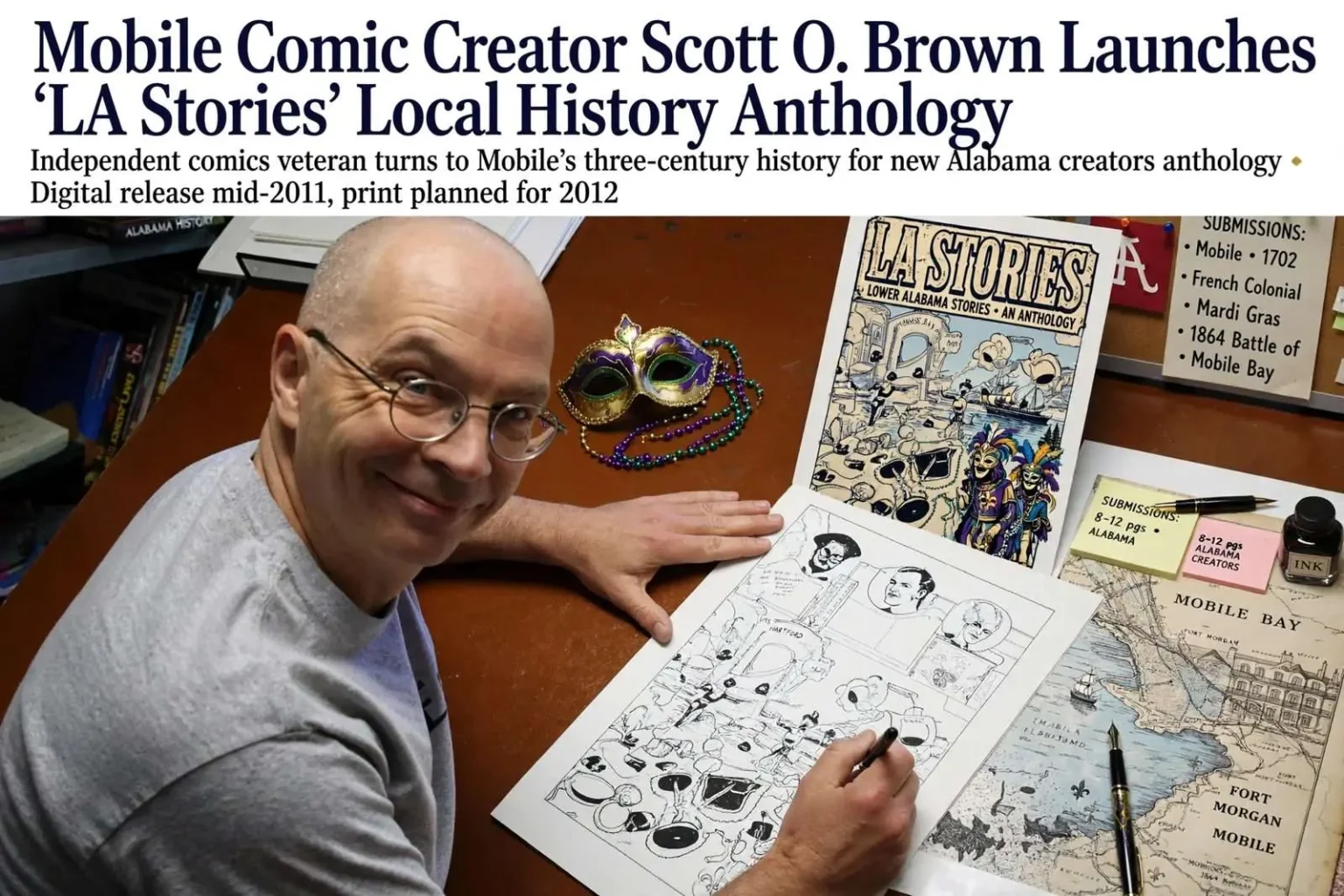
Mobile native Scott O. Brown, a comics industry veteran with more than a decade of experience as a writer, letterer, publisher, editor and production manager, is turning his hometown’s rich history into an anthology comic book series called “LA Stories” — short for Lower Alabama Stories.
The project aims to bring Mobile and Alabama’s local lore and history to life through serialized, character-driven comics, drawing on writers and artists from across the state. The anthology format — a rotating collection of short pieces bound under one title — gives Brown a flexible canvas for the region’s stories, allowing each installment to range across centuries and neighborhoods while building a shared identity as a showcase for Alabama creators.
Brown, whose independent work has earned honors including the IP Award for independent publishing and a Harvey nomination, said the anthology will mine everything from Mardi Gras to the Battle of Mobile Bay, weaving historical events with a uniquely Southern voice.
A Deep Well of Material
The choice of subject matter is no accident. Mobile’s history stretches back more than three centuries, from its founding as the colonial capital of French Louisiana through Spanish and British rule, into statehood, the Civil War, and the boom years of the port. The city claims the oldest Carnival celebration in the United States — its Mardi Gras traditions predate those of New Orleans, carried from colonial Mobile to the younger upriver city — and its societies, parades, and mystic organizations have accumulated two centuries of pageantry and legend.
The Battle of Mobile Bay, meanwhile, stands among the most storied naval engagements in American history, when Adm. David Farragut’s fleet ran past the harbor defenses in 1864 and sealed the last major Gulf port open to the Confederacy. Between those bookends lies a landscape of stories: steamboat packets on the rivers, the shipyards and lumber camps of the pine belt, moonshine runs through the piney woods, and the small-town characters whose lives rarely make it into textbooks but define how a region remembers itself.
For comics, that history is largely untapped. National publishers have mined the Civil War, the Wild West, and the big-city twentieth century, but the Gulf Coast’s particular blend of French colonial roots, river culture, and Gulf Coast port life has rarely reached the page. Brown’s project aims to claim that ground for the people who know it best — Alabama writers and artists telling Alabama stories.
A Call for Local Talent
Brown is currently accepting story and art submissions for the series. Writers and artists must live in Alabama or have ties to the state, though out-of-state creators will be paired with an Alabama collaborator. Pitched stories should run between eight and 12 comic pages and must be either literary or historical with a strong sense of place.
The eight-to-12-page format is the classic anthology unit — long enough for a complete story with a beginning, middle, and end, short enough that a creator can produce one without committing a year of their life. The “strong sense of place” requirement sets the anthology’s editorial compass: this is not a generic fantasy or superhero showcase, but a collection deliberately rooted in the landscapes, cities, and communities of the state. A reader should be able to tell from the page that the story could only come from Lower Alabama.
The pairing rule for out-of-state creators shows how the project balances openness with its mission. Talented writers and artists with Alabama roots who have moved away can still contribute, but only in collaboration with a creator currently in the state — keeping the anthology’s center of gravity firmly local and building working relationships among Alabama creators in the process.
Selected pieces are expected to appear online starting mid-2011, with a print edition planned for 2012. The staggered release lets the anthology build an audience piece by piece, with digital installments generating momentum before the collected print edition arrives. For contributors, online publication provides immediate exposure, while the print volume gives the work a lasting artifact — the kind of collection that ends up on shelves in local bookstores and in the hands of readers discovering the state’s comics scene for the first time.
Creators retain the rights to their stories and will be asked to sign an agreement covering print, online and future publishing opportunities. Rights retention is a significant draw for contributors. In an industry where work-for-hire deals routinely strip creators of ownership, an anthology that lets writers and artists keep their characters and stories while granting the project defined publishing rights lowers the barrier for participation — particularly for creators who hope to develop their anthology pieces into longer works later.
Questions and submissions may be sent to Scott O. Brown at [email protected].
The Veteran Behind the Project
Brown’s resume gives the project its professional backbone. More than a decade spent as a writer, letterer, publisher, editor and production manager means he has held nearly every job in the comics production chain, and the anthology’s contributors will work with an editor who understands both the creative and business sides of the medium. Lettering and production experience, in particular, translate directly into clean, professional-looking pages — the difference between a comic that reads as amateur and one that competes on the shelf.
The recognition his independent work has earned — the IP Award for independent publishing and a nomination for a Harvey Award, one of the comics industry’s oldest peer honors — signals that the project has a curator with credibility. Anthologies live or die on trust: contributors commit unpaid or low-paid work on the promise of professional treatment and real readership, and an editor with a track record makes that promise believable.
Brown’s own connection to Mobile runs through the project’s premise. A native of the city who built a career in comics elsewhere in subject and geography, he is bringing both home — applying an industry-honed skill set to the stories of the place that formed him. The pattern is a familiar one in regional publishing: a creator establishes themselves nationally, then turns their attention to the material only they can tell.
Alabama’s Growing Comics Scene
The anthology arrives at a moment of quiet growth for comics in the South. Independent comics conventions, small-press publishers, and local creator groups have multiplied across the region over the past decade, and Alabama has shared in that development through its shops, conventions, and scattered collectives. What the state has lacked is a flagship publication devoted specifically to its own history and folklore — a gap “LA Stories” is designed to fill.
If the project succeeds on its own terms, its impact could reach beyond the comics page. Regional history told through visual storytelling reaches readers — particularly younger ones — that traditional histories often miss, and a successful anthology could seed school visits, gallery shows, and future volumes. Other states have seen regional anthologies become ongoing institutions, and the depth of Mobile’s story material gives this one room to run for years.
For now, the call is open to Alabama writers and artists with eight to 12 pages of literary or historical work and a story only they can tell. The first installments are expected online in mid-2011, and the state’s creators have the chance to be part of the first wave of what Brown hopes will become a standing showcase for Lower Alabama’s stories.
The anthology’s subject range rewards that openness. Mardi Gras alone offers creators centuries of material — the colonial roots of the celebration, the rise of the mystic societies, the secret rituals of parade flinggers and court balls — while the military history of the coast, from colonial skirmishes to the Civil War’s naval drama, offers another vein entirely. Between the epic material sit the smaller stories that anthologies do best: a family’s generation-spanning tale on a Mobile street, a ghost story from a river town, a slice-of-life piece set in a hometown diner.
Character-driven is the operative phrase in the project’s description. Rather than treating history as a sequence of dates and battles, the anthology asks creators to find the people inside it — the soldier, the longshoreman, the Carnival queen, the child watching a parade for the first time. That approach aligns with where comics as a medium have moved over the past generation, as memoir, historical fiction, and literary graphic novels have won readers far beyond the traditional fan base.
What Submissions Should Know
For interested creators, the entry requirements are straightforward. Stories must run eight to 12 pages, must be literary or historical, must carry a strong sense of place, and must come from creators living in Alabama or with state ties — with out-of-state creators matched to an Alabama collaborator. Rights stay with the creators, subject to an agreement covering print, online, and future publishing. Submissions and questions go to [email protected].
The publication plan — digital first in mid-2011, print collection in 2012 — mirrors strategies that independent publishers across the industry have adopted successfully. Releasing stories online builds an audience incrementally and lets contributors share published work quickly, while the print edition consolidates the run into a collectible volume. For a regional anthology, the print book also serves as a calling card: something the project can place in local shops, libraries, and conventions to announce that Alabama’s stories have a home in comics.
Whether “LA Stories” becomes a one-time showcase or the start of an ongoing Alabama comics institution will depend on the response to this first call. But the pieces are in place: an experienced editor with industry honors, a publishing plan that respects both creators and readers, rights terms that invite participation, and a state full of history that comics have barely touched. Lower Alabama’s stories now have an open door — and an invitation to walk through it.