Senior Bowl Reached Deal to Remain in Mobile for 2010
Mobile and Senior Bowl officials reached a 2009 agreement to keep the 2010 game at Ladd-Peebles Stadium while negotiations continued on a longer contract.
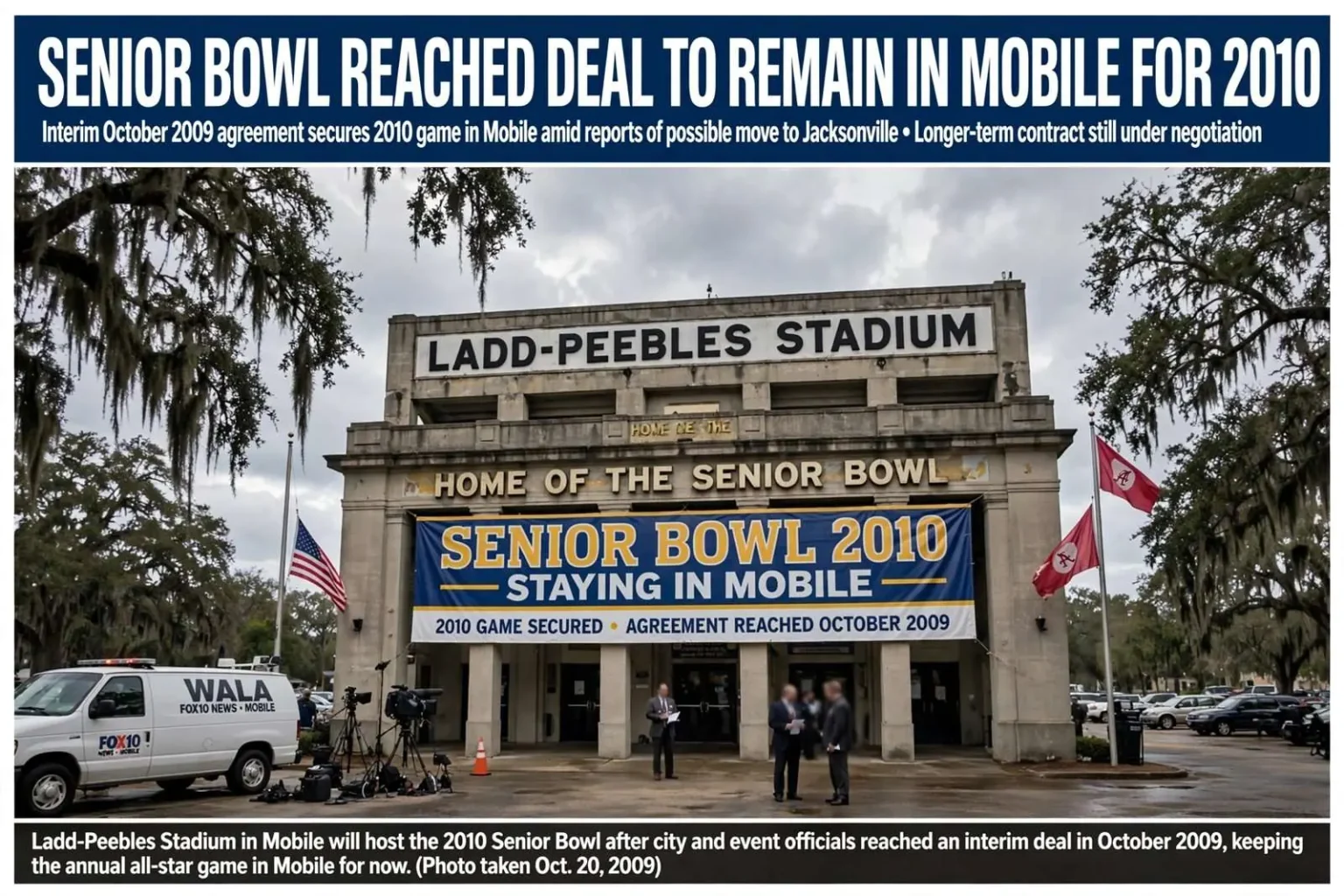
Senior Bowl officials and Mobile’s stadium and sports leaders reached an agreement in October 2009 to play the 2010 game in Mobile, ending immediate concern that the longtime all-star event could leave the city.
The agreement was reached by lawyers and board leaders for Ladd-Peebles Stadium and the Mobile Arts and Sports Association. Negotiations continued toward a longer-term contract, with the 2009 agreement keeping the next game in Mobile while the parties worked on the event’s future beyond 2010.
News reports had raised the prospect of a move to Jacksonville, Florida, which gave the October agreement its urgency for a city that had hosted the all-star game for generations.
The dispute behind the agreement
The October 2009 agreement settled an immediate question but not the underlying one. The Senior Bowl — the postseason all-star game that brings the nation’s top college seniors to Mobile for a week of practices, scouting and one nationally watched game — had been the subject of news reports raising the possibility that it could relocate to Jacksonville, Florida. For Mobile, the reports landed on an event the city regarded as one of its signature sporting possessions.
The parties at the table were the institutions that made the event possible: Ladd-Peebles Stadium, the historic venue that hosts the game, and the Mobile Arts and Sports Association, the organization that stages it. When disagreements between the stadium and the event’s organizers surface, the game’s location becomes a negotiating question — and when a competing city’s name enters the news, the stakes of those negotiations rise sharply.
The agreement reached in October 2009 was an interim one, brokered and documented by lawyers and board leadership on both sides. It committed the 2010 game to Mobile while both parties continued negotiating a longer-term contract that would define the event’s future beyond that season. That structure — securing the next game, then working on the future — allowed both institutions to plan for the immediate season while the larger questions remained open at the negotiating table.
Why the Senior Bowl matters to Mobile
The stakes were about more than one football game. The Senior Bowl is a weeklong economic and civic event: practices attended by fans and scouts, community appearances by the players and coaches, and a game that draws visitors from across the region into Mobile’s hotels, restaurants and businesses. The event’s standing as the premier postseason all-star game for college seniors gives it a national audience and a professional significance — NFL teams send their staffs to evaluate draft prospects in person.
Mayor Sam Jones called the Senior Bowl a valued local sporting event and said city leaders would continue working to retain it. The mayor’s statement reflected the city’s view of the game as an asset worth active effort: an annual tradition with decades of history in Mobile, a recognizable national brand tied to the city’s name, and a week of activity that reaches beyond the stadium into the local economy.
Ladd-Peebles Stadium itself is part of that story. The venue has hosted generations of Mobile football, from high school championships to the Senior Bowl, and its identity is bound to the events that fill it. A Senior Bowl departure would have left a void in the stadium’s calendar and in the city’s self-image as a host city for major football events.
The 2009 episode also illustrated the event’s position in the broader landscape of college football’s postseason. All-star games compete for relevance as the sport’s calendar evolves, and cities compete for the events that anchor their sporting calendars. Mobile’s position — hosting a game with a national scouting audience — was worth defending, and the October agreement was the city’s defense of it.
Jacksonville’s pursuit
The reports that had raised the prospect of a move to Jacksonville, Florida, were the immediate context for the October 2009 agreement. Jacksonville had emerged in news coverage as a potential destination for the event, and the possibility that Mobile could lose a game it had hosted for generations became a public concern rather than a private negotiating point.
Competing cities’ interest in the Senior Bowl was not idle speculation. All-star games are mobile assets, and the prospect of attracting one carries the same civic logic that drives any city’s pursuit of a sporting event: visitors, publicity and a place in the national football calendar. For Jacksonville, a city with its own football identity and venue infrastructure, the reports showed the interest was real enough to matter.
The public nature of the reports changed the dynamics of the local negotiations. Once the possibility of a move was in the news, the parties in Mobile were negotiating under public scrutiny, with the community watching whether its institutions could resolve their differences well enough to keep the event. The October agreement — committing the 2010 game to Mobile — answered the immediate question and bought the negotiations time.
How the event is organized
Understanding the 2009 dispute requires understanding the structure of the event itself. The Mobile Arts and Sports Association is the organization behind the Senior Bowl, responsible for the week’s operations: assembling the rosters of top college seniors, arranging coaching staffs, hosting the NFL scouting contingent and staging the game. Ladd-Peebles Stadium is the venue, providing the facility where the game and its surrounding activities take place.
Events of this kind depend on the alignment of those two parties — the organizer and the venue. When their interests diverge over the terms of their relationship, the event’s location becomes negotiable in a way it otherwise never would be. The 2009 negotiations were about that relationship: the contract between the organization that runs the game and the stadium that hosts it.
The use of lawyers and board leaders to reach the October agreement reflected the seriousness of the moment. Board-level engagement on both sides, with legal counsel documenting the interim commitment, is the machinery of a dispute that has outgrown routine management — and its product, the 2010 commitment, was the assurance the city needed while the longer-term work continued.
The mayor’s position
Mayor Sam Jones’s public statement placed the city squarely behind the effort to retain the event. Calling the Senior Bowl a valued local sporting event, Jones said city leaders would continue working to retain it — language that committed the city’s attention to the negotiations without inserting the city as a formal party to the contract discussions between the association and the stadium.
That positioning is typical of municipal involvement in disputes between private or nonprofit institutions. The city’s leverage lies in its standing and its relationships rather than in the contract itself, and a mayor’s public commitment to retention signals to both parties that the community is watching and that losing the event would carry civic consequences.
For Mobile’s residents, the mayor’s statement matched their own view of the game. The Senior Bowl has been part of the city’s January rhythm for generations, and its week of activities — practices open to fans, the players’ community involvement and the game itself — is a fixture of local life as much as an economic event.
What the record shows
This account records the interim 2010 agreement and the ongoing negotiations as reported in October 2009. It does not state the subsequent contract terms or the event’s location after that season — questions that were, at the time of the reporting, still open and being negotiated between the parties.
What the October 2009 agreement established is clear: the 2010 Senior Bowl would be played in Mobile, the immediate prospect of a departure was set aside, and the institutions behind the game continued working toward the longer-term arrangement that would govern its future. The episode stands as a moment when Mobile’s commitment to the event was tested publicly and answered with an agreement that kept the game where the city believed it belonged.
The game’s place in Mobile’s history
The Senior Bowl’s roots in Mobile run deep. The game has been part of the city’s sporting life since the mid-twentieth century, growing from a regional showcase into the premier postseason all-star event for college seniors and a fixture of the NFL draft calendar. Each January, the nation’s top senior prospects arrive for a week of practice that is as important to their professional futures as the game itself, with NFL teams sending coaches, scouts and executives to evaluate them in person.
That professional dimension is what distinguishes the Senior Bowl from other postseason exhibitions. Practices are attended as closely as the game, coaching staffs drawn from NFL teams work the players all week, and the evaluations formed in Mobile influence draft boards across the league. For the players, the week is a direct audition for their professional careers; for the city, it means hosting the people whose decisions shape the sport.
The event’s longevity in Mobile has made it part of the city’s identity. Generations of Mobile residents have attended games at Ladd-Peebles Stadium, and the event’s name carries the city’s football reputation into national sports coverage every year. An event with that history is treated locally as something close to a civic institution — which is why the possibility of its departure, reported in the news in 2009, produced the response it did.
The economics of a hometown event
The Senior Bowl’s week in Mobile extends beyond the stadium. Visitors filling hotels, restaurants and shops; players and coaches staying in the city; the national media presence that follows the event — all of it represents economic activity concentrated in a single week each year. Cities that host recurring sporting events treat them as annual economic assets, and Mobile’s leadership has historically counted the Senior Bowl among the events worth protecting.
The event also carries intangible value in promotion. A nationally covered football game played in Mobile keeps the city’s name in front of audiences far beyond the region, reinforcing the branding that cities cultivate through sports, tourism and cultural events. For a city of Mobile’s size, an event with the Senior Bowl’s national profile is a promotional asset that advertising dollars could not easily replicate.
Those considerations framed the city’s response to the 2009 reports. Mayor Jones’s statement — a valued local sporting event, and a commitment that city leaders would continue working to retain it — reflected the full range of what the game represents: tradition, economy, identity and the practical value of being the city where the sport’s future players are evaluated.
Negotiating under pressure
The structure of the 2009 resolution — an interim agreement securing the 2010 game while longer-term talks continued — is a common instrument when institutions renegotiate a relationship under time pressure. It gave both the Mobile Arts and Sports Association and Ladd-Peebles Stadium certainty for one season, avoided a rupture that could have sent the event elsewhere, and left the difficult questions to a negotiation conducted without a deadline hanging over it.
Interim agreements of that kind also serve the community’s interest. Fans, sponsors, hotels and the NFL teams that attend the event all needed to know where the 2010 game would be played, and the October agreement provided that answer months in advance. The alternative — a negotiation that dragged into the season without resolution — would have created uncertainty for every participant in the event’s orbit.
The episode’s outcome, as reported, was that the game stayed for 2010 and the parties kept talking. For a city that had watched news reports entertain the possibility of losing its all-star game to another state, the agreement marked the difference between concern and crisis — and the continued negotiations represented the work of turning a one-year commitment into something durable.