Historical report preserved from an archived 2008 local news story.
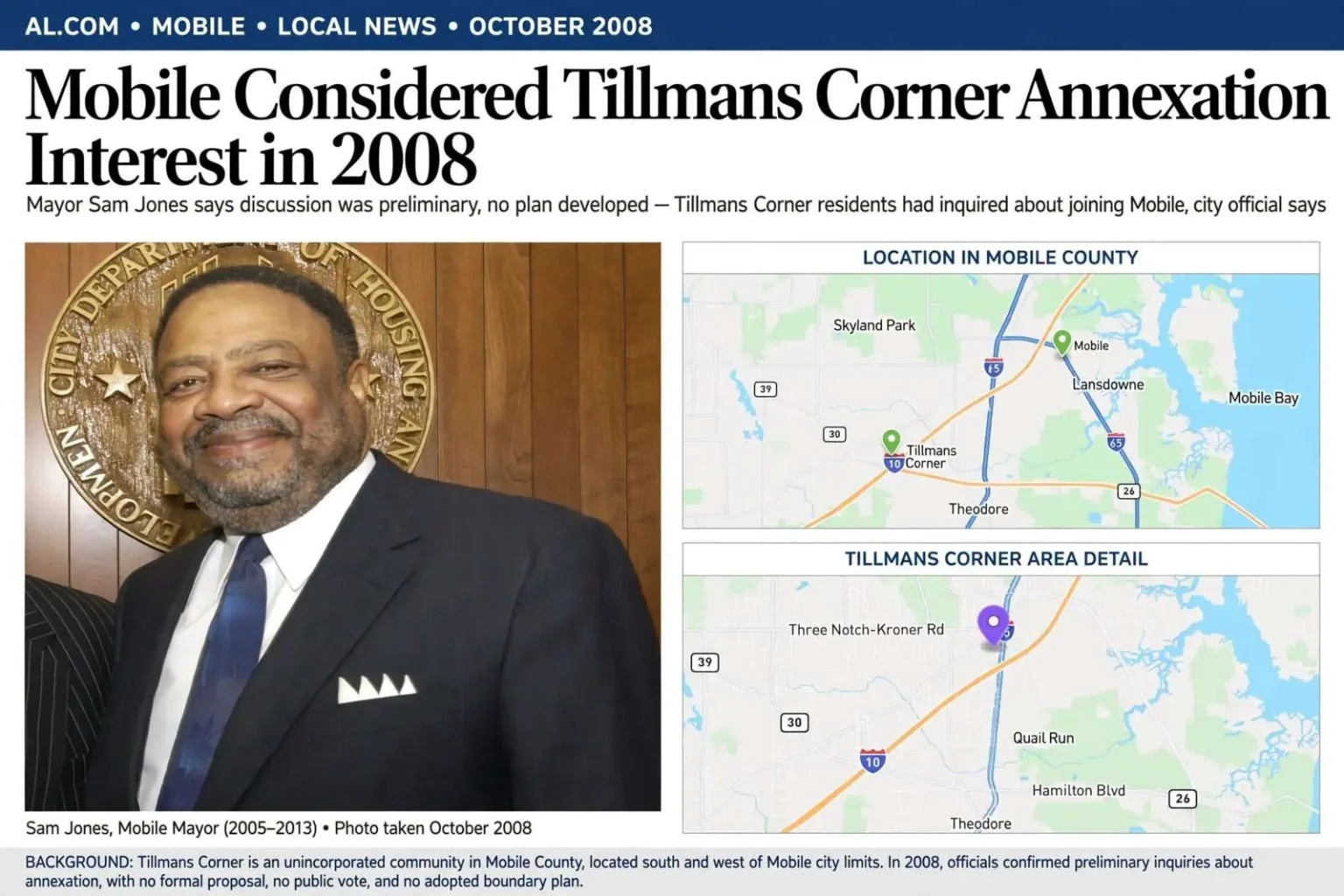
Mobile Mayor Sam Jones said in a 2008 local news report that the city and some Tillmans Corner residents had expressed interest in possible annexation, but he emphasized at the time that no definite plan had been developed. The remarks, preserved here from the archived story, captured a preliminary conversation rather than an adopted proposal, and no annexation of the Tillmans Corner area followed from the discussion described in that report.
According to the archived account, Jones explained that the city typically did not initiate annexation discussions by approaching communities directly. Instead, he said, communities generally contacted city officials to ask about the process themselves. That distinction matters in Alabama municipal law, where annexation most often begins at the request of property owners or residents rather than by unilateral action of a city council. Jones noted that three or four communities in Mobile County had asked about becoming part of the city, placing Tillmans Corner among the areas where residents had at least inquired about what joining Mobile would involve.
The 2008 report presented the Tillmans Corner discussion as preliminary and did not describe an adopted annexation proposal, a public vote, or a boundary plan. It recorded interest, conversations, and the mayor’s characterization of how the process normally begins, and nothing more. This article preserves that historical record and is not a statement about current boundaries, annexation policy, or any present-day proposal involving Tillmans Corner or the city of Mobile.
Tillmans Corner: the community behind the discussion
Tillmans Corner is one of the largest unincorporated communities in Mobile County, sitting south of the city limits along U.S. 90 and near the intersections that connect west Mobile to Theodore and the I-10 corridor. For decades it has functioned as an urbanized area without its own municipal government, with residents relying on Mobile County for sheriff’s patrols, county services, and planning, while shopping, schools, and churches tie the community tightly to the rest of the metropolitan area. Commercial strips along the major highways, established residential subdivisions, and longstanding local institutions give the area a strong identity despite never having incorporated as a city.
That in-between status is precisely what makes annexation a recurring topic in the community’s history. Unincorporated urban areas in Mobile County have, at various times over the years, weighed the trade-offs between joining an existing municipality and remaining unincorporated. Annexation into Mobile would bring city police service through the Mobile Police Department, city planning and zoning, municipal court, and access to city-run services, along with city property tax rates. Remaining unincorporated keeps county tax rates in place but leaves residents dependent on county-level services and on decisions made by the county commission rather than a city council.
The fact that residents themselves initiated the inquiries, as Jones described, fits the community’s situation. When questions about fire protection response times, street maintenance, drainage, and law enforcement coverage arise in an unincorporated area, residents often reach out to nearby cities to learn what annexation would change, even when no organized petition ever follows. Interest of that kind can simmer for years without producing a formal effort.
How annexation works in Alabama
Alabama law provides several routes by which territory joins a municipality, and all of them begin with the people in the affected area rather than with the city itself. The most common method is petition-based annexation, in which a majority of the freeholders, the property owners, in the territory to be annexed sign a petition requesting inclusion, which is then acted on by the municipality’s governing body. Another route is annexation by election, in which registered voters in the territory petition for a referendum and the question goes to a vote of the residents who would be affected. In both cases, the impetus comes from within the community seeking to join.
Cities cannot simply draw their boundaries outward on their own initiative under the general annexation statutes, which is why Mayor Jones’ point about communities initiating contact reflects how the process genuinely operates. A city can express willingness and describe what services and taxes would apply, but the legal mechanics require action by the property owners or voters in the territory. This arrangement is intended to prevent municipalities from forcibly absorbing areas whose residents do not want to be included, and it shapes the way annexation conversations unfold across the state, in Mobile County and beyond.
Annexation discussions also have practical fiscal dimensions. For a city, adding developed urban territory brings in additional property tax and sales tax revenue but also adds obligations: police beats, street maintenance, drainage, planning staff, and municipal services must extend to the new area. For residents, the calculation involves comparing county tax bills to city tax bills and weighing what additional services they would receive in return. Those trade-offs are usually the heart of any annexation debate, and they explain why inquiries so often stall at the exploratory stage, as the 2008 report indicated the Tillmans Corner conversation had.
The context of 2008
Sam Jones served as mayor of Mobile during a period when the city was evaluating its growth and service delivery, and the archived 2008 report reflects the routine questions that arise in any growing metropolitan area about where municipal boundaries should lie. Mobile had annexed various parcels over the decades, and unincorporated urbanized areas such as Tillmans Corner sat directly against the city limits, creating natural questions about whether and when such communities might join. Jones’ answer, as preserved, was careful: there was interest on both sides, but no definite plan had been developed, and the city’s practice was to respond to communities rather than pursue them.
The report’s framing of three or four Mobile County communities asking about joining the city suggests that the interest was not unique to Tillmans Corner. Unincorporated communities around any growing county seat periodically evaluate their status, and in a county the size of Mobile, with large unincorporated population centers spread from Citronelle to Grand Bay and from Saraland’s edges to the Bayou La Batre area, such inquiries are a recurring feature of local government rather than an extraordinary event.
Nothing in the archived account indicates that the 2008 discussion advanced beyond interest and questions. No petition drive, referendum, or council action was described, and the story itself emphasized the preliminary nature of the conversation. That is a common trajectory: communities ask about the process, officials explain it, and the matter rests until residents decide whether the trade-offs justify a formal effort.
Why the record is preserved
Historical reports like this one are kept because questions about boundaries and annexation resurface repeatedly, and readers encountering mentions of past discussions deserve the original context. The 2008 story has been cited in later conversations about growth and services in south Mobile County, and preserving its exact contents prevents the gradual drift that can occur when an exploratory remark is remembered years later as a formal plan. The record here is simple: a mayor describing standard practice, residents expressing interest, and no proposal ever adopted.
For current readers, the article should be understood strictly as history. It records what was said in 2008 about a preliminary discussion. It makes no claim about the present boundaries of the city of Mobile, about the current status of Tillmans Corner, or about any annexation policy or proposal that may exist today. Residents with questions about the city’s current limits or about how annexation would work for their property should consult current municipal and county officials rather than this archived report.
Annexation and daily life in unincorporated Mobile County
The issues that drove the 2008 inquiries are the same ones that shape life in unincorporated communities generally. Law enforcement coverage in unincorporated Mobile County is provided by the Mobile County Sheriff’s Office rather than a municipal police department, and response patterns differ from those of city police beats. Planning and zoning decisions rest with the county rather than a city planning commission, which affects what can be built along commercial corridors. Street lighting, drainage projects, and road maintenance are handled through county departments and commission districts rather than city public works. Each of these differences comes with its own cost, reflected in the tax rates paid by residents of unincorporated areas, which are generally lower than those paid inside city limits.
When residents of an area like Tillmans Corner ask about annexation, the questions they bring are concrete: Would police response improve? Would city crews maintain streets and drainage that the county handles now? How much would the property tax bill change? What would happen to fire service contracts? Officials answering those questions, as Jones did in 2008, typically stick to describing the process and the general terms rather than promising specific outcomes, because no commitment exists until a formal annexation is adopted by law.
The town-hall character of these discussions is a familiar feature of local government. Communities that inquire about annexation often do so after a specific concern, such as a development dispute or a service shortfall, brings the question to the surface. When the concern fades or the trade-offs look less attractive on close inspection, the interest subsides, which is consistent with the preliminary picture the archived report painted.
The larger pattern in south Alabama
Mobile County’s municipal map has been shaped by waves of incorporation and annexation over more than a century. Cities such as Prichard, Saraland, Satsuma, Chickasaw, Creola, and Bayou La Batre each incorporated at particular moments when residents of unincorporated areas decided they wanted their own governments, and the boundaries of the city of Mobile itself have expanded over the decades through annexations of developed suburban territory. Tillmans Corner remains among the largest unincorporated urbanized communities in the county, which is why its status surfaces periodically in local discussions of growth, services, and representation.
The 2008 conversation preserved here fits squarely within that long pattern: an unincorporated urban community, a city with an established annexation process, residents asking questions, and an administration describing how those questions get answered. What the record does not contain is equally important: no adopted plan, no petition drive described, no vote. Preserving that distinction is the purpose of this archived report, and it is the standard against which any future discussion of Tillmans Corner and annexation should be measured.