Senior Bowl’s Mobile Future Was Uncertain During 2009 Talks
In March 2009, Senior Bowl leaders said the event had not entered exclusive talks with Tampa but was considering interest from other cities as Mobile's contract expired.
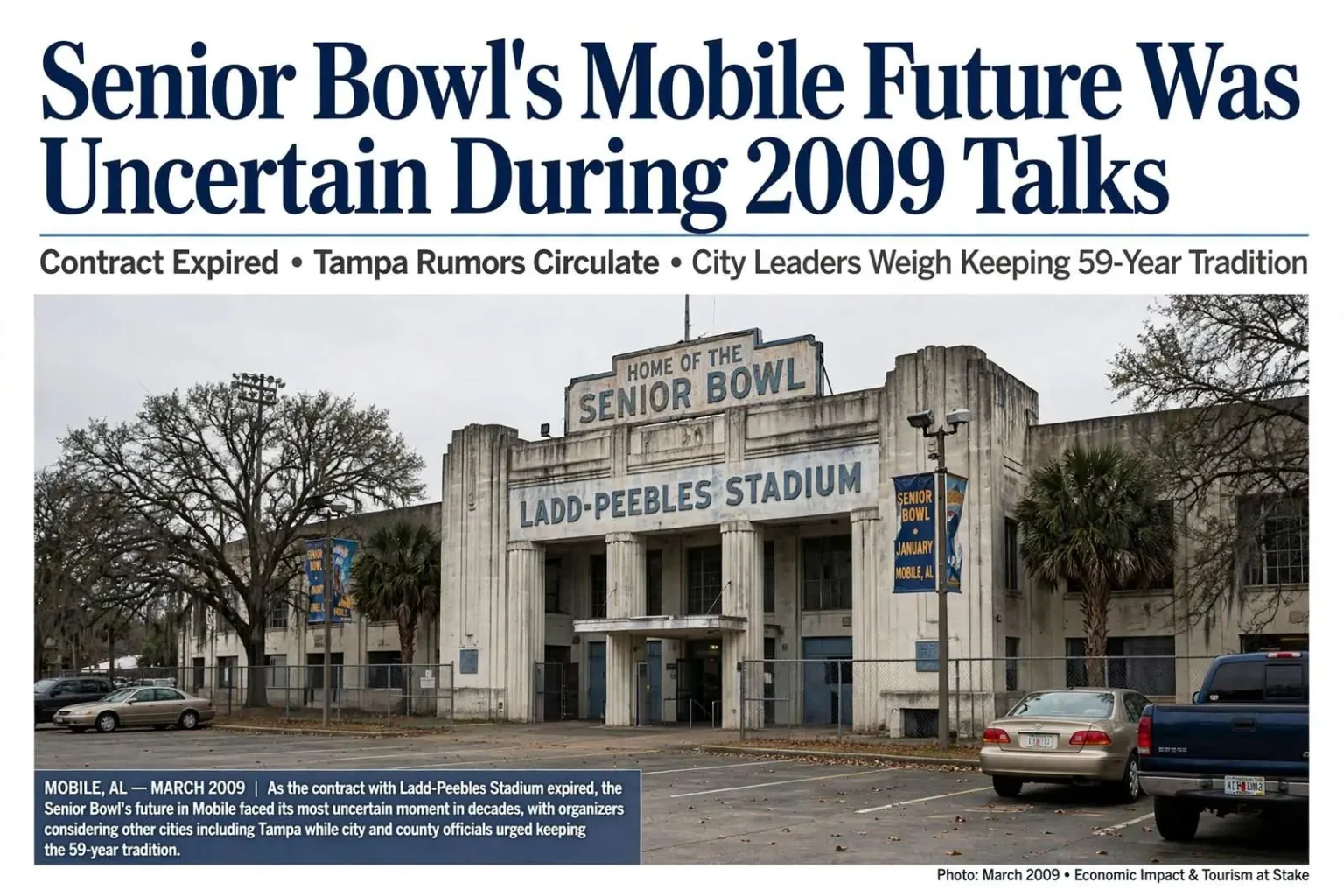
In March 2009, the future of the Senior Bowl in Mobile was genuinely uncertain. The event’s contract with Ladd-Peebles Stadium had expired, and the game’s leaders — weighing outside interest from other cities — were considering their options. For an event that had been played in Mobile for 59 of its first 60 years, the expiration of that contract turned an annual winter tradition into an open question, and the discussions that followed became one of the most consequential local sports and tourism stories of the era.
The Senior Bowl is the country’s premier postseason college all-star game, a gathering of the nation’s top senior NFL draft prospects that draws coaches, scouts and executives from every professional franchise to Mobile each January. That week of practices and interviews has enormous value to the host city: hotels fill with team personnel and media, restaurants and businesses see a midwinter boost, and the game itself puts Mobile on national television during a dead period in the sports calendar. Any suggestion that the event might leave was, therefore, not a matter of interest only to football fans — it was an economic issue for the entire city.
Tampa Rumors, Denied
Reports had circulated that the Senior Bowl had entered exclusive negotiations with Tampa, a city with a deep football infrastructure and a history of hosting major events. Senior Bowl president Steve Hale addressed those reports directly, saying they were inaccurate. He acknowledged, however, the reality behind the speculation: without a current contract in Mobile, organizers were considering their options and gauging interest from other cities. The distinction mattered. The game’s leadership was not announcing a departure, but it was not committing to staying either — it was preserving leverage and exploring the market at a moment when its future home was formally unsecured.
The situation placed pressure on Mobile’s leadership to make the case for keeping the game. Mayor Sam Jones said the Senior Bowl was a valued sporting event for Mobile and a contributor to the local tourism economy. His administration understood what was at stake beyond the game itself: the Senior Bowl week functioned as a national showcase for the city, an annual demonstration that Mobile could host events that draw nationwide attention. In a city that had invested in its downtown and its waterfront during those years, the game’s brand aligned with the city’s ambitions.
A Mobile County commissioner similarly described the game as a significant community partner, one that brought hotel stays and commerce to the area. County government had a direct interest both as a steward of Ladd-Peebles Stadium, the longtime home of the game, and as a beneficiary of the visitor spending the event generated. The commissioner’s comments reflected a broader local consensus — from City Hall to the county courthouse to the business community — that losing the Senior Bowl would be more than a sporting loss; it would be a blow to the region’s tourism economy and its self-image.
Five Nine Years of History at Ladd-Peebles
The game’s roots in Mobile ran deep by 2009. The Senior Bowl had been played in Mobile for 59 of its first 60 years, a continuity matched by few events anywhere in American sports. The one exception underscored the point about fragility: the game had been played elsewhere once before, a reminder to local leaders that traditions survive only as long as both sides keep their end of the bargain. Ladd-Peebles Stadium, the aging facility in the heart of the city, had been the game’s home for decades, and the state of that stadium was widely understood to be part of the conversation — facilities, amenities and the fan experience were the currency with which host cities competed for events like this one.
What happened during the March 2009 negotiations recorded the positions of each side at a pivotal moment: the game’s leaders openly evaluating alternatives, the mayor defending the event’s value, the county acknowledging its significance. The record of that month does not state a final agreement; later reports in this archive document the subsequent decisions that determined where the Senior Bowl would be played in the years that followed. What the 2009 episode makes clear is that Mobile’s grip on the game was never guaranteed — it was renegotiated, contested and, ultimately, renewed by choices made by the city, the county and the game’s leadership.
The stakes in the 2009 talks become clearer when the Senior Bowl’s role in the football economy is understood. Each January, the game brings together the best senior players in college football for a week of practices attended by hundreds of NFL coaches, scouts, general managers and medical staff — every franchise sends personnel, because the practice week offers the last extended look at draft prospects before the combine and the draft. Mobile becomes, for that week, the center of the professional football world. The coverage extends from national sports networks to draft publications, and the city’s name is spoken constantly in the months leading up to the NFL draft.
That visibility is why cities like Tampa — with modern stadiums, large hotel inventories and established event-hosting machinery — represent a credible threat. A host city that could offer better facilities and a bigger media market would always have an argument. Mobile’s counterargument was history and identity: the game had grown up at Ladd-Peebles Stadium, generations of fans had attended, and the event’s connection to the city was part of its brand as much as its roster was part of its appeal. The tension between those two arguments — modern amenities versus tradition — runs through virtually every negotiation over the location of a storied sporting event, and the March 2009 talks were a textbook instance.
How Cities Compete for Events
The mechanics of such negotiations are fairly standard. A bowl game’s organizers sign a stadium use agreement with a host venue, covering dates, rents, revenues and facility standards. When that agreement lapses, the organizers gain immediate leverage: they can talk to other cities without breaking a contract, and they can use the outside interest to extract better terms at home. City and county governments, for their part, must decide what a prospective loss would actually cost them — in direct visitor spending, in taxes, in the harder-to-measure value of national exposure — and how much they are willing to commit to prevent it.
In Mobile’s case, the parties on the local side were clear. Mayor Sam Jones spoke for the city, affirming the event’s value to tourism. The Mobile County Commission, which held authority over Ladd-Peebles Stadium, viewed the game as a community partner that delivered hotel stays and commerce. Steve Hale, speaking for the Senior Bowl, kept the game’s options open while denying any exclusive deal with Tampa. Each position was rational, and together they framed the negotiation that would decide the game’s home for the years that followed.
It is worth remembering what the game means to the region’s players and fans as well. For college players from Alabama, Auburn, South Alabama and across the Southeast, a Mobile-based Senior Bowl means playing a nationally scrutinized game within driving distance of home, in front of fans who have watched them for years. For local fans, it means an annual chance to see the next generation of NFL talent up close at accessible prices. Those community bonds are not line items in a stadium contract, but they are among the reasons Mobile fought to keep the game — and they are why the 2009 uncertainty resonated so widely in the city.
The March 2009 episode also offers a lesson in how history gets recorded. Because the reporting from that month captured positions rather than outcomes — Hale denying exclusive talks while admitting the game was weighing options, Jones and the county affirming the event’s value — the archive of that moment is a snapshot of leverage, not a resolution. Readers encountering the 2009 coverage today should understand it as such: a record of what each party said while the outcome was still undetermined. The final decisions came later, in subsequent reports, and it is those later documents that tell the reader where the Senior Bowl ultimately landed.
What the snapshot does establish is how close the city came, publicly at least, to a genuine negotiating crisis. An expired contract is not a technicality in the events business — it is the legal foundation on which a decade’s worth of planning rests, and both sides knew it. Hale’s careful language, denying exclusivity with Tampa while confirming interest from other cities, was the language of an organization keeping maximum freedom of movement. Jones’s and the commissioner’s public affirmations were the language of a host community making its case in real time, through the press, knowing the game’s leadership was listening.
The Broader Meaning for Mobile
Episodes like this one recur in cities that host signature events. Whether the subject is a bowl game, a fishing rodeo or a festival, the pattern is the same: the event outgrows or outlasts its facilities, other cities circle, and the host must decide how much its tradition is worth. Mobile’s experience in 2009 became part of the community’s understanding of what it takes to keep an event — attention to the condition of the venue, responsiveness to the organizer’s needs, and a willingness by both city and county to treat the event as economic infrastructure rather than as an entitlement.
For the Senior Bowl itself, the 2009 talks marked one chapter in an institutional history that has made the game a fixture of the NFL calendar and a rite of passage for draft prospects. For Mobile, the episode tested the city’s commitment at a moment when its premier sporting tradition was, for the first time in decades, formally unanchored. The positions recorded in March 2009 — and the decisions documented later in this archive — together tell the complete story of how a 59-year relationship between a city and a football game was renegotiated in public, one statement at a time.