Adam Bourne Runs for Chickasaw City Council on Police, Curfews and ‘the Crown Jewel of Mobile County’
A former Alabama assistant attorney general and industrial development board member announced a run for Chickasaw City Council in 2008, promising more police, a teen curfew and code enforcement.
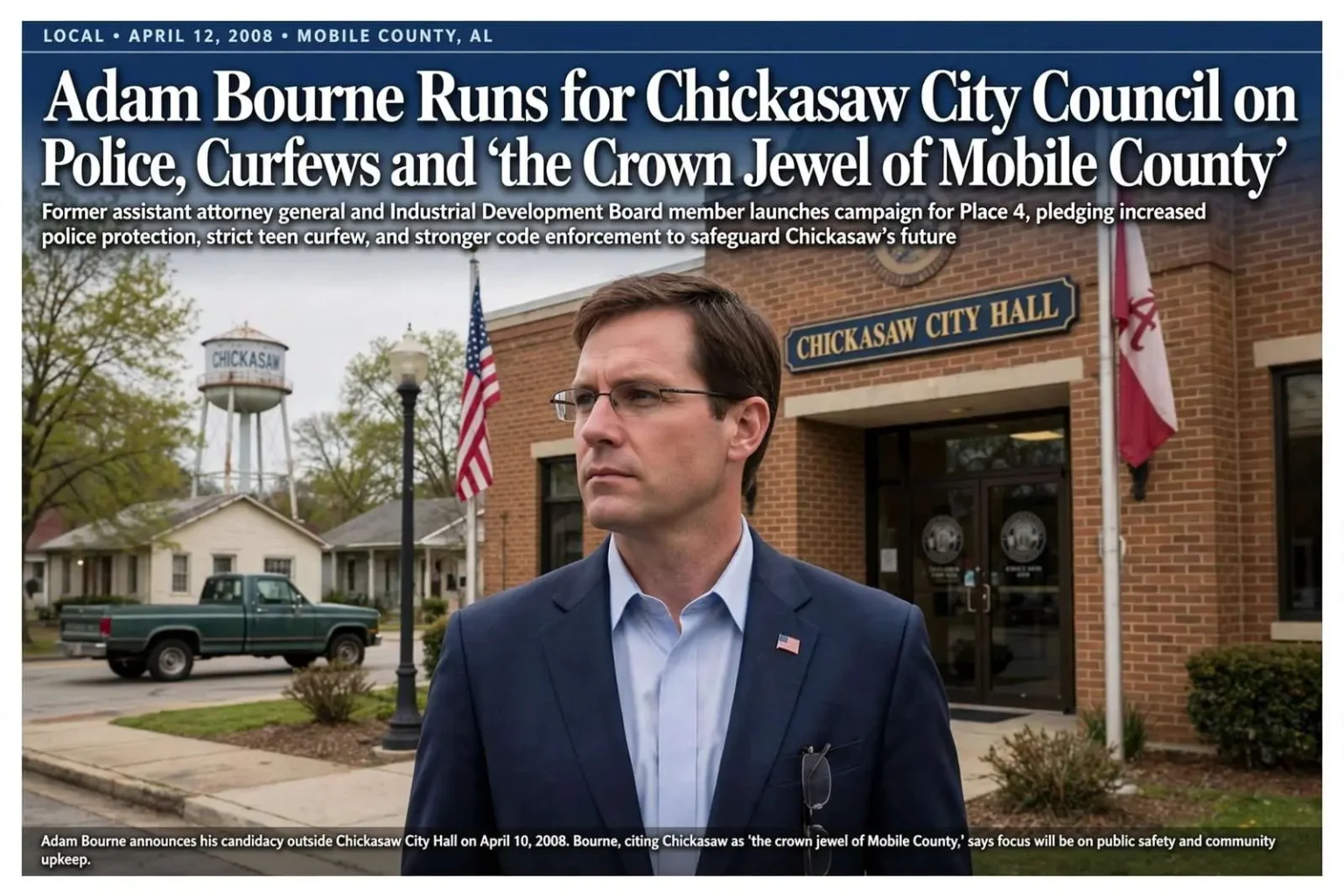
Adam Bourne, a member of the Chickasaw Industrial Development Board and a former Alabama assistant attorney general, announced in April 2008 that he was a candidate for the Chickasaw City Council, Place 4. His platform was short, specific and unmistakably municipal.
Bourne said his campaign would emphasize: an increase in police protection; a strict curfew on teenagers; and enforcement of building and weed ordinances. He added that he would “fight to make sure Chickasaw’s children always have access to outstanding public schools.”
The closing line of his announcement was the one that stuck. “Chickasaw is the crown jewel of Mobile County,” Bourne said, “and I look forward to making our city an even better place to live, work and play.”
For a small-city council race, the announcement carried unusually polished credentials and an unusually confident frame. Bourne was not promising to transform Chickasaw; he was promising to protect, polish and enforce — a platform that treated the city as something already valuable and worth defending.
A Small City With a Large History
The confidence in that phrase is easier to understand with some background. Chickasaw was built as a shipbuilding town. During the First World War the Tennessee Coal, Iron and Railroad Company, a U.S. Steel subsidiary, laid out a planned community north of Mobile to house workers at its shipyard, and the place grew from that industrial purpose.
It incorporated in 1946. By 2008 Chickasaw was a compact city of roughly six thousand people wedged between Mobile, Prichard and Saraland, close enough to the port and the industrial corridor along the Mobile River to feel their economic pull, and small enough that a city council seat is genuinely a neighborhood office.
The company-town origins still show in the city’s fabric. Chickasaw’s grid of modest worker cottages, its early schools and its commercial strip were all built around the rhythms of the shipyard, and generations of families in the city can trace their arrival to a grandparent hired onto the yards. That heritage gives the city an identity larger than its population — a place that was planned, built and inhabited with purpose rather than one that simply accumulated around a highway.
Geography defines the city’s modern circumstances as much as history does. Chickasaw sits along U.S. Highway 43 and the old rail lines north of Mobile, hemmed in by larger neighbors on nearly every side. There is little room to annex outward, a limited commercial tax base along the highway corridor, and a residential tax base of modest means — the classic constraints of a built-out, first-ring suburb in the Mobile area.
Why Weed Ordinances Matter
To a reader outside a small municipality, a platform built on curfews and weed ordinances can look thin. It is not.
Code enforcement, in a city the size of Chickasaw, is one of the few levers a council actually controls. Overgrown lots and derelict structures depress the value of the houses around them, and a neglected property does not merely offend the neighbors, it costs them money. A council member who gets the mowing done and the vacant buildings addressed has delivered something tangible in a way that a distant legislature rarely can.
The same is true of police protection, which in a city of that size is a question of a handful of officers on a handful of shifts, and of a teen curfew, a policy that small Gulf Coast cities have adopted, debated and repealed in cycles for decades.
Curfews occupy a peculiar place in small-city governance. Supporters argue that a nighttime curfew gives police a tool to move young people off corners before trouble starts, and that its mere existence changes behavior without heavy enforcement. Critics — including civil liberties advocates and some parents — counter that curfews criminalize ordinary teenage life and disproportionately fall on young people with nowhere else to go. Cities across the Gulf Coast have lurked between those positions for years, enacting curfews after crime spikes and quietly relaxing them when enforcement proves unworkable. Bourne’s call for a “strict” curfew placed him firmly in the enforcement-first camp, consistent with a platform that leaned heavily on the city’s ordinances as instruments rather than suggestions.
The police-protection plank, meanwhile, speaks to the economics of small-city public safety. Chickasaw in 2008 maintained its own police department, a significant share of any small city’s general fund, and every additional officer or shift had to be weighed against street repairs and garbage service. Candidates who promise “increased police protection” in a city of six thousand are really promising a budget fight, and voters there know it — which is why the pledge carries more weight than it would in a larger city where such promises are cheaper to make.
The Schools Question
Bourne’s line about schools was, in 2008, more loaded than it appears. Chickasaw’s students were then served by the Mobile County Public School System, the largest district in Alabama.
Small cities in the county had periodically weighed breaking away to form their own systems, as Saraland did in 2006 and Satsuma and Chickasaw would both do in the years that followed. Chickasaw established its own city school system in 2011.
The succession wave that swept Mobile County’s northern suburbs began precisely as Bourne was announcing his candidacy. Saraland’s 2006 split — the first successful city breakaway from the county system in decades — showed neighboring communities that separation was legally and financially possible, and within a few years Satsuma and Chickasaw followed. When Chickasaw voters backed their own system and the city established one in 2011, it did so with the same arguments Bourne’s platform echoed in 2008: that local control, local taxes and local accountability would produce better schools for the city’s children.
In that light, a candidate promising in 2008 that Chickasaw’s children would “always have access to outstanding public schools” was speaking into a live and consequential local argument about who should run them — an argument that resolved, three years later, exactly in the direction the platform implied. The council seat Bourne sought in 2008 would be part of the city government that founded and funded the new system.
The Lawyer’s Résumé
Bourne came to the race with credentials unusual for a small-city council candidate: service in the Alabama attorney general’s office and a seat on the body charged with recruiting industry to the city.
Both roles pointed in the same direction. An assistant attorney general’s officeholder understands how state law constrains what a municipality can do — how annexation works, how ordinances must be drafted to survive challenge, how code enforcement has to be documented. An industrial development board member understands the other half of the ledger: that a city’s ability to fund police, curfews and mowing depends entirely on its tax base.
Both suggested a candidate thinking about Chickasaw’s tax base as well as its lawn ordinances, which are, in the end, the same subject approached from opposite directions. Attracting a small manufacturer to the industrial corridor adds revenue that can hire an officer; enforcing the ordinances keeps a neighborhood attractive enough that the revenue stays. Bourne’s platform connected the two halves of small-city survival that candidates more often treat separately.
Small-City Politics, in Full
Place 4 campaigns in Chickasaw are conducted at street level by necessity. There are no television markets to buy, no consultancies to retain and no buses to rent — a candidate knocks on doors, attends the church picnics and school events, and is recognized at the grocery store. That intimacy raises the stakes of every promise, because the voters who hear them will see the officeholder at the ballpark the following week.
It also means the issues that decide small-city races are precisely the ones Bourne named. In a municipality of six thousand, the budget is dominated by police, fire, sanitation and streets, and the disputes that fill council meetings are the overgrown lot next door, the derelict house down the block, the teenagers gathering after dark. A platform that addressed those items directly was a platform written for the way Chickasaw actually works.
The 2008 election cycle arrived at a pivotal moment for the city’s finances and its self-image as well. Prichard’s fiscal troubles to the south had made national news, Saraland’s split from the county school system had redrawn the region’s map of municipal ambition, and the suburbs north of Mobile were all weighing what kind of cities they intended to become. Chickasaw’s council races in that era were, in effect, referendums on that question.
Where It Led
Bourne remained active in Mobile County public life in the years that followed, later serving in the Alabama House of Representatives.
That progression — from municipal board service, to a city council campaign, to the Legislature — is a well-worn path in Alabama politics, and it begins in races exactly like this one. The Place 4 council seat Bourne sought in April 2008 may have covered six thousand people, but it trained the same skills every office requires: reading a budget, answering to neighbors, and turning a platform of specific promises into specific results.
The campaign he announced that April, for a place on a council in a city of six thousand people, was where it started — with police protection, a strict curfew, enforced ordinances, defended schools, and the declaration that Chickasaw was, and would remain, the crown jewel of Mobile County.