University of South Alabama Mobile
Real Estate Economist Don Epley Headlined Sunrise Rotary’s First Program of 2009
With the housing market in free fall and credit frozen, the Sunrise Rotary Club of Mobile opened its 2009 program year by turning to one of its own members: University of South Alabama real estate scholar Don Epley.
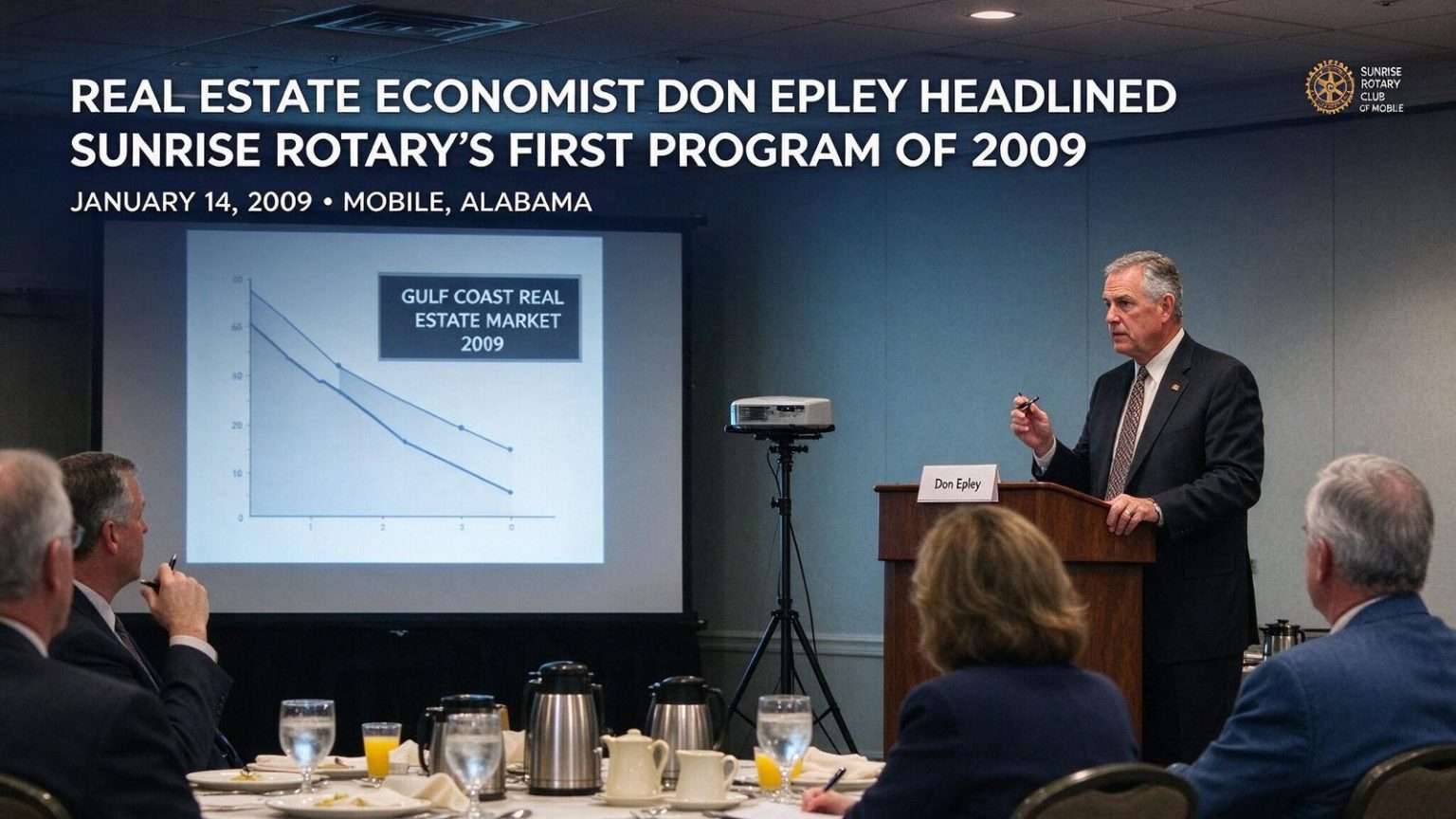
The Sunrise Rotary Club of Mobile opened its 2009 program year on Wednesday, Jan. 14, with a speaker who needed no introduction to the membership. Don Epley, a Distinguished Professor of Real Estate at the University of South Alabama and director of the Center for Real Estate Studies in the Mitchell College of Business, is a member of the club himself, and he took the podium at a moment when almost no subject was more anxiously discussed in Mobile than the state of the property market.
The date of the talk is worth remembering. In January 2009 the national economy was in the grip of the worst downturn since the Great Depression. Credit markets had seized up in the autumn of 2008, homebuilders across the Gulf Coast had stopped breaking ground, and appraisals that had been routine two years earlier had become a source of open dispute between buyers, sellers and lenders.
For a Mobile audience of business owners, bankers, lawyers and educators, an analyst with Epley’s training was precisely the person to explain what the numbers actually showed rather than what fear suggested. A morning Rotary club drawn heavily from downtown professions wanted more than reassurance; it wanted a reading of the data from someone with no stake in the answer.
A national reputation, newly relocated to the Gulf Coast
Epley’s credentials stretched well beyond the region. He holds a doctorate in regional and urban economics from the University of Missouri, along with the MAI designation from the Appraisal Institute and the CCIM designation from the Commercial and Investment Institute — the two most recognized professional credentials in American appraisal and commercial investment real estate, held by a relatively small share of practitioners.
His standing in the academic side of the field was equally established. He served as president of the American Real Estate Society and spent fifteen years on its board of directors, was elected a trustee of the Appraisal Foundation in Washington and served a term on that body’s executive committee — the national organization that sets the appraisal standards and qualifications federal regulators and lenders rely on.
He has authored or co-authored eight textbooks and edited two academic journals, a body of work that placed him among the most published voices in real estate education in the country.
He came to Mobile from Washington State University, where he had held an endowed professorship, and by the time he addressed the club he had already become one of the most frequently quoted voices in the local media on the direction of the regional economy and its real estate markets. Reporters covering the Gulf Coast downturn had learned to call him first.
He and his wife, Sue, have two daughters and three grandchildren.
His role at South Alabama mattered to the audience as much as his résumé. The Mitchell College of Business had built its real estate program into a regional resource, and the Center for Real Estate Studies gave the Gulf Coast something few metro areas of Mobile’s size possessed: a university-based research operation devoted specifically to property markets.
Timing that spoke for itself
The circumstances of January 2009 gave the talk weight no agenda could manufacture. Nationally, the financial crisis that had begun with housing had spread through nearly every sector; locally, the effects were visible on every commercial corridor, from slowed retail construction to stalled office leasing and shrinking lending lines at community banks.
Credit markets had seized up in the autumn of 2008, homebuilders across the Gulf Coast had stopped breaking ground, and appraisals that had been routine two years earlier had become a source of dispute between buyers, sellers and lenders. Valuations written during the boom no longer matched what distressed transactions were bringing, and both lenders and borrowers needed a framework for sorting through the disagreement.
The Center for Real Estate Studies, which Epley led, had been established to give the region something it had long lacked: an independent, university-based source of market data and analysis. Its surveys and market reports were designed to be usable by banks, brokers, appraisers and local governments alike, at a moment when everyone needed a common baseline.
That work would become the foundation of an annual Gulf Coast commercial real estate summit, a gathering that drew brokers, developers and lenders from across the coast in the years that followed. What began as a classroom and research effort grew into the closest thing the region had to a shared, public accounting of its property markets.
For the club’s members, the practical stakes were immediate. Rotarians in banking, law, development and education were all making decisions that quarter — about loans, leases, contracts and hiring — and each of those decisions depended on some judgment about where the market was headed.
Club business
Attendance chairman Billy McLean reported that participation had moved back above 70 percent, and he urged members to keep pushing toward the club’s 75 percent goal by attending make-up meetings at other clubs and bringing prospective members to breakfast.
“We have a high percentage of our members with over 100 percent and many over our goal of 75 percent who are helping get our attendance up,” McLean said, adding that steady attendance was what made strong programs, service projects and charitable contributions possible.
His emphasis reflected how service clubs actually work. Attendance is not an administrative vanity: it is the raw material of every project a Rotary club completes, from scholarships to community service days, and the first casualty of an economic downturn is often the lunch-hour or breakfast habit that keeps a club functioning.
The club extended its sympathies to member Gigi Armbrecht on the recent death of her mother, Jeanne Le Blanc.
Allen Carroll served as program chairman for January, assembling the month’s slate of speakers as the club reset its calendar for the new year.
The following week’s meeting, timed to Senior Bowl week, was set to feature Phil Savage, the Mobile native and former general manager of the Cleveland Browns. The Senior Bowl, played in Mobile each January, draws NFL coaches, scouts and executives to the city for a week of practices and evaluation, and it has long been a source of civic pride and national attention for the city.
On Jan. 28, Palmer Kennedy, headmaster of St. Luke’s Episcopal School, was scheduled to speak, giving the club a window into one of the area’s growing private schools at a time when enrollment trends and education funding were shifting along with the economy.
Youth leadership and membership
Club leaders also began recruiting for the 2009 Rotary Youth Leadership Awards conference, scheduled for April 2-5 at Camp ASCCA near Dadeville on Lake Martin. RYLA is an intensive leadership training program for high school juniors and seniors, built around exercises, discussions and team projects intended to develop the skills Rotary’s adult members practice in their own clubs.
Camp ASCCA, on the southern shore of Lake Martin, is a well-known Alabama institution — a year-round camp facility whose grounds and program staff have hosted leadership and youth gatherings from across the state. For students selected for RYLA, the four-day session is among the most sought-after leadership experiences open to Alabama teenagers.
The club traditionally offered places first to members’ children and to students from the St. Paul’s Interact Club before opening applications more widely. Interact, Rotary’s high-school service arm, gives students their first experience with organized service projects, and RYLA is the natural next step for the most engaged of them.
Donna Ames and Carolyn Akers handled application forms, with a Feb. 4 deadline for the first round — a cutoff designed to give the district time to confirm its slate for the April session.
President Jay Ison and the board continued to press members to propose new candidates for membership, noting that there was no guest charge for bringing a prospective member to a weekly meeting. The message was aimed squarely at the members most likely to know strong candidates: those already active in the club’s programs.
Founded on Rotary’s motto of “Service Above Self,” the Sunrise club is one of several Rotary clubs meeting in the Mobile area, alongside Mobile West, Mobile Downtown and the Daphne/Spanish Fort club across the bay — a network that lets members make up missed meetings close to home or work and keeps the district’s service projects coordinated.
The meeting that opened 2009 captured the club at a particular moment: an economist talking candidly about a collapsing market, a membership being asked to hold its attendance and recruitment steady through the downturn, and a youth pipeline being built for the spring. It was, in miniature, what Rotary clubs across the Gulf Coast were doing that winter — keeping their civic machinery running while the economy around them was being rebuilt.