Mobile Pushes Back Second Line Transit Launch to After Labor Day
Mobile has postponed the launch of its rebranded Second Line Transit bus system from late July to sometime after Labor Day, citing the need for more rider outreach and a longer fleet rebranding timeline.
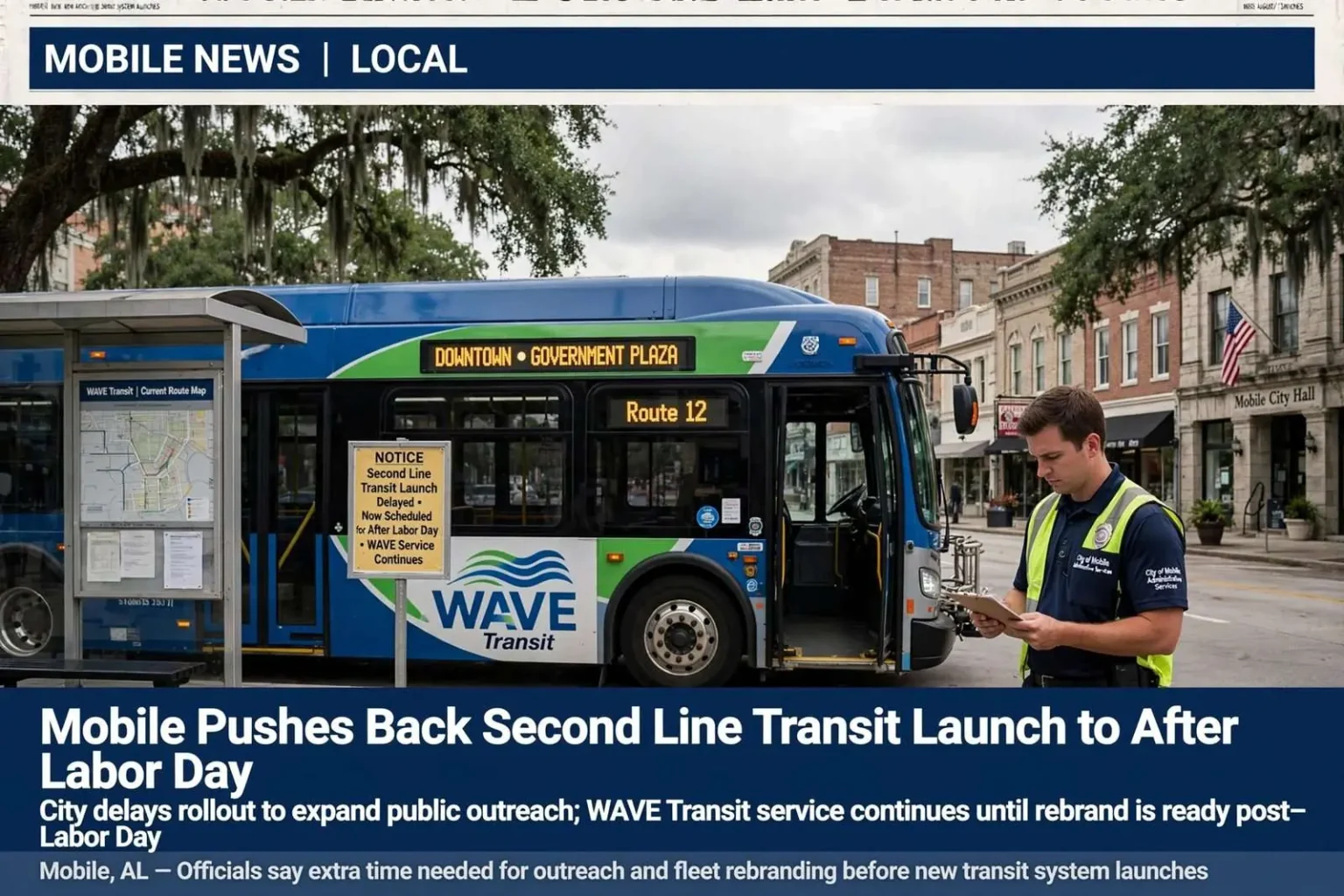
Mobile officials have pushed back the launch of Second Line Transit, the city’s rebranded public transportation system, after previously targeting a late-July debut. City councilors learned this week that the system, which will replace the WAVE Transit brand with new routes, buses, trolleys and taxi-like vans, will not roll out until sometime after Labor Day. The delay means riders across Mobile will keep using the existing WAVE network for several more weeks while the city finishes preparing the new service for public use.
Jacob Laurence, the city’s deputy director of administrative services, told council members during a pre-meeting work session that additional public outreach is needed before launch, even after the city held multiple community meetings in recent weeks on route changes and how the new system will work. Those sessions, held across the city, were intended to walk current riders through the redesigned route map and explain how the new mix of vehicles will operate alongside one another.
“Over the course of the previous public engagement there were some concerns the public continued to maybe not quite get, and we want to ensure the success of the system translated into public confidence in that system,” Laurence said.
Why officials hit pause on the rollout
The extra outreach push reflects a recurring challenge in public transit transitions: riders who depend on the system daily often learn about changes through word of mouth rather than official announcements, and confusion at the moment of a switchover can mean missed work shifts, medical appointments and school trips. By holding the launch until after Labor Day, the city buys time to answer questions one-on-one and make sure the people who rely on WAVE buses today know exactly what will change and when.
City officials also determined that rebranding the existing fleet of WAVE buses and MoGo Rideshare vehicles to reflect the Second Line Transit name would take longer than previously anticipated. Every vehicle in the fleet has to be pulled from service temporarily to receive new wraps, and the work has to be sequenced so that enough buses remain on the road each day to cover the current schedule while the conversion moves forward.
Laurence said the city also plans to sell off some buses nearing the end of their useful life and did not want to spend money rebranding vehicles it intends to offload. Wrapping a full-size transit bus is a significant per-vehicle expense, and putting new branding on buses destined for sale would have effectively spent public money on vehicles the city will no longer operate. The plan is to complete the fleet transition once the remaining vehicles are identified and the surplus units are moved out.
“There is a meeting this week to discuss internally what the timeline is for launch,” Laurence said. “Currently we have said let’s wait until after Labor Day.”
Mayor: riders must not feel left out
Mayor Spiro Cheriogotis said after the council’s regular meeting that “a little more education and outreach” about Second Line Transit will help current transit riders better prepare for the new system. His comments underscored a concern that the city’s most frequent riders — many of whom do not drive and depend on the buses for employment, groceries and medical care — could be disadvantaged if the switch is rushed.
“We just want to make sure we love all the people we’re serving right now with our transit system,” he said. “We don’t want to lose them. We don’t want them to feel left out.”
The mayor also said the projected cost of new Second Line Transit wraps for the existing WAVE buses prompted him to send the rebranding proposal back to the drawing board. He indicated he wants the city to be sure the expenditure is justified before committing to it, particularly with other transit needs competing for the same budget. The rebrand is expected to be revisited once staff return with revised pricing and a clearer picture of which vehicles will remain in the fleet long term.
The delay also gives city staff room to fine-tune operational details that matter most to riders, including printed and digital route guides, stop signage, and training for drivers and dispatchers on the new route structure. Officials have not announced a specific launch date beyond the post-Labor Day window, and council members are expected to receive updates at upcoming work sessions as the internal timeline meeting produces a firmer schedule.
Second Line Transit represents the most significant overhaul of public transportation in Mobile in years. The rebrand retires the long-standing WAVE Transit name, which has identified the city’s fixed-route bus service for decades, and introduces a redesigned network intended to better match where Mobile residents actually live, work and shop. Alongside conventional buses, the new system incorporates trolleys for higher-visibility corridors and taxi-like vans that can deviate from fixed paths, a hybrid model aimed at serving both dense urban neighborhoods and lower-density areas where full-size buses run mostly empty.
The taxi-like van component is modeled on microtransit services that have spread across mid-sized Southern cities in recent years. Rather than waiting at a fixed stop for a bus on a rigid schedule, riders in participating zones can request a van pickup, and the vehicle routes itself to collect several passengers heading in the same direction. For neighborhoods that lost direct routes in past schedule revisions, that flexibility is the difference between having service and not having it.
What changes for riders when the switch happens
When Second Line Transit goes live, riders will encounter new route numbers and maps, new vehicle liveries, and updated schedules. Transit planners in comparable transitions typically publish a side-by-side comparison of old and new routes in the weeks before launch so that current riders can find their replacement route. City officials have not detailed exactly how that information will be distributed in Mobile, but the additional outreach Laurence described suggests printed materials, community meetings and online guides are all part of the plan.
The MoGo Rideshare vehicles already operating in the city will be folded into the Second Line brand, unifying what has until now been a patchwork of services under separate names. Riders who use MoGo today will see the same kind of on-demand service continue, just presented as part of a single, cohesive system rather than a standalone pilot program.
The stakes for Mobile’s transit riders
Transit transitions are high-stakes moments for the people who depend on the system most. A rider who boards the wrong bus on launch day, or waits at a stop that has been discontinued, can lose hours and, in some cases, a job. That reality is why cities undertaking overhauls of this kind increasingly front-load public engagement, stationing staff at major transfer points and partnering with employers, clinics and schools to spread the word before the first day of new service.
The post-Labor Day timing also avoids launching during the late-summer stretch when schools are settling into their academic-year routines and trip patterns are still shifting. Waiting until early fall gives the new network a more stable ridership picture from day one and lets city staff observe how school-related travel fits into the redesigned routes.
Council members will track the rollout in the weeks ahead, and any further adjustments to the launch date or the rebranding budget are expected to surface at future work sessions. For now, city officials are asking riders to keep using the existing WAVE service as they do today, with the promise that a clearer, better-publicized transition is coming once the internal timeline is settled.
The council’s work-session discussion also touched on the practical sequencing of the fleet changes. Vehicles slated for sale will be identified first, so that wrap crews do not spend time and material on buses that will leave the fleet. The city then plans to wrap the remaining buses in waves, keeping service coverage intact while each group of vehicles cycles through the shop. Because wraps are applied only when a bus is out of revenue service, the schedule depends heavily on spare vehicle availability — another reason officials want breathing room before the public launch.
How Mobile’s transit system evolved to this point
Mobile’s public transportation history stretches back more than a century, through privately operated streetcars to the publicly supported bus network riders know today. The WAVE brand carried the system through decades of route changes, federal funding shifts and the steady suburbanization that pulled jobs and shopping away from the downtown core. Like many Gulf Coast cities of similar size, Mobile has struggled to sustain ridership as car ownership became near-universal and route networks designed around a pre-highway city aged poorly.
The move toward on-demand options such as MoGo Rideshare reflected a national recognition that fixed routes alone cannot serve a modern mid-sized city efficiently. Microtransit-style services let agencies cover wide areas with smaller vehicles, redirecting capacity to where requests actually come from rather than running large buses on lightly used segments. Folding those services into a single Second Line Transit brand is intended to present riders with one system, one identity and one set of information sources instead of several disconnected programs.
The name itself draws on the Gulf Coast’s shared cultural tradition — the second line, familiar across the region from New Orleans to Mobile’s own Mardi Gras heritage, evokes a parade that anyone can join. City officials have presented the rebrand as a signal that the system belongs to the whole community, not just to its daily commuters.
What happens between now and launch
With the internal timeline meeting scheduled for this week, the city is expected to finalize the sequence of remaining outreach events, fleet work and staff training. Residents with questions about how the new routes will affect their trips can follow upcoming community meeting announcements from the city, and riders are encouraged to raise concerns now, while there is still time to adjust route details before the system goes live.
Officials have framed the delay not as a setback for the project itself but as a deliberate choice to get the transition right. Laurence’s message to the council was that public confidence is the true measure of the rollout’s success — a system that launches on time but confuses its riders would fail the very people it is meant to serve. The post-Labor Day window, they say, is the price of doing that correctly.