Mobile Metro Jail Replaced Failed Air-Conditioning Units in 2007
In August 2007, Mobile County moved to replace two failed Metro Jail air-conditioning units as heat affected inmates and about 230 employees.
Originally reported August 16, 2007.
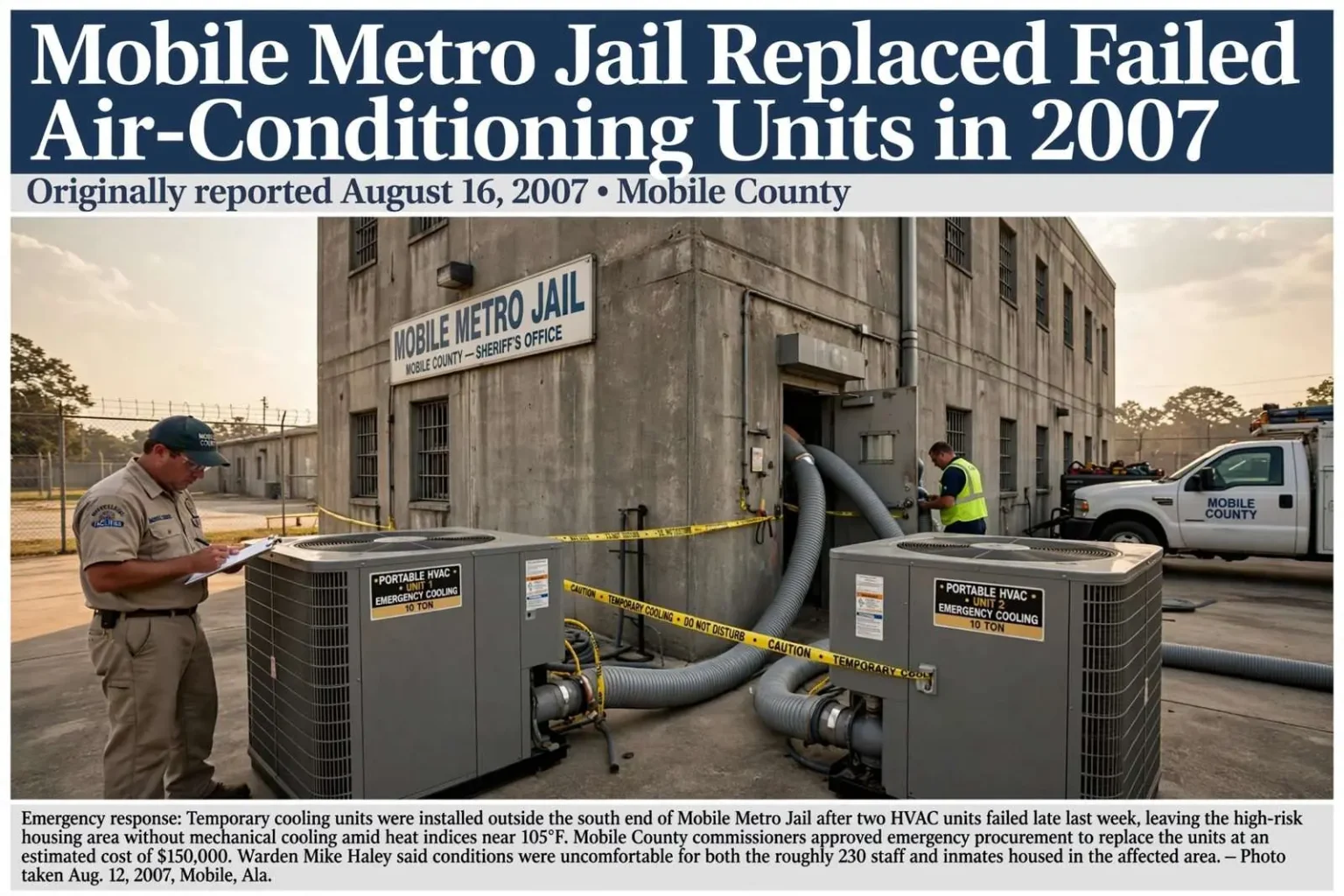
Mobile County moved to replace two failed air-conditioning units at Mobile Metro Jail in August 2007 as temperatures approached triple digits, according to an archived local news report. The units had broken late the previous week in the south end of the jail, where some high-risk prisoners were held, leaving part of the facility to run without its mechanical cooling through one of the hottest stretches of an Alabama summer.
Warden Mike Haley said there was little air movement and that conditions were uncomfortable for both inmates and the approximately 230 employees who worked at the jail. Temporary air units were installed over the weekend to take the edge off the affected area, though officials said heavy rain could affect equipment placed on the ground. County commissioners voted to use a faster procurement process rather than the standard 30- to 60-day bidding period, and officials estimated two replacement units would cost about $150,000.
August Heat in a Concrete Building
The timing made the failures urgent in a way that mechanical breakdowns in most county buildings are not. Mobile in mid-August routinely produces heat indices above 105 degrees, and a jail is a dense, concrete, human-packed building where body heat, kitchen exhaust, and equipment loads stack on top of the outdoor temperatures. Losing cooling in a housing area does not merely make the space unpleasant; within hours it pushes the interior toward temperatures that raise genuine health risks — heat exhaustion first, then the dehydration and cardiac stress that heat stroke brings.
High-risk inmates added a security dimension to the medical one. The south end of the jail held prisoners classified for close custody, the men whose movement is restricted and who are locked in cells or small sections for most of the day. Staff cannot simply move that population to a lobby or an outdoor yard to escape a hot wing, and the security protocols that govern their housing slow any emergency relocation. When the cooling failed in that specific area, the jail had to manage a heat event among the inmates least able to help themselves.
The approximately 230 employees absorbed the same conditions on top of their workloads. Correctional officers working in a hot housing unit wear uniforms and duty gear, walk continuous rounds, and respond to incidents in a building where a heat-stressed inmate population is a predictable source of disturbances. Jail administrators watch officer fatigue closely during such events, because tempers — inmates’ and staff’s alike — shorten as temperatures climb, and the warden’s observation that conditions were uncomfortable for both groups was a statement about institutional stability as much as comfort.
Emergency Procurement, County Style
The county commission’s decision to skip the standard 30- to 60-day bidding period put the repair on the emergency track that government procurement reserves for genuine urgencies. Normal bidding exists to protect public money — competing quotes, documented selection, board approval — but a jail in August could not wait two months for a cooling system, and Alabama’s procurement rules give commissions an emergency mechanism for exactly that situation. The vote allowed the county to contract directly for the replacement units while documenting the justification.
The estimated $150,000 for two replacement units reflected the scale of jail HVAC in general. Institutional air conditioning is not residential equipment scaled up: the units serve concrete housing areas with high occupancy loads, run continuously in a building that never closes, and must be sized to keep functioning during the heat events when they are needed most. Two units representing a $150,000 replacement were a serious piece of the jail’s mechanical plant, and their failure suggested the kind of end-of-life equipment cycle that county facility budgets dread.
The temporary units bridging the gap carried their own complications. Ground-placed portable equipment needs power, fuel or drainage management, and protection from the weather — and officials noted that heavy rain could affect the units sitting outside the building. Mobile’s August afternoons deliver thunderstorms with little warning, so the stopgap cooling was itself fragile, reinforcing the case for speeding the permanent replacement.
The Jail and Its Population
Mobile Metro Jail housed the county’s pretrial detainees and short-sentenced inmates, a population that flows through the building far faster than a state prison’s and that averaged well over a thousand people in the mid-2000s. The facility sits on a compact urban site, and its operations run around the clock: intake from every law enforcement agency in the county, court transports daily, medical and mental health services, kitchens, laundry, and the maintenance staff whose work — failed units notwithstanding — keeps the building habitable at all.
Jails differ from prisons in their vulnerability to exactly this kind of equipment failure. A prison holds a stable population in a campus of buildings; a jail takes whoever the county’s arrests produce, including people withdrawing from drugs, people with untreated medical conditions, and people in the first days of incarceration, when the risks from any physical stress are highest. A cooling failure in a jail wing is therefore a medical event as much as a comfort problem, and jail medical staff are part of every conversation about how long the facility can operate under degraded conditions.
The 2007 failure also arrived in an era when jail standards bodies — the state’s jail inspection authority among them — pressed counties on environmental conditions in their facilities. Heat management in southern jails had drawn scrutiny for years, and the national pattern was already established: summer cooling failures in county jails produced lawsuits, medical emergencies, and in the worst cases deaths. Mobile County’s fast response in 2007 — temporary units within days, emergency procurement within a week — tracked what the era’s standards effectively demanded.
What the Failure Revealed
Equipment failures like this one are the visible edge of a maintenance story that counties rarely tell in public. Mechanical systems in a jail run continuously for decades, and the replacement cycle for major HVAC components is long enough that administrations change between the times a commission has to vote on a chiller or a rooftop unit. When two units fail together, the usual inference is that the equipment had been aging along the same timeline, and the $150,000 replacement estimate signaled to the commission that the jail’s mechanical plant was entering the phase where such votes would recur.
The south-end location of the failed units compounded the concern, because housing areas classified for high-risk inmates tend to be the most restrictive and the least flexible parts of a facility. Contingency planning for equipment failure in a jail normally includes relocating or spreading out the affected population, but a high-risk unit’s inmates cannot be distributed casually into general population or into areas not configured for their custody level. The warden’s staff had to manage the heat where it was, with the temporary cooling as the mitigation, until the permanent units were in place.
Commissioners’ willingness to bypass standard bidding also reflected the county’s institutional memory of what a jail heat event can become. Beyond the immediate health risks, degraded conditions in a locked facility generate grievances, disturbances, and litigation exposure that cost far more than a cooling unit. A $150,000 emergency replacement, decided within days, was the cheaper outcome by any accounting the commission could make.
This article records a 2007 facilities issue and does not describe current Metro Jail conditions. It preserves, as the archived report did, the warden’s description of the breakdown, the county’s emergency procurement response, and the cost estimate as they stood in August 2007 — a snapshot of one hot summer week in the ordinary crisis management of a county jail.
Heat and Inmate Health Standards
The medical logic behind the urgency deserves spelling out, because jail cooling failures are not merely an amenity question. Sustained indoor temperatures in the nineties push even healthy people toward dehydration and heat exhaustion within hours, and jail populations carry risk factors that raise the danger substantially: medications that impair temperature regulation, withdrawal symptoms, heart disease, hypertension, and the psychiatric conditions whose treatments interact badly with heat. Inmates in a locked wing cannot get themselves to shade or water; their access to fluids and cool air is entirely in the institution’s hands.
National detention standards treat environmental conditions accordingly. Professional jail standards call for temperature monitoring, hydration protocols during heat events, medical screening for inmates most vulnerable to heat illness, and documentation of the institution’s response when cooling fails. A jail that loses cooling in a housing area is expected to act — extra fluids, increased checks, medical watches on at-risk inmates, and if necessary relocation — and the temporary units Mobile County installed over that weekend were the visible piece of what those obligations require.
The legal backdrop reinforces the practical one. Courts have repeatedly held that deliberate indifference to extreme heat in confinement violates constitutional protections, and southern jails and prisons have paid for cooling failures in judgments and settlements. County commissioners voting on a jail repair are, in effect, voting on that exposure too — one more reason the emergency procurement in 2007 moved through the commission without the debate that a routine $150,000 contract might have drawn.
The Staffing Side of the Story
The warden’s mention of the approximately 230 employees pointed to the other half of the institution that a cooling failure strains. Correctional officers and support staff work the same heat their charges endure, but they do it while performing security duties — searches, escorts, count, emergency response — that physical exhaustion makes harder and riskier. Jail administrators track heat effects on staff because an officer’s impaired attention in a housing unit is a safety problem for everyone on the wing.
Facilities that lose cooling also generate overtime quickly. Staff rotate through hot areas more frequently, extra hands are brought in for welfare checks and movement, and maintenance crews work long days on the temporary equipment. A mechanical failure in a jail ripples through the payroll in ways a comparable failure in an office building never does, and the county’s emergency spending in 2007 was only partly about the $150,000 in units themselves.
The summer of 2007 fits, too, into the longer story of the aging Metro Jail facility, which county officials have discussed in the years since — a downtown building serving a growing county, where mechanical systems, plumbing, and space all age on timelines that outlast the administrations budgeting for them. The August 2007 vote on two air-conditioning units was one of those recurring, unglamorous decisions through which counties keep large institutions running: unremarkable when it works, front-page news for a week when it does not.
This article records a 2007 facilities issue and does not describe current Metro Jail conditions. The details preserved here — the failed units in the south end, the warden’s account of conditions for inmates and the 230 employees, the temporary cooling and its rain vulnerability, the emergency procurement, and the $150,000 estimate — come from the archived report of August 16, 2007, and stand as the record of that week’s breakdown and response.