Citronelle Police Investigated Severe Assault in 2007
Citronelle Police investigated a severe assault on Dogwood Drive in August 2007 near the location of a recent homicide, according to WKRG.
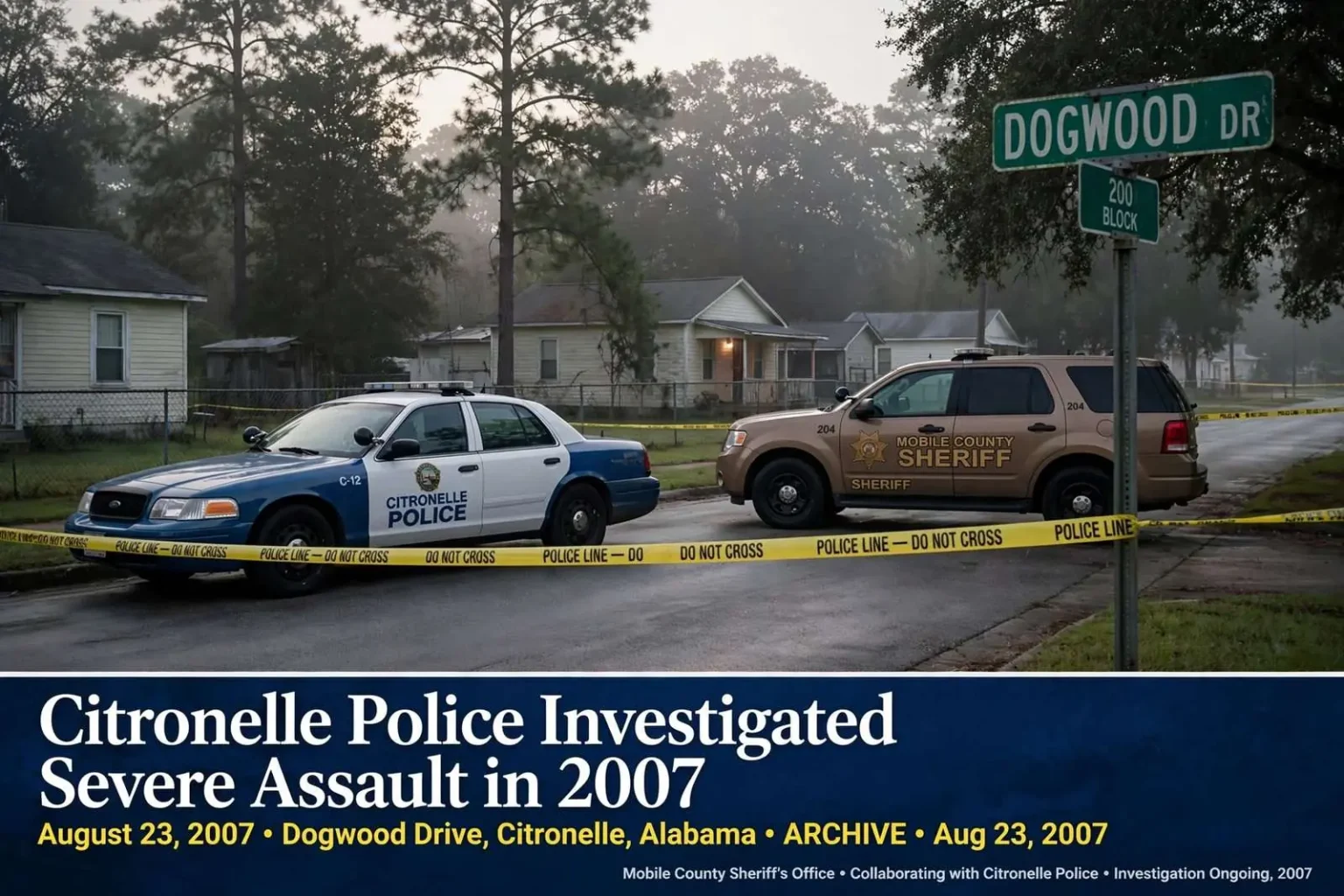
Originally reported August 23, 2007. This historical account intentionally omits graphic details and identifies no suspect. It reflects the initial investigation reported at the time and does not state later findings or court outcomes.
Citronelle Police investigated a severe assault on Dogwood Drive in August 2007 near the location of a homicide reported the previous week, according to an archived local news report. The connection in time and place between the two cases — separated by only days and by a short distance in the same small north Mobile County town — made the assault an immediate priority for investigators already working a murder.
Police responded about 5 a.m. to a 911 call and found a 42-year-old man with serious injuries. The report described the man as the employer of the homicide victim, a link that immediately shaped how investigators viewed the new case: not a random predawn attack on a stranger, but another thread in a sequence of events centered on the same small circle of people in the same community.
Mobile County Sheriff Sam Cochran said investigators viewed the incidents as an isolated series of events rather than random violence and were working to solve the cases. Cochran, who led the Sheriff’s Office through a long tenure covering some of the most consequential years in the county’s modern law enforcement history, stressed the department’s commitment to untangling the connected cases. As with all such accounts, this report reflects the state of the investigation as it was described at the time and draws no conclusions about what later investigation established.
Citronelle: a small town at the county’s northern edge
Citronelle sits in the far northern reaches of Mobile County, nearly 35 miles north of the city of Mobile, close to the Washington County line. With a population of only a few thousand residents, it functions as the commercial and social center for a rural surrounding area — a place with a compact downtown, volunteer-rooted civic institutions, and the deep familiarity that comes with generations of families living side by side. In a town that size, a homicide is an extraordinary event, and two violent incidents within a week touched nearly everyone’s sense of safety.
Dogwood Drive is a residential street in the town, the kind of road where houses sit close together and neighbors notice unfamiliar vehicles. A severe assault there in the early morning hours — police were called around 5 a.m. — would have been the talk of the town before the day was out, and the fact that it occurred near the scene of the homicide reported the week before intensified both the fear and the speculation that necessarily follow such events in a close-knit community.
The town also has a long institutional history with law enforcement. Citronelle maintains its own police department, one of the small municipal forces scattered across Mobile County outside the city of Mobile, and small departments typically work major cases in partnership with the county sheriff’s office and other agencies. The resource gap between a small municipal force and the demands of a homicide investigation is significant, which is why the collaboration described in the report — with Sheriff Cochran’s investigators engaged alongside city police — is the standard arrangement for north Mobile County communities.
The connection that shaped the investigation
The detail that the assault victim was the employer of the homicide victim stood at the center of the early investigation. An employment relationship ties two people together in ways investigators can trace — workplace, finances, schedules, and the personal dynamics that flow through any small-business setting. When a homicide victim’s employer is found severely injured a week later, a short distance from the first crime, the natural investigative question is whether the two events share a cause, and the report indicates that sheriff’s investigators were treating them as part of an isolated series of events.
The phrase matters in two directions. For the broader public, “isolated series of events” was reassurance: investigators did not believe a predator was loose in Citronelle selecting victims at random. For the circle of people connected to the cases, it meant something more sobering — that investigators believed the danger, if any remained, was tied to the specific relationships at the center of the two incidents. Both messages were communicated through the sheriff’s public statements, a balancing act that law enforcement leaders perform in nearly every case where a community’s fear and a specific investigative theory run in parallel.
Cochran, who became Mobile County’s sheriff in 2006 after decades with the Mobile Police Department, brought a large-city investigative background to cases like this one in the county’s rural reaches. His tenure became one of the longest in the office’s modern history, and the north county communities — Citronelle, Mount Vernon, Creola, and the unincorporated areas between them — were a regular part of the office’s workload, covering the majority of the county’s land area with a fraction of its population.
The 5 a.m. 911 call
The timeline in the report — a 911 call at about 5 a.m., officers arriving to find a 42-year-old man seriously injured — describes the opening hours of a case in which the first responders’ observations matter enormously. In assault cases, the scene as found, the victim’s condition, and the statements gathered in the first hours form the foundation on which everything later rests. Early morning calls in small towns bring out whichever officers are on duty, backed by sheriff’s deputies and, for injuries of the severity described here, emergency medical crews dispatched from the nearest station.
Serious assault cases from that period in rural Mobile County presented the usual investigative challenges: limited forensic turnaround times at that era’s crime labs, the long reaches between communities that give suspects time and routes to leave, and the double-edged nature of small-town witness pools, where everyone knows everyone and fear of being involved keeps some information unspoken. Investigators from the sheriff’s office working both the homicide and the assault would have been running two scenes, two witness canvasses, and one central question — how the two events connected.
The archived report deliberately omits the graphic details of the man’s injuries and identifies no suspect, a restraint that reflects both the sensitivity of the case and the standards of responsible reporting on active investigations. Naming no suspect in a case where no arrest had been made protects the innocent, and the omissions in the historical record leave the account focused on what could be responsibly stated at the time: what happened, where, and how investigators framed it.
Violence in rural Mobile County
The Citronelle cases arrived in a decade when north Mobile County’s rural communities were grappling with the same pressures visible across rural Alabama — economic transition, the outflow of younger residents, and the persistent challenges of drugs and domestic violence that cross every jurisdictional line. Small police departments handle the daily volume, but cases involving homicide and severe violence pull in the sheriff’s investigators, state agencies, and sometimes federal partners, and the coordination among them becomes part of the story of every major case in the county’s outlying towns.
For Citronelle residents, the week that contained both the homicide report and the Dogwood Drive assault was a stretch many still remember, in the way small towns remember the events that breach their sense of safety. The assurance that investigators viewed the violence as an isolated series of events — contained within a specific set of relationships — helped, but reassurance and reality are different things until cases are solved, and the archived report captures the community at the point where nothing was yet resolved.
The account also preserves a portrait of how the work was described at the time: a 911 call before dawn, a victim found alive with serious injuries, an investigator’s link between victim and employer, and a sheriff promising that the cases would be worked. Beyond that point the historical record in this article makes no claims. The disposition of both cases — the homicide reported the previous week and the Dogwood Drive assault — rests in the case files and court records of the agencies and courts that handled them, and this account draws no conclusion about guilt, innocence, or outcome.
What the record shows — and what it doesn’t
Historical accounts like this one serve a purpose beyond nostalgia or curiosity. They preserve, for the communities where the events occurred, the documented starting points of cases whose later chapters may be scattered, incomplete, or unknown to newer residents. The facts stated here — the dates, the location on Dogwood Drive, the 5 a.m. call, the 42-year-old victim, his connection to the homicide victim, and Sheriff Cochran’s characterization of the cases — come from the archived local news report of August 23, 2007, and nothing beyond it.
Anyone with knowledge of either case — the homicide or the assault — was directed, as always in such investigations, to the Mobile County Sheriff’s Office or Citronelle Police. Cold cases from that era in Mobile County remain periodically subject to review, and tips from the public have reopened and resolved cases decades old across Alabama. What endures in the meantime is the documented record of a small town’s hardest week, and the investigators who promised to see it through.