Mobile County sheriff vehicleAn archived report covered a Mobile County pursuit and suspected meth-lab investigation in 2008.

Historical report preserved from an archived 2008 local news story.

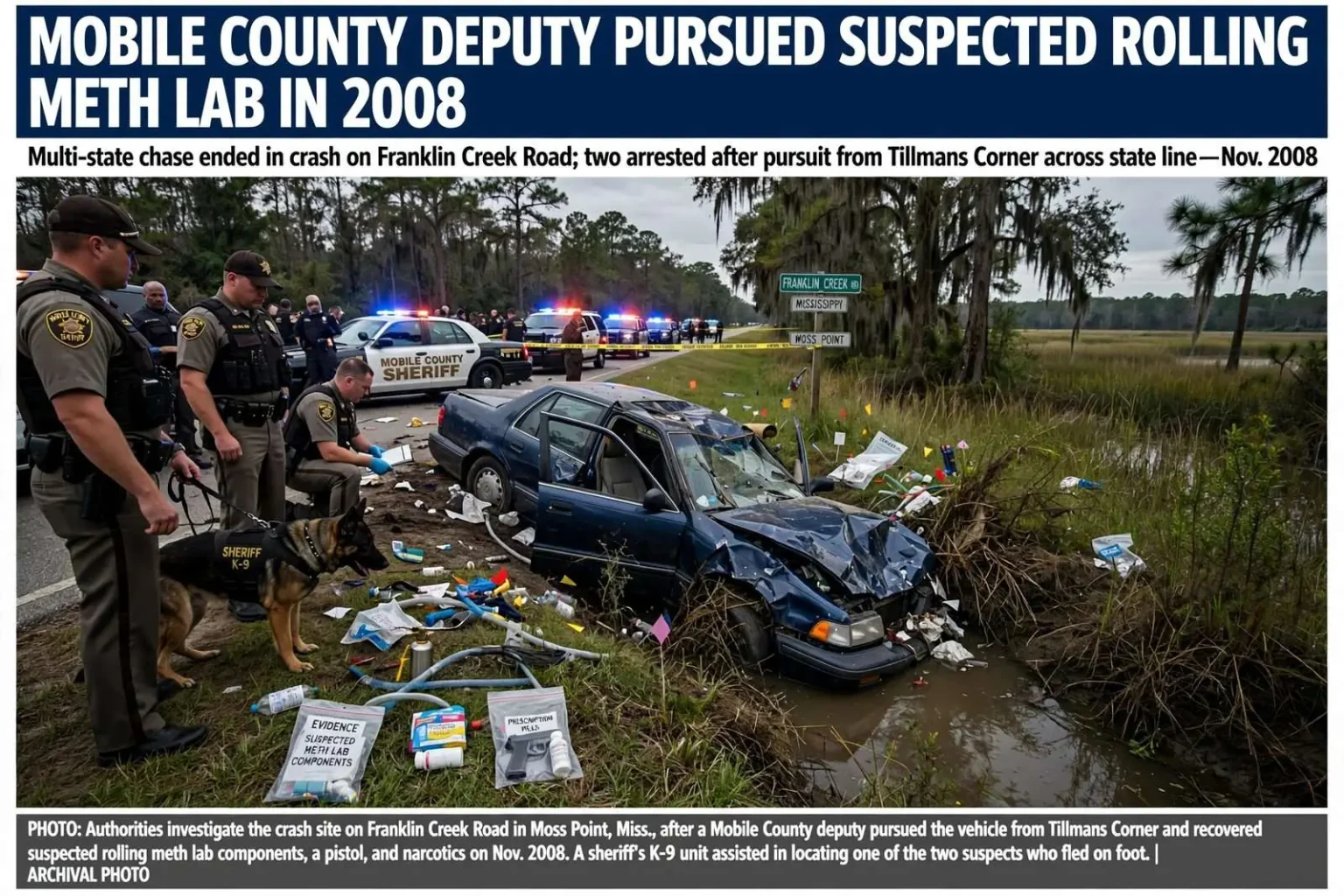
A Mobile County deputy pursued a vehicle from Tillmans Corner into Moss Point, Mississippi, after an attempted traffic stop near Sperry Road and Old Pascagoula Road in 2008, according to an archived local news report. The report said the driver accelerated away and that items were thrown from the vehicle during the pursuit, turning a routine stop attempt into a multi-state chase that crossed the state line before it ended. The case stands as a snapshot of the methamphetamine trade as it operated along the Gulf Coast corridor in the late 2000s.

The chase ended after the vehicle crashed in a ditch on Franklin Creek Road across the state line. Authorities said two men ran from the vehicle but were taken into custody, with a sheriff’s K-9 unit helping locate one of them. The use of a tracking dog reflected standard practice for foot pursuits in the thick pine woods, brush and drainage ditches that surround the roads connecting western Mobile County with Jackson County, Mississippi, where a fleeing suspect on foot can disappear quickly into overgrown parcels.

Investigators reported finding suspected components of a rolling methamphetamine lab, a pistol, prescription pills and methamphetamine in the vehicle. The men faced several charges at the time, including drug, weapon and fleeing-related allegations. This historical account does not state any later court outcome.

Where the chase began

Tillmans Corner, the unincorporated community at the heart of the story, sits south and west of downtown Mobile along U.S. Highway 90 and Old Pascagoula Road, one of the busiest commercial and residential crossroads in Mobile County outside the city limits. The intersection of Sperry Road and Old Pascagoula Road lies in a patchwork of neighborhoods, small businesses, churches and older subdivisions where the Mobile County Sheriff’s Office handles routine patrol duties. A deputy initiating a traffic stop near that intersection would have had immediate access to U.S. 90, which runs west toward the Mississippi line, giving a fleeing driver a direct escape route.

The route described in the archived report followed that escape corridor precisely. From the attempted stop, the pursuit crossed into Jackson County, Mississippi, and ended in Moss Point, a riverfront city just north of Pascagoula that borders Alabama along the western edge of the greater Mobile metropolitan area. Motorists can move between the two jurisdictions in a matter of minutes on Old Pascagoula Road and connecting routes, a geography that has long made cross-border coordination a routine part of law enforcement work on both sides of the line.

Multi-county pursuits of this kind draw in agencies quickly. A Mobile County deputy crossing into Mississippi is joined by Mississippi Highway Patrol, the Jackson County Sheriff’s Office and municipal police departments as the chase passes through their jurisdictions, and the crash that ends a pursuit triggers medical response along with arrest procedures. The archived report’s account of two suspects fleeing the wrecked vehicle on Franklin Creek Road matches the typical sequence: a crashed car, a foot chase, and a K-9 team called in to track anyone who breaks for cover.

See also  Mobile's Moon Pie Drop Returns With Mardi Gras Parade, Live Music and Free Museum Access

Rolling meth labs and the danger they posed

The suspected rolling methamphetamine lab described in the report refers to a method common in the era: portable labs assembled inside vehicles so that operators could buy precursors in one jurisdiction, cook in another and dispose of evidence along the way. Law enforcement agencies across south Alabama and southern Mississippi encountered such vehicles regularly during the 2000s, and officers were trained to treat any traffic stop involving suspected lab components as a hazardous-materials situation, because the chemicals involved are toxic, flammable and prone to violent reaction.

A lab discovered in a seized vehicle cannot simply be towed to an impound lot. Clean-up crews certified to handle meth lab chemicals must be called in, the scene is treated as contaminated, and evidence technicians photograph and catalog components before disposal. For the deputies involved in the 2008 case, the discovery of suspected lab components meant the routine end of a pursuit — a crash and an arrest — became an extended, hazardous scene that stretched across two states and required coordination between the Mobile County Sheriff’s Office and Mississippi authorities.

The era in context

The 2008 chase occurred during the peak years of small-scale meth production in the Southeast. Congress had restricted sales of pseudoephedrine-containing cold medicines in 2006, forcing cooks to travel clinic-to-clinic and store-to-store to gather precursors, and mobile labs became one response to those restrictions. Gulf Coast law enforcement made dozens of lab seizures a year in Mobile, Baldwin and Washington counties during that period, and cooperative operations between Alabama and Mississippi agencies were common because trafficking routes ran naturally along U.S. 90, U.S. 98 and the Interstate 10 corridor.

The items recovered in the vehicle — a pistol, prescription pills and methamphetamine alongside the suspected lab components — reflected the profile officers expected in such stops. Firearms are frequently present in drug cases because narcotics trafficking operates outside regulated channels, and diverted prescription pills circulated alongside methamphetamine throughout the region. Charges arising from a stop like this one typically included unlawful possession of controlled substances, possession of drug paraphernalia, possession of a firearm in connection with drug activity, attempting to elude law enforcement, and any outstanding warrants — a combination consistent with the “drug, weapon and fleeing-related allegations” the archived report described.

For the pursuing deputy, the case illustrated the split-second judgments that pursuits demand. A suspect who refuses to stop with suspected meth lab chemicals aboard creates risks that extend well beyond the traffic violation that prompted the stop: the vehicle can crash and ignite, chemicals can spill into ditches and creeks, and the chase can pass through residential neighborhoods at high speed. Departments across the Gulf Coast revised pursuit policies repeatedly during this era, weighing the severity of suspected offenses against the danger high-speed driving poses to the public.

See also  Carnival Ecstasy Sails From Mobile One Last Time Before Retirement

The people and places left behind

The two men taken into custody near the wrecked vehicle faced the charges noted in the report at the time. The archived account does not state any later court outcome, and historical records of that kind leave the story unresolved by design: arrests documented in 2008 news coverage did not necessarily result in the convictions prosecutors initially sought, and appellate outcomes, plea agreements and sentencing records were rarely covered in follow-up stories. What the record preserves is the event itself — the attempted stop, the flight across the state line, the crash, the K-9 search and the seizures.

Moss Point residents who witnessed the crash on Franklin Creek Road experienced the tail end of a phenomenon that recurred along the border throughout the decade. Small towns and unincorporated communities on both sides of the Alabama-Mississippi line absorbed the consequences of the meth trade: contaminated dump sites in ditches and woods, overloaded county jails, and crowded court dockets. Sheriff’s offices responded with K-9 units, interagency task force participation and specialized training for hazardous lab scenes.

The 2008 pursuit also shows how the geography of Tillmans Corner connects Mobile’s southern suburbs to the Mississippi coast. The roads involved — Sperry Road, Old Pascagoula Road, U.S. 90 and Franklin Creek Road — form a corridor that a modern commuter drives in twenty minutes and a fleeing driver can cover even faster. For the agencies responsible for that corridor, the case was one entry in a long ledger of cross-border pursuits, but for the neighborhoods along the route it was a vivid reminder of how quickly a routine traffic stop in their community could become a two-state emergency.

How such cases moved through the courts

When a pursuit ends across a state line, prosecution typically begins in the state where the chase ends — in this case Mississippi, where the crash and arrests occurred — while the initiating agency in Alabama may also seek charges for offenses committed on its side of the line. A suspect who flees from a Mobile County deputy faces Alabama counts for eluding and any offenses committed before the state line, and Mississippi counts for the events that followed. Defendants in such cases often appear before judges in both states, and coordinating testimony between the two prosecutor offices adds months to proceedings that a single-jurisdiction case would not require.

The presence of suspected meth lab components compounds that process. Evidence must be documented by trained technicians, chemical analysis is completed at a state crime laboratory, and certified disposal contractors handle the hazardous materials before a trial can proceed. In 2008, Alabama’s lab backlog and the logistics of Gulf Coast cleanups meant that months could pass between an arrest and an indictment, and years were not unusual between arrest and final sentencing when firearms enhancements applied.

See also  Burned Car Found in Grand Bay Woods Identified as Vehicle of Missing Nurse Terri Sullivan

The archived report does not say what ultimately became of the two men arrested on Franklin Creek Road, and no outcome is offered here. The historical record preserves the names of only the road, the agencies and the charges — the kind of snapshot a nightly newscast or next-morning newspaper provided before follow-up reporting became rare in local outlets. Many similar cases from the period survive only in this form, which is why such accounts are republished with their limits stated plainly.

What the case says about the region it crossed

Reading the 2008 report today, the details sketch a specific time and place along the central Gulf Coast. Tillmans Corner in that era was one of the most densely populated unincorporated communities in Alabama, patrolled by the sheriff’s office rather than a city police department, and its commercial strips along U.S. 90 generated the traffic stops that occasionally turned into chases. Twenty minutes to the west, Moss Point sat on the Pascagoula River with its own economic struggles in the years following Hurricane Katrina, which had struck both communities hard three years before this pursuit.

Katrina’s aftermath is part of the backdrop of nearly every 2008 Gulf Coast story. Displaced residents, damaged housing stock and disrupted economies shaped crime patterns across the region, and methamphetamine, like other illicit markets, followed the disruption. Agencies on both sides of the line worked the same corridors with shared radio interoperability improvements funded in the storm’s wake, making cross-border pursuits like this one easier to coordinate than they had been only a few years earlier.

The K-9 unit that helped locate one of the fleeing men represents another thread of that era’s law enforcement investment. Sheriff’s offices across south Alabama expanded their K-9 programs in the 2000s, deploying dogs trained in tracking, narcotics detection or both. A dog capable of both tasks was especially valuable in cases like this one, where a suspect could be located in the woods and the vehicle seized at the scene could be screened for the same narcotics involved in the chase.

Preserved in three paragraphs of archived text, the 2008 pursuit from Sperry Road and Old Pascagoula Road to a ditch on Franklin Creek Road remains a small but complete record of its moment: a deputy’s routine stop, a driver’s desperate decision, two states’ worth of responders, and a hazardous seizure that took the meth trade’s mobile era out of traffic and into the evidence room. The account ends where the archived coverage ended — with charges filed and outcomes unknown — and it stands now as regional history rather than current news.