2008 Forecast Put Mobile Among Fast-Growing U.S. Metro Areas
A 2008 forecast cited by WKRG projected Mobile would lead U.S. metro areas in growth of gross metropolitan product from 2007 through 2012.
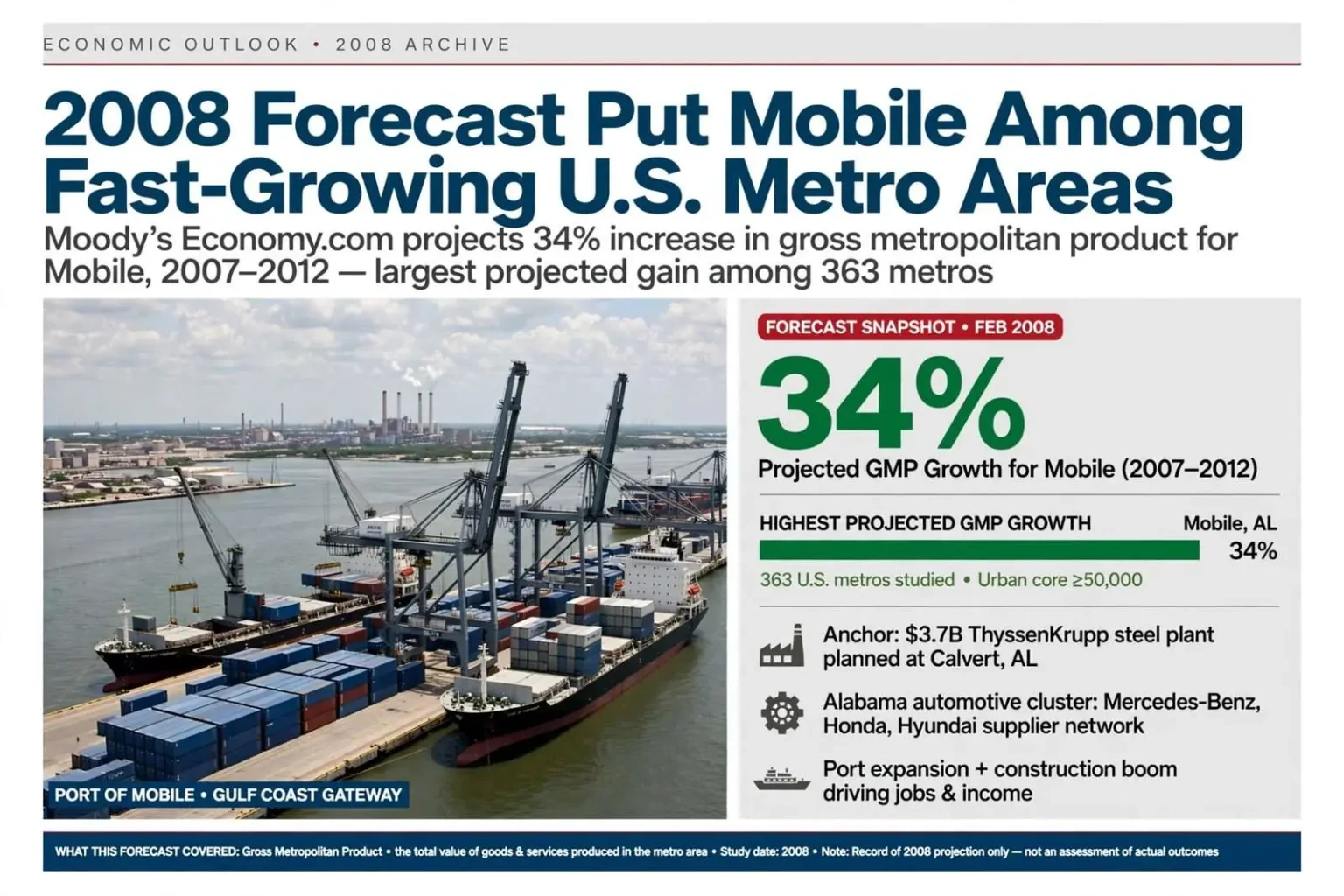
A 2008 economic forecast cited by a local station placed Mobile among the country’s fastest-growing metropolitan areas, projecting the nation’s largest change in gross metropolitan product between 2007 and 2012. The Moody’s Economy.com forecast projected a 34% increase for Mobile over that five-year window. This is a record of a 2008 forecast, not a current economic ranking or an evaluation of whether the projection was realized.
The report attributed regional momentum in part to the planned $3.7 billion ThyssenKrupp steel plant and pointed to automotive manufacturing investment elsewhere in Alabama. The study examined 363 cities with an urban core of at least 50,000 people and also considered population growth, job growth, housing starts and personal income growth in its comparisons.
Understanding Gross Metropolitan Product
Gross metropolitan product, the measure at the center of the forecast, is the metropolitan cousin of gross domestic product: the total market value of all goods and services produced within a metro area’s borders. Economists use it to compare the underlying economic weight of regions, since it captures everything from port operations and manufacturing output to health care, retail and professional services. A projected change in GMP is therefore a statement about total economic activity, not simply about jobs or population.
Moody’s Economy.com, the forecasting arm that produced the study, was one of the most widely cited sources for regional economic projections in that era. The firm built econometric models for each of the nation’s metropolitan areas, feeding in data on employment by industry, income, construction, trade and demographics to generate outlooks that businesses, governments and journalists used for planning. Its metro-level forecasts were standard reference points for stories about which regions were positioned to grow.
The study’s scope — 363 cities with an urban core of at least 50,000 people — covered essentially every significant metropolitan economy in the country. Looking across that full field, ranking Mobile first in projected GMP growth was a striking result for a metro area of Mobile’s size, and it explains why the local station gave the forecast prominent coverage when it was released.
Why 2008 Mobile Attracted Forecaster Attention
The anchor of the projection was ThyssenKrupp’s planned steel mill at Calvert, in north Mobile County near the Washington County line. The German industrial giant had selected the site for a $3.7 billion complex combining a steelmaking operation and a stainless processing facility, drawn by the deepwater access of the Tombigbee River, the proximity of Mobile’s port and the labor and incentive environment that Alabama had assembled. At the time, it ranked among the largest industrial investments in the state’s history.
A project of that scale ripples far beyond its own payroll. Steel mill construction employed thousands of building trades workers, and the plant’s permanent operation was expected to support suppliers, contractors, trucking and service businesses across the region. Economic modelers accounted for those multiplier effects when projecting metropolitan output, which is why a single industrial announcement could shift a metro’s five-year forecast so dramatically.
The forecast also credited automotive manufacturing investment elsewhere in Alabama, a reference to the industry cluster the state had built since the early 1990s. Mercedes-Benz’s Tuscaloosa County plant had put Alabama on the global manufacturing map, followed by Honda in Lincoln and Hyundai in Montgomery, along with the suppliers that clustered around each assembly plant. Those operations anchored a manufacturing economy that gave Alabama modelers and forecasters evidence of durable industrial momentum, and Mobile stood to participate through its port and supplier networks.
The Broader Mobile Economy of the Era
Mobile in 2008 offered forecasters more than one bright spot. The Port of Mobile was expanding its role as a Gulf gateway for container traffic, forest products and heavy cargo, and the Alabama State Port Authority was investing in terminals and capacity at a moment when global trade was still rising. Aerospace and shipbuilding added to the industrial base, with major yards and defense contractors drawing payrolls into the metro area.
Construction activity along the Gulf Coast was itself a growth driver in the years following Hurricane Katrina, as the region rebuilt housing, schools and infrastructure with an influx of federal and insurance money. For a metro economy, a sustained construction boom lifts employment, income and output across the board, and the models feeding the 2007-2012 projection would have registered that activity alongside the coming ThyssenKrupp build-out.
Population trends pointed the same direction. Baldwin County, across Mobile Bay, ranked among Alabama’s fastest-growing counties throughout the decade, and the metro’s residential and commercial development followed. Rising housing starts and personal income — two of the additional measures the study considered — were visible on the ground in new subdivisions, retail centers and office parks from west Mobile to the Eastern Shore.
The Forecast and the Recession It Could Not See
Timing shaped everything about how the 2008 projection has been remembered. The forecast was issued as the national economy was sliding into what became the most severe downturn since the Great Depression, a contraction that hit housing, construction and trade — three pillars of the Gulf Coast economy — especially hard. Metro-level projections made before the full scope of the financial crisis was clear were revised repeatedly across the country, and regions whose outlooks depended on large capital projects watched closely as credit markets tightened.
Large industrial projects such as the ThyssenKrupp mill followed their own multi-year timetables for construction and hiring, which cushioned them somewhat from short-term swings but did not make them immune. State and local officials continued to describe the plant as transformative for the region through the construction period, even as the broader economic picture shifted beneath the assumptions of pre-crisis forecasts.
The episode is a common one in economic forecasting. Projections describe the momentum visible at the moment they are made, extended forward through models that cannot anticipate wars, financial panics or pandemics. A first-place ranking in projected output growth was an honest reading of Mobile’s 2008 fundamentals; whether the intervening years honored it is a separate question that this archived report does not attempt to answer.
Reading a Historical Forecast Today
The value of a preserved forecast lies less in its accuracy than in what it reveals about how the region saw itself at the time. The 2008 story captured a Mobile that expected to be defined by heavy industry, port trade and manufacturing momentum — a self-image the city had been building through industrial recruitment for a decade and a half.
For readers reconstructing the period, the report offers specific anchors: the 34% projected GMP increase, the 2007-2012 window, the 363-city comparison field, the $3.7 billion ThyssenKrupp investment and the automotive cluster credited alongside it. Those details, preserved from the local station’s coverage, document both the scale of the expectations and the moment of national confidence in which they were formed — just before the downturn that reshaped the economic landscape every one of those 363 cities shared.
How Metro Forecasts Are Built
Understanding what went into a projection like this one helps explain both its promise and its limits. Regional models such as those maintained by Moody’s Economy.com linked national assumptions — interest rates, consumer spending, federal policy — to local industry structures, so that a metro dominated by manufacturing would respond differently to a national shock than one dominated by services or government. Employment by sector, wage data, construction permits and trade flows all fed the equations, and the output was a growth path for each measure the study cited.
Because of that design, the additional measures in the study — population growth, job growth, housing starts and personal income growth — were not decorative. They were the components through which metropolitan output was expected to rise, and each one corresponded to something visible in Mobile at the time: new residents arriving on the Eastern Shore, payrolls expanding around port and industrial projects, cranes over subdivisions in west Mobile and Daphne, and incomes rising with the shift toward higher-paying industrial work.
The models also assumed continuity — that announced projects would be built on schedule, that trade would keep flowing, that national conditions would follow their expected path. That is why a forecast released in early 2008 could carry such confidence about 2012, even as the financial system was already showing strain. The arithmetic was sound; the world it projected into changed.
Mobile’s Industrial Recruitment Playbook
The confidence behind the forecast did not come from nowhere; it reflected a deliberate statewide strategy that Alabama had been executing since the Mercedes-Benz deal in the early 1990s. That project — won with incentive packages that were controversial then and standard practice since — established the template: identify a global manufacturer, offer a competitive site and trained workforce, and let the supplier ecosystem follow. Honda, Hyundai and then ThyssenKrupp each built on the precedent, and each announcement raised the state’s standing in site-selection circles.
Mobile’s position within that strategy was geographic. The city controlled the port infrastructure that heavy industry needed, the rail and highway connections that moved raw materials and finished product, and tracts of land along the rivers and the coast suitable for large plants. The Calvert site combined deepwater access with room for the sprawling footprint a steel complex requires, and the state’s training programs — already proven by the automotive plants — promised a workforce pipeline for the mill’s skilled positions.
Local economic developers in the period spoke of Mobile as a city on the edge of transformation, and the Moody’s forecast gave that narrative a number: 34% output growth, the largest projected change in the country. Whatever later years brought, the 2008 report preserved the peak of that moment — the point at which Mobile’s industrial ambitions and the national forecasting establishment’s models pointed the same direction.
What the Record Preserves
As a historical document, the report fixes several facts in place: the source (a Moody’s Economy.com forecast cited by a local station in 2008), the measure (gross metropolitan product change, 2007 to 2012), the figure (34% for Mobile), the comparison field (363 cities with urban cores of at least 50,000), the attribution (the ThyssenKrupp plant and Alabama’s automotive investment) and the caveats the station attached to the story at the time.
Those caveats deserve the last word. The report was a record of a forecast, not an economic ranking, and nothing in it evaluated whether the projection came true. Readers using it today should hold it as evidence of Mobile’s 2008 economic self-image — confident, industrial and nationally noticed — rather than as a verdict on how the following five years actually unfolded.