Citronelle man accused of killing sister-in-law must wear ankle monitor if bonded out
A Citronelle man accused of killing his sister-in-law and setting her home on fire must wear an ankle monitor if bonded out; bond set at $250,000 total.
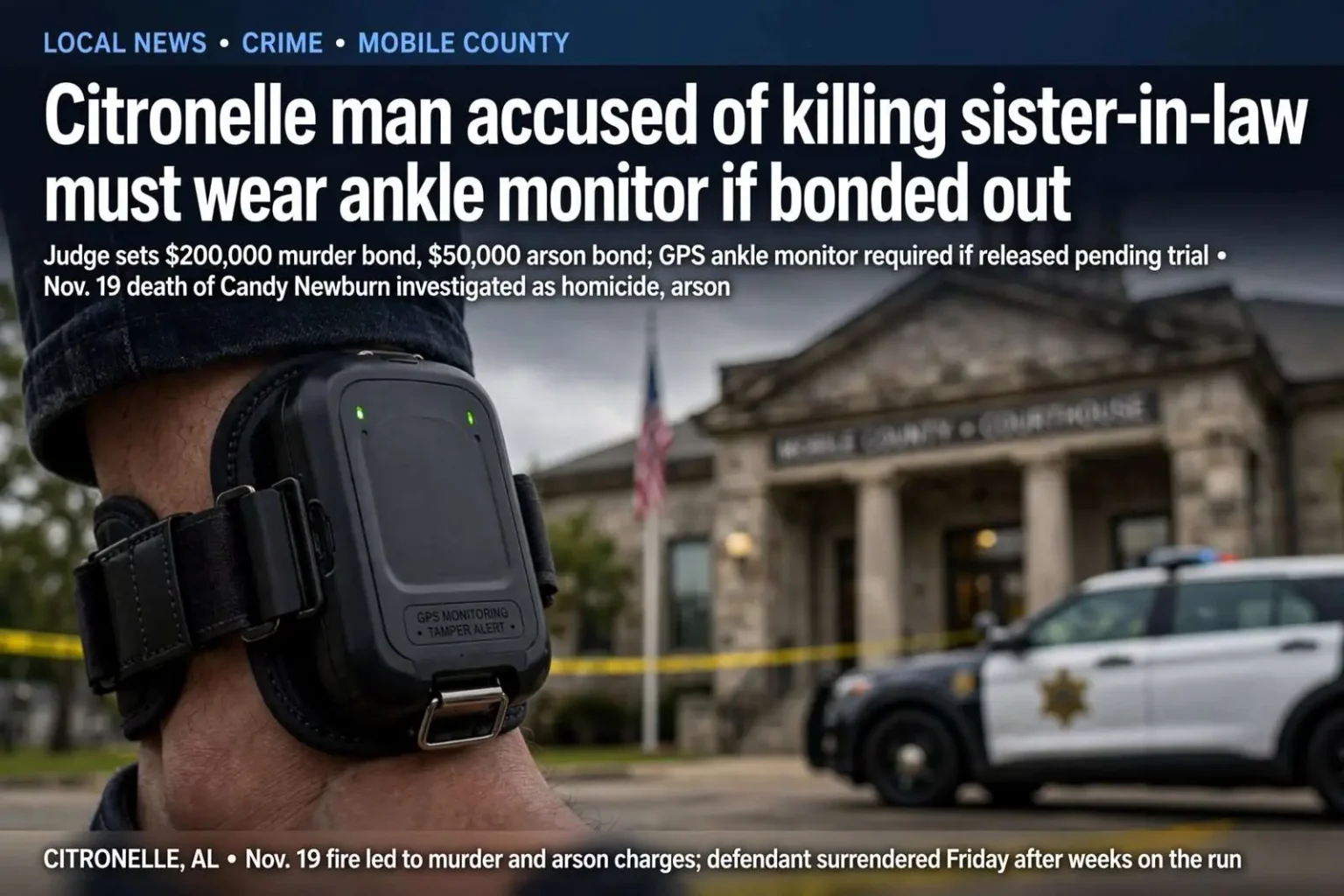
A Citronelle man accused of killing his sister-in-law and setting her home on fire last month will be required to wear an electronic monitoring device if he is released on bond, under conditions set when he appeared in court after weeks on the run. Jason Newburn is charged with murder and arson in the Nov. 19 death of Candy Newburn, whose body was found inside her home in Citronelle after a fire there, and the monitoring requirement is the court’s answer to the question of what happens if the man who avoided capture for weeks is now released pending trial.
The case began with the fire itself. Emergency crews responded to a Citronelle home on Nov. 19 and discovered that the person inside — Candy Newburn — was dead, an ordinary house fire call that quickly became a death investigation. Authorities concluded that she had been killed before the fire was set, and the combination of murder and arson charges filed against Jason Newburn reflects that conclusion: the fire, in the state’s account, was not the cause of death but an act intended to cover it up.
After the fire, Newburn was nowhere to be found. He remained on the run for weeks following the blaze, a period in which authorities sought him while the investigation into Candy Newburn’s death continued in Citronelle, the small city in northern Mobile County where the case unfolded. The manhunt ended on a Friday when Newburn turned himself in to face the charges, weeks after the fire that brought deputies and investigators to the home.
The bond hearing and its conditions
On Monday morning, a judge set bond at $200,000 on the murder charge and $50,000 on the arson charge, and attached a condition that will follow Newburn if he manages to post those amounts: an electronic monitoring device worn on the ankle, tracking his whereabouts around the clock. The condition is among the tools courts use when releasing someone charged with a violent crime, sitting between a straight release on bail and the outright denial of bond, and it gives authorities an immediate alert if the defendant removes the device or travels where he is not permitted.
Bond amounts of that scale reflect the gravity of the charges and the court’s assessment of the circumstances. Murder carries the most serious penalties in Alabama law, and arson — particularly arson committed in connection with a death — is charged as a serious felony in its own right. The two charges together also explain the structure of the bond: each charge carries its own amount, and Newburn would need to meet both to be released from custody on the combined total.
The ankle monitor requirement is common in cases where a defendant has already demonstrated a willingness to avoid authorities. Newburn’s weeks on the run gave the court a concrete reason to impose tracking rather than rely on his promise to appear, and electronic monitoring programs — administered in cooperation with the sheriff’s office and private monitoring contractors — have become a standard condition in serious felony cases across Alabama for defendants who secure release.
The investigation that followed the fire
The discovery of a body in a house fire sets in motion a specific investigative sequence that fires investigators, deputies, and forensic teams follow. The first question is whether the fire itself could have caused the death; the second is whether the fire was accidental, or deliberately set. When investigators concluded that Candy Newburn died before the fire began and that the blaze was set to conceal what happened, the case moved from a fire scene examination to a homicide investigation — and the arson charge became a second crime rather than an accident.
Evidence from a fire scene is gathered methodically: investigators look for patterns of burning, the presence of accelerants, the point of origin, and the condition of the structure’s exits and entrances. In north Mobile County, that work typically draws on the Mobile County Sheriff’s Office and state fire marshals’ resources, since smaller municipal departments rely on county and state partners for complex fire investigations. The weeks between the Nov. 19 fire and the charges filed in the case covered that process, along with the autopsy and the interviews that built the account authorities presented to the court.
Newburn’s weeks on the run added another dimension to the case. During that period, authorities worked to locate him while the community in Citronelle — a city of a few thousand residents near the Washington County line, where such a death reverberates quickly — followed the investigation. His decision to turn himself in on a Friday ended the search and moved the case into the court system, where the bond hearing the following Monday set the terms under which he would await trial if released.
What the charges mean as the case moves forward
It bears emphasis that Newburn is entitled to the presumption of innocence, and the charges now pending against him are accusations that prosecutors will have to prove in court. The bond conditions — the $200,000 and $50,000 amounts and the ankle monitoring requirement — are not a finding of guilt but the framework the judge set to secure his appearance at future proceedings while the case is pending. If he is released, the monitor will record his movements; if he violates the conditions, he can be returned to custody.
The murder and arson charges each carry their own path through the court system. In Alabama, a murder charge of this kind is a felony requiring indictment by a grand jury before the case proceeds to trial, and the arson count will be handled alongside it as part of the same prosecution. The timeline from bond hearing to trial in a serious felony case typically stretches over many months, and the ankle monitor condition means that any release in the meantime comes with constant documentation of where the defendant is.
For Citronelle and the surrounding communities of north Mobile County, the case has moved through its stages in public view: the fire on Nov. 19, the discovery of Candy Newburn’s body, the weeks her accused killer spent at large, the Friday surrender, and the Monday bond hearing that ended with a judge’s conditions. The next stages — grand jury, arraignment, and eventually trial — will unfold in the Mobile County court system, with the electronic monitoring requirement standing as the court’s guardrail for as long as Newburn remains out of custody on bond.
Electronic monitoring and how it works in Alabama courts
The ankle monitor imposed as a condition of bond is a piece of technology that has become routine in Alabama’s felony courts over the past two decades. The devices — typically GPS-enabled units strapped to the ankle — report the wearer’s location continuously to a monitoring service, which flags violations: leaving a permitted zone, approaching a prohibited person or place, or tampering with the unit itself. Judges use them in domestic violence cases, in cases involving defendants considered flight risks, and in situations like this one, where the record already includes a period when the defendant avoided capture.
The conditions also serve a practical purpose for the agencies involved. A defendant on a monitor is easier to keep track of than one released on a signature alone, and the monitoring data provides an objective record if questions arise later about a defendant’s movements. Costs for monitoring are generally borne by the defendant under the programs most Alabama jurisdictions use, adding a financial element to the conditions of release. For victims’ families, the requirement provides a measure of assurance that the accused will not simply disappear again while the case is pending.
In setting bond, judges weigh several factors: the seriousness of the charges, the defendant’s ties to the community, prior record, employment, and — critically in this case — any history of failure to appear or flight. Newburn’s weeks on the run after the fire were squarely before the court at the Monday morning hearing, and the combination of substantial bond amounts and mandatory electronic tracking reflects that history. The court’s order makes clear that any release will be on conditions far more restrictive than a standard bond.
The community and the case ahead
Deaths of this kind land hard in a community the size of Citronelle, where the victim and the accused had family ties and the court file involves a sister-in-law relationship. The weeks between the fire and the surrender left neighbors following developments closely, and the bond hearing drew attention as the first formal step in the court process after the arrest. Residents of the city — which serves as a commercial center for the northern reaches of Mobile County — will be watching as the case moves through the courts in the months ahead.
The prosecution’s case will rest on the evidence assembled from the fire scene, the autopsy, and the investigation conducted during and after the manhunt. The defense, for its part, will have the opportunity to test that evidence at every stage, from the grand jury presentation through pretrial motions to trial itself. The bond amounts and the monitoring requirement will remain in place unless the court modifies them, and the conditions give the sheriff’s office and the monitoring service the tools to respond immediately if the terms are broken.
What began with a fire in Citronelle on Nov. 19 now sits where the justice system intends such cases to sit: charges pending, bond conditions set, an ankle monitor waiting if the accused posts bond, and a trial process ahead. For the family of Candy Newburn, the Monday morning hearing closed one chapter of uncertainty — the weeks when the man accused in her death was somewhere authorities could not find him — and opened the longer, slower chapter of the court proceedings to come.