Mobile County Deputies Detail Use-of-Force Training Amid National Debate
Mobile County Sheriff's Office instructors explain why deputies train to aim for center mass rather than 'shoot to wound' during encounters.
Following a string of high-profile police-involved shootings that drew intense national scrutiny in 2014, use-of-force instructors with the Mobile County Sheriff’s Office are pushing back on a question they say misunderstands how law enforcement training actually works: why don’t officers just shoot to wound rather than kill?
The question has followed nearly every controversial shooting that reaches the national news, asked by commentators, protesters and ordinary observers who wonder why trained marksmen cannot simply disable a suspect. At the Sheriff’s Office firing range near Big Creek, the deputies who train Mobile County’s officers consider the question a misunderstanding of both the physiology of a gunshot and the split-second timeline of a violent encounter — and they spent a training session demonstrating exactly why.
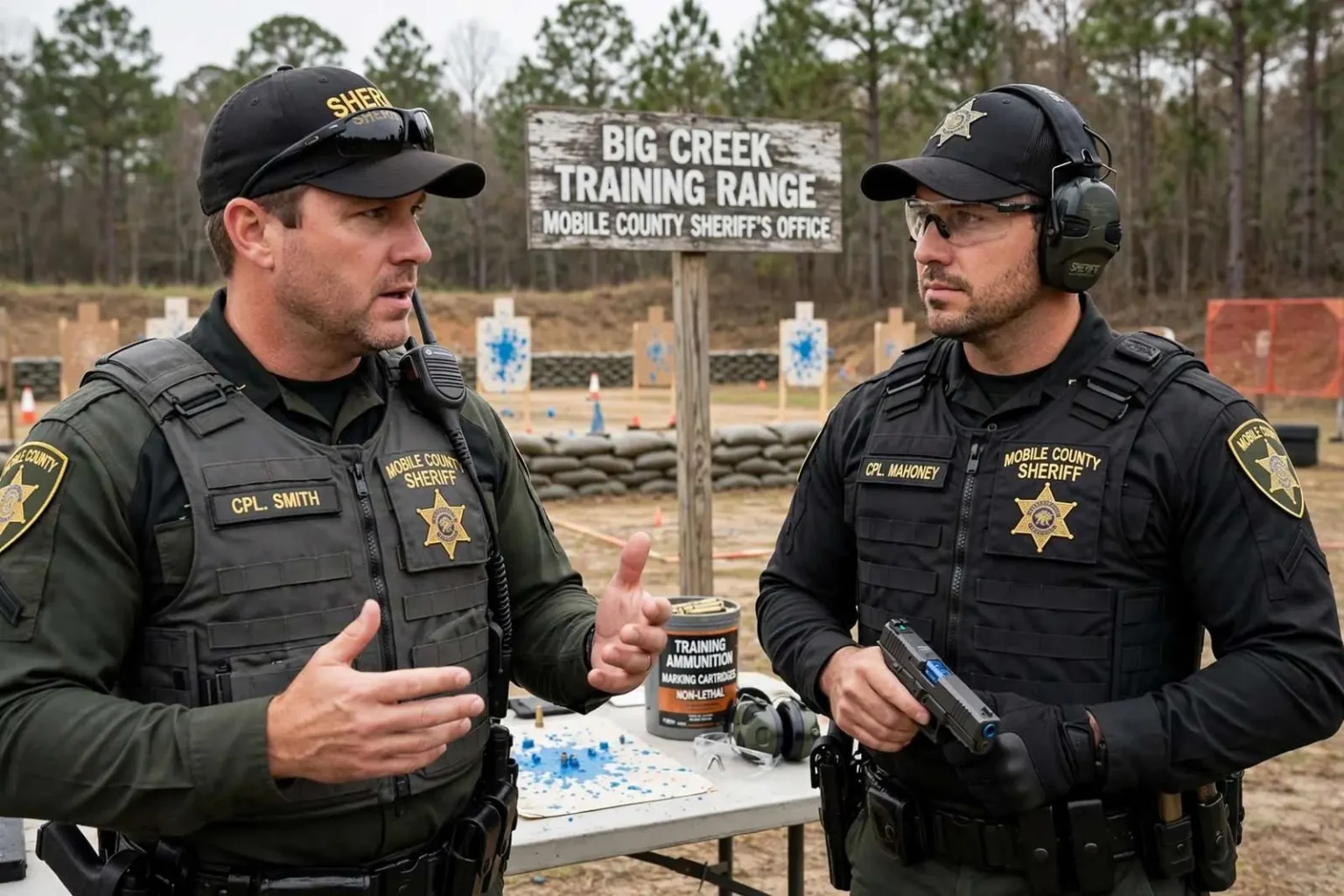
Cpl. David Smith, who helps oversee training at the Sheriff’s Office firing range near Big Creek, said the question ignores the reality of how quickly violent encounters unfold and how firearms training is structured nationwide, not just in Mobile County. The range sits off the beaten path in the county’s inland stretches, where deputies can train with live fire, scenario drills and the training ammunition that lets two officers shoot at each other without consequence.
“Shoot to stop, not to kill”
“We teach deputies and police officers to shoot to stop, not necessarily shoot to kill,” Smith said, adding that officers are trained to aim for center mass — the torso — because it represents the largest and most reliable target during a high-stress encounter. Intentionally aiming for an arm or leg, he said, simply is not realistic when officers must draw, aim and fire within seconds while a threat is moving toward them or a bystander.
The reasoning breaks down into pieces the public rarely hears assembled. A bullet to an arm or leg does not reliably stop a threat — a person can remain fully capable of firing a weapon or completing an attack after being hit in a limb — and a missed shot intended for an arm travels on toward whatever is behind the subject. Under stress, with a heart rate spiking and fine motor control degrading, even the best marksman’s accuracy collapses toward the target’s center. Training that aimed at limbs would produce missed shots and un-stopped threats, the instructors argue, endangering both officers and bystanders.
The “shoot to stop” phrasing also reflects how the law frames the decision. Deadly force is permitted only when an officer reasonably believes it is necessary to protect against death or serious injury — not as a graduated option somewhere between a Taser and a warning. There is, in the structure of both training and law, no such thing as a shot intended to wound: a firearm is deployed when the threat cannot be stopped any other way, and it is deployed to end the threat as quickly as possible.
A demonstration under training ammo
During a demonstration exercise using training ammunition, Smith and fellow instructor Cpl. Joe Mahoney simulated a physical confrontation to show how quickly a situation can escalate once a subject charges an officer. Even with both participants aware they were in a training scenario, most of the simulated shots landed on extremities rather than a targeted center-mass hit, reinforcing the instructors’ point that precision marksmanship under real-world stress is far more difficult than television and film often suggest.
The demonstration carried its own irony: two professional instructors, calm, prepared and standing in a controlled environment, could not reliably choose their shot placement once a simulated subject was moving toward them. If the professionals under no real danger scatter their hits to arms, hands and legs, the argument went, the expectation that a frightened officer in a genuine life-or-death moment will surgically pick a limb is fantasy. “It’s Hollywood, it’s not reality,” Smith said.
Training ammunition — marking cartridges fired from adapted duty weapons — is the closest thing to real combat that agencies can safely replicate. It stings, it marks its hits with colored detergent, and it forces participants to move, take cover and make decisions in real time. Departments that use it report the same consistent finding: under the pressure of a charging role-player, accuracy degrades and hit placement drifts to whatever part of the body happens to be presented. That is precisely why the Mobile County instructors use the demonstration with visiting officers and community groups.
Declining to judge other cases
Both instructors declined to weigh in on specific national cases that had fueled the broader debate over police use of force that year, saying they were not present for those incidents and could not speak to details they hadn’t personally reviewed.
The restraint was deliberate. In an era when each new shooting produced instant national judgment — on cable news and social media within hours — the instructors were making a quieter point about how force decisions should actually be evaluated: by investigators with access to witness statements, physical evidence and the full sequence of what the officer perceived. Second-guessing the split-second decision with incomplete information, they suggested, is a category error that neither defends officers nor serves the public.
Their refusal to comment also reflected the training culture they represent. Use-of-force instructors across the country emphasize that reviews of officer-involved shootings must distinguish between what an officer knew at the moment and what later evidence revealed — a standard built into both court precedent and departmental review procedures. Hindsight, they noted, is always 20/20; the officer’s decision has to be judged against the seconds he or she actually lived through.
Relationships as prevention
But Mahoney said building better relationships between deputies and the communities they serve is critical to preventing the kind of mistrust that can follow a controversial shooting elsewhere in the country. “It goes back to just reconnecting with our communities and letting them know that we’re there for them,” Mahoney said, adding that the vast majority of law enforcement officers are simply trying to do their jobs safely and get home to their families at the end of a shift.
The emphasis on relationships is not incidental to use-of-force training — in the modern curriculum, it is part of it. Departments increasingly teach that de-escalation begins long before any encounter: with deputies who know the neighborhoods on their beats, who are visible at community events when nothing is wrong, and who have earned the credibility that carries a tense moment toward a peaceful ending. The sheriff’s office rationale is practical as much as philosophical — a community that trusts its deputies reports more crime, cooperates more willingly and reaches for a phone instead of a weapon when trouble starts.
Mobile County’s geography makes that relationship-building a logistical challenge of its own. The county stretches from the urban core of the city of Mobile — patrolled by the city police department — through suburbs, rural crossroads and bayou communities to the Mississippi line, and deputies cover territory that includes fishing villages, industrial corridors and fast-growing suburbs. Building trust across that range means showing up in dozens of distinct communities, each with its own expectations of the sheriff’s office.
Inside the training itself
The training session offered a rare look inside how Mobile County’s Sheriff’s Office prepares deputies for split-second, high-stakes decisions — and why the agency believes public perceptions of those decisions often don’t match the split-second reality officers face on the ground.
Firearms and use-of-force training is a recurring obligation, not a one-time academy course. Deputies return to the range for scheduled qualifications, and scenario training weaves in judgment problems: when to draw, when to hold fire, when a less-lethal tool is the right answer. Agencies invest heavily in this cycle because the legal standard for force turns on whether an officer acted reasonably — and reasonableness, in court, is judged against what a trained officer would have done, making the quality of training legally consequential as well as practically vital.
The instructors’ demonstration also addressed the physiological side of the debate that few members of the public ever see explained. Under mortal threat, the body dumps adrenaline, vision tunnels, hearing narrows and fine motor skills vanish — phenomena documented across decades of research on combat performance. Training is designed for that degraded state: simple decisions, rehearsed repeatedly, so they execute automatically when the complex ones fail. That is why the answer to “why not aim for the leg” is not a justification but a description of what human performance under stress actually looks like.
The 2014 national debate that framed the session produced lasting changes in policing — body cameras spread rapidly, de-escalation curricula expanded, and departments faced new scrutiny of their force policies. The Mobile County instructors’ message, offered from the range near Big Creek, was that the region’s agencies were engaging the conversation honestly: opening their training to public view, explaining the anatomy of a force decision and conceding the legitimacy of the community’s concern about outcomes, while defending the method by which deputies are actually taught to shoot.
What the public takes from sessions like this one may matter as much as what the deputies learn. The gap between imagined marksmanship and real marksmanship — between the movie version and the training-ammonition demonstration — sits at the center of many public disputes over police shootings. The Mobile County instructors’ bet is that showing the reality, in a gym where the shots sting but nothing is permanent, closes some of that gap. “It’s Hollywood, it’s not reality” is a four-word summary of the lesson, and it is one the agency intends to keep teaching, one demonstration at a time.