Colorado Man Sues Mobile Funeral Home Over Mother’s Missing Jewelry
A Colorado man is suing a Mobile funeral home, claiming his late mother's gold jewelry disappeared while her body was in the facility's care.
A Colorado man has filed a lawsuit against a Mobile funeral home, alleging that jewelry belonging to his late mother went missing while her body was in the facility’s care. Christopher Kuhn, of Northglenn, Colorado, filed suit in Mobile County Circuit Court against Azalea City Funeral Home and Crematory, located on Zeigler Circle West, along with two men who operate the business.
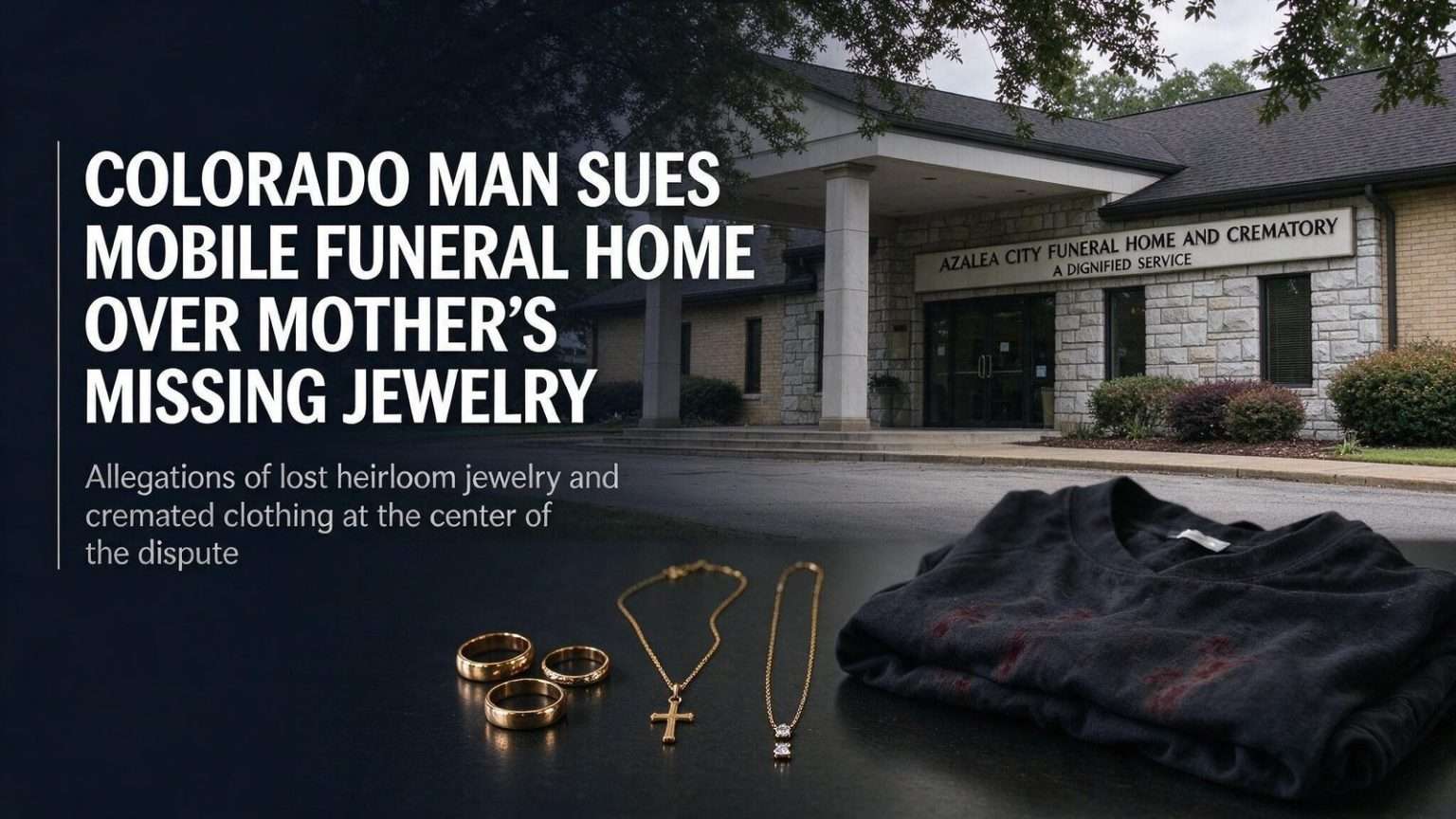
According to the lawsuit, Kuhn’s mother arrived at the funeral home in September 2013 wearing three 14-karat gold rings, a gold necklace featuring three diamonds representing each of her sons, and a separate gold necklace with a cross pendant. She was also wearing blood-stained clothing at the time she was brought into the funeral home’s custody.
The suit alleges that after the funeral home took custody of the body, the jewelry could not be located. Kuhn claims the funeral home was supposed to return the items to him along with his mother’s clothing, which he says was needed for investigative purposes. Instead, according to the complaint, funeral home operators offered a series of explanations before eventually telling Kuhn that the property had been lost or taken while in their care — and that the blood-stained clothing had already been cremated along with the body.
Heirlooms described as irreplaceable
According to court filings, the family considered the missing items irreplaceable heirlooms with significant sentimental value, and the lawsuit states that funeral home operators ignored specific instructions to preserve both the jewelry and the clothing. The necklace set with three diamonds — one for each of the mother’s sons — is the kind of personal effect that carries meaning no appraisal can capture, and the complaint treats its loss as the central injury of the case.
The clothing, too, had a purpose beyond sentiment in the family’s account. Kuhn says it was needed for investigative purposes, an indication that his mother’s death involved circumstances in which the condition of clothing could matter to authorities. The allegation that it was cremated with the body, before anyone outside the funeral home could examine it, forms the second major claim in the suit.
Kuhn is seeking compensatory and punitive damages, along with costs associated with the litigation and any additional relief the court deems appropriate. Compensatory damages would address the value of the lost property, while punitive damages are reserved under Alabama law for conduct considered wanton or reckless — a signal of how strongly the complaint characterizes the funeral home’s handling of the estate.
The defendant’s side
The funeral home’s operators had not responded publicly to the allegations as of the time the lawsuit was filed, and the claims outlined in the complaint represent only the plaintiff’s side of the dispute. Defendants in Alabama civil cases have a defined period after formal service to answer, and nothing in the filing binds the court or establishes the facts as pleaded.
Azalea City Funeral Home and Crematory operates on Zeigler Circle West in west Mobile, one of several funeral businesses serving the city. Naming the business alongside the individuals who operate it is a common structure in such cases, since it puts both the entity and its operators before the court and prevents liability questions from turning entirely on corporate form.
Mobile County Circuit Court, where the case was filed, handles major civil litigation for southwest Alabama, including negligence and wantonness claims that exceed the jurisdiction of the county’s district court. A case of this kind would typically move through discovery — requests for documents, records of the funeral home’s custody logs, and sworn depositions of the operators and staff — before any trial date is set.
What the law says about a decedent’s property
When a person dies, personal effects worn at the time of death — rings, necklaces, eyeglasses, clothing — become part of the estate, and the funeral home holding the body is generally understood to be a custodian of those items until they are released to the family. Industry practice calls for inventorying valuables, documenting their condition and obtaining a signed receipt when they are transferred, steps that exist precisely to prevent the kind of dispute now playing out in Mobile.
Alabama regulates funeral establishments through a state licensing board, and operators can face professional consequences separate from civil liability when personal property in their care is mishandled. Civil suits like Kuhn’s, however, are where families typically seek compensation, and Alabama juries have historically been willing to place substantial value on items whose worth is sentimental rather than monetary.
The complaint’s allegation that specific preservation instructions were ignored is likely to be a focal point of the case. If the family can show it directed the funeral home to hold the jewelry and clothing — and that the instructions were documented — the defense would be left explaining how items in documented custody disappeared and how clothing was destroyed without the family’s knowledge or consent.
A recurring problem in the funeral industry
The case highlights a type of dispute that occasionally arises in the funeral industry, where families entrust every physical remnant of a loved one — body, clothing and personal effects — to a business during the most difficult days of their lives. The vast majority of those arrangements end without incident, but when valuables go missing, families often learn that the documentation trail is thinner than they assumed, and that proving what was present at intake is harder than proving what was absent at release.
Consumer advocates who work with bereaved families recommend that survivors take simple precautions in the immediate aftermath of a death: inventory jewelry and valuables before or at the time of transfer, ask the funeral director for a written list of effects received, photograph items when possible, and get signed receipts for everything released back to the family. Funeral homes that follow best practice maintain exactly those records, and their logs usually become the decisive evidence when disputes arise.
The emotional weight of such disputes is hard to overstate. Items like the three-diamond necklace described in Kuhn’s complaint are meant to be passed between generations, and their loss severs a physical link to the person who wore them. That is why courts in Alabama and elsewhere have allowed sentimental value to inform damage awards, even though no market price can truly replace an heirloom.
For now, the allegations await their day in court. Kuhn’s mother’s jewelry — three gold rings, two necklaces and the blood-stained clothing she was wearing in September 2013 — is the subject of a Mobile County Circuit Court docket, and the operators of Azalea City Funeral Home and Crematory will have the opportunity to answer the complaint’s claims under oath. What the litigation will establish, one way or the other, is who bears responsibility for property that entered the funeral home on a grieving family’s behalf and never came out.
How funeral disputes typically unfold in court
When a family sues a funeral home over missing property, the case usually turns on the timeline of custody — who handled the body at intake, who signed for valuables, who had access to the preparation room, and when the family first raised the alarm. Defense filings often argue that items were never present, or that they were returned at some point without documentation, while plaintiffs point to the funeral home’s own records, which the industry requires it to keep.
Discovery in such a case can be wide-ranging. Attorneys for the family would be entitled to the funeral home’s intake logs, any inventory sheets or receipts, cremation authorization forms, employee schedules for the relevant days, and any internal incident reports created after Kuhn began asking questions. Depositions of the two operators named in the suit would give each side its first unfiltered account of what happened inside the facility in September 2013.
Settlement is a common outcome in cases of this type, particularly where the sentimental value of the items far exceeds their market worth and the reputational stakes of a public trial are high. Funeral businesses depend on community trust, and a jury trial over a missing heirloom necklace — whatever the verdict — is an outcome most operators work hard to avoid once a claim has been filed.
What makes the Mobile case unusual, if the allegations hold, is the combination of the missing jewelry and the destroyed clothing. Families who lose a keepsake can at least keep the question private; a family that says evidence-relevant clothing was cremated without permission is raising a different order of harm, one that touches on the conduct of a death investigation as well as the conduct of the funeral business. That combination is likely to shape both the litigation and any professional scrutiny that follows it.