Citronelle Man Dies After Harley-Davidson Collides With Car on Celeste Road
ALEA says Thomas W. Graham Jr., 60, of Citronelle died when his Harley-Davidson hit a car on Celeste Road north of Saraland.
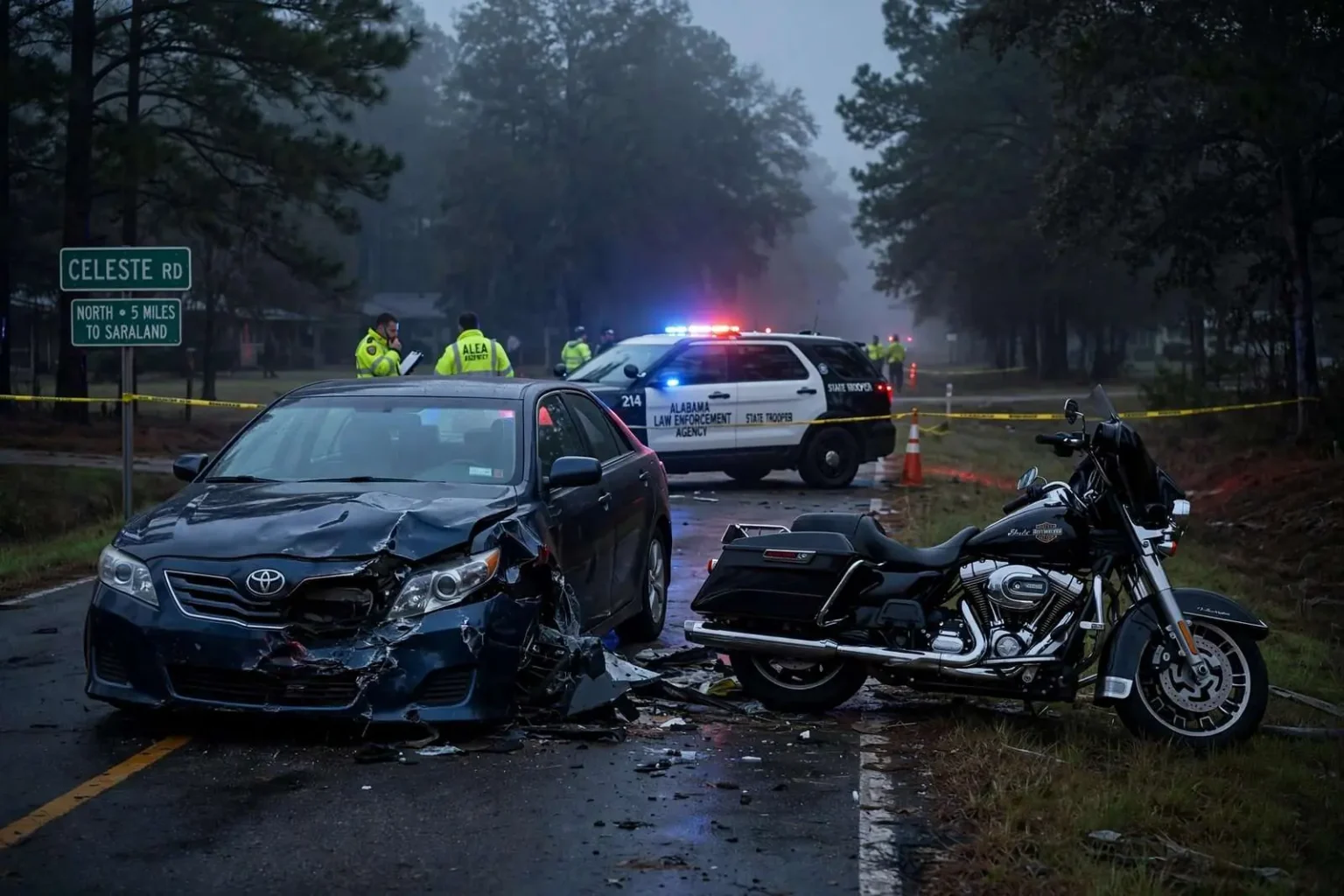
A 60-year-old Citronelle man was killed in an early-morning motorcycle crash in northern Mobile County, according to the Alabama Law Enforcement Agency. Thomas W. Graham Jr. was pronounced dead at the scene after the 2015 Harley-Davidson Electra Glide he was riding struck a 2008 Toyota Camry on Celeste Road, roughly five miles north of Saraland. Troopers said the collision happened at about 5:34 a.m. Wednesday, Jan. 11.
The timing of the crash — well before sunrise in mid-January — meant the rural stretch of Celeste Road was dark at the time of the collision. Morning commuters, delivery drivers and early-shift workers travel the roads of northern Mobile County in pre-dawn hours, and darkness is a recurring factor in the crashes ALEA troopers investigate across the region.
Troopers with ALEA’s Highway Patrol Division are continuing to investigate the crash, and no further details have been released. In fatal crashes, that work typically includes reconstructing the sequence of events, examining both vehicles and documenting the roadway before any determination is made about contributing factors.
Graham was pronounced dead at the scene by the Mobile County authorities who responded along with troopers. His death is among the first Mobile County traffic fatalities of the new year.
The crash site: Celeste Road north of Saraland
Celeste Road runs through rural northern Mobile County, connecting communities along the U.S. Highway 43 corridor between Saraland and Citronelle. The stretch where the crash occurred, about five miles north of Saraland, is a two-lane road flanked by wooded land, home sites and small farms — a typical north Mobile County landscape where traffic is light but speeds are higher than in town.
Rural two-lane roads account for a disproportionate share of Alabama’s serious traffic crashes. Narrow shoulders, limited lighting and a mix of passenger cars, trucks and motorcycles sharing the pavement all contribute to the risk, particularly in the dark morning and evening hours.
The collision between a motorcycle and a passenger car highlights a risk pattern troopers see repeatedly: riders on touring bikes like the Electra Glide often travel year-round along the Gulf Coast, where mild winters keep motorcycles on the road even in January, and interactions with other vehicles at intersections and driveways can turn catastrophic.
Who investigates fatal crashes in Alabama
The Alabama Law Enforcement Agency, formed in 2015 by consolidating the former Department of Public Safety and other state agencies, handles crash investigation on Alabama roads through its Highway Patrol Division. Troopers investigate fatal and serious-injury crashes, issue initial reports and work with local coroners and district attorneys when charges may be warranted.
In a fatal crash like this one, troopers document the scene with photographs and measurements, often using specialized teams for reconstruction in complex cases. Vehicle damage, roadway marks and the final resting positions of the vehicles all become evidence used to establish how the collision occurred.
ALEA typically does not release extensive detail while an investigation is ongoing, and contributing factors such as speed, visibility or the actions of either driver generally are not made public until the investigation is complete. The agency’s findings can be used by the Mobile County District Attorney’s Office if any criminal charges are considered.
The victims and communities involved
Thomas W. Graham Jr. was a 60-year-old resident of Citronelle, a city of about 3,900 people in the far northern reaches of Mobile County. Citronelle sits roughly 35 miles north of Mobile and is known for its history as an oil and gas town, its railroad heritage and the forests and rolling terrain that distinguish it from the coast.
Graham would likely have been traveling the network of rural roads that ties Citronelle to the rest of the county, where Saraland serves as one of the principal commercial centers. That daily pattern of travel between northern Mobile County communities and the cities along Highway 43 puts riders and drivers on roads like Celeste Road at all hours.
The driver of the 2008 Toyota Camry struck by the motorcycle was not identified in ALEA’s preliminary information, and no details about injuries in that vehicle were released. Investigators will interview the driver as part of the standard workup in a fatal crash.
Motorcycle safety on Gulf Coast roads
Alabama’s Gulf Coast climate allows year-round riding, and touring motorcycles are a common sight on Mobile County roads even in winter. The Harley-Davidson Electra Glide, a heavyweight touring model, is popular with experienced riders who use it for long-distance travel as well as daily transportation.
Safety officials consistently urge riders to wear helmets — required by Alabama law for all riders — to use high-visibility gear in low light, and to assume that other drivers may not see them at intersections. Drivers, meanwhile, are reminded to check twice for motorcycles, particularly at dawn and dusk when visibility is limited.
Pre-dawn hours carry specific hazards: darkness hides both motorcycles and hazards on the roadway, and wildlife crossings are common on rural roads like Celeste Road. Fatigue and reduced visibility in the early morning make the period around sunrise one of the more dangerous times on Alabama’s rural highways.
What happens after a fatal crash
After a fatal collision, the sequence is well established. Emergency crews respond and attempt lifesaving measures; the county coroner’s office takes custody of the deceased; and troopers close the roadway while they document the scene. Investigations can take weeks to finalize, with toxicology testing of involved parties often the slowest component.
Once the investigation concludes, ALEA issues its final crash report, which insurance companies, courts and families rely on. If the evidence shows a violation contributed to the death, the case may be referred for prosecution under Alabama’s traffic homicide laws.
For the family, the process includes making arrangements and, in many cases, waiting months for final answers. Victim advocates and coroner’s offices in Mobile County help families navigate the steps that follow a sudden loss on the highway.
Rural roads and the response network
Northern Mobile County is served by a patchwork of volunteer fire departments, county rescue squads and municipal services, all of which can be called into a serious crash on roads like Celeste Road. Response times in rural areas run longer than in the cities, which is one reason officials emphasize that the minutes immediately after a collision are critical to survival.
When a rider is down, bystanders are urged to call 911 immediately and, if trained, begin first aid while help is on the way. Troopers and coroner’s officials then handle the scene according to the state’s fatal crash protocol, which includes documentation, notification of next of kin and a formal report.
Crashes on rural two-lane roads also often require closing the roadway entirely, rerouting traffic onto alternate county roads. Residents of the Celeste Road area saw that disruption Wednesday morning as troopers worked the scene into daylight hours.
What riders and drivers should know
Troopers point to a handful of habits that repeatedly reduce motorcycle fatalities: full-face or approved helmets, reflective gear in darkness, managing speed on unfamiliar rural roads, and never assuming an oncoming driver has registered a motorcycle’s approach. For drivers, the guidance is to scan for motorcycles at intersections and driveways, allow extra following distance and avoid distractions during the low-light hours when a rider is hardest to see.
Alabama’s motorcycle safety program offers rider courses around the state, and experienced riders often refresh their skills after the winter months. On touring machines like the Electra Glide, rider training emphasizes braking distance, cornering and swerving techniques that can make the difference in a sudden encounter with another vehicle.
Remembering Thomas W. Graham Jr.
Thomas W. Graham Jr. was 60 years old and lived in Citronelle, in northern Mobile County. He died where the crash occurred, on Celeste Road about five miles north of Saraland, at approximately 5:34 a.m. on Wednesday, Jan. 11.
News of a fatal crash travels quickly through small communities like Citronelle, where residents are closely connected and traffic fatalities touch extended networks of family, church and work. Neighbors in the area of Celeste Road reported the heavy emergency response in the dark morning hours as crews worked the scene.
Friends and family members mourning a loss like this often gather through local churches and community organizations, and the close-knit nature of northern Mobile County’s towns means the effects of the crash extend well beyond the two vehicles involved.
A reminder for the new year
January begins the period when Alabama’s crash statistics are tallied for the year, and early-morning crashes like this one are a recurring category in the state’s data. State and local safety campaigns urge all drivers to slow down, buckle up and stay off their phones, and they ask motorcyclists to ride defensively and make themselves visible.
The Gulf Coast Newsroom will provide updates on the investigation as ALEA releases additional information about the crash on Celeste Road.