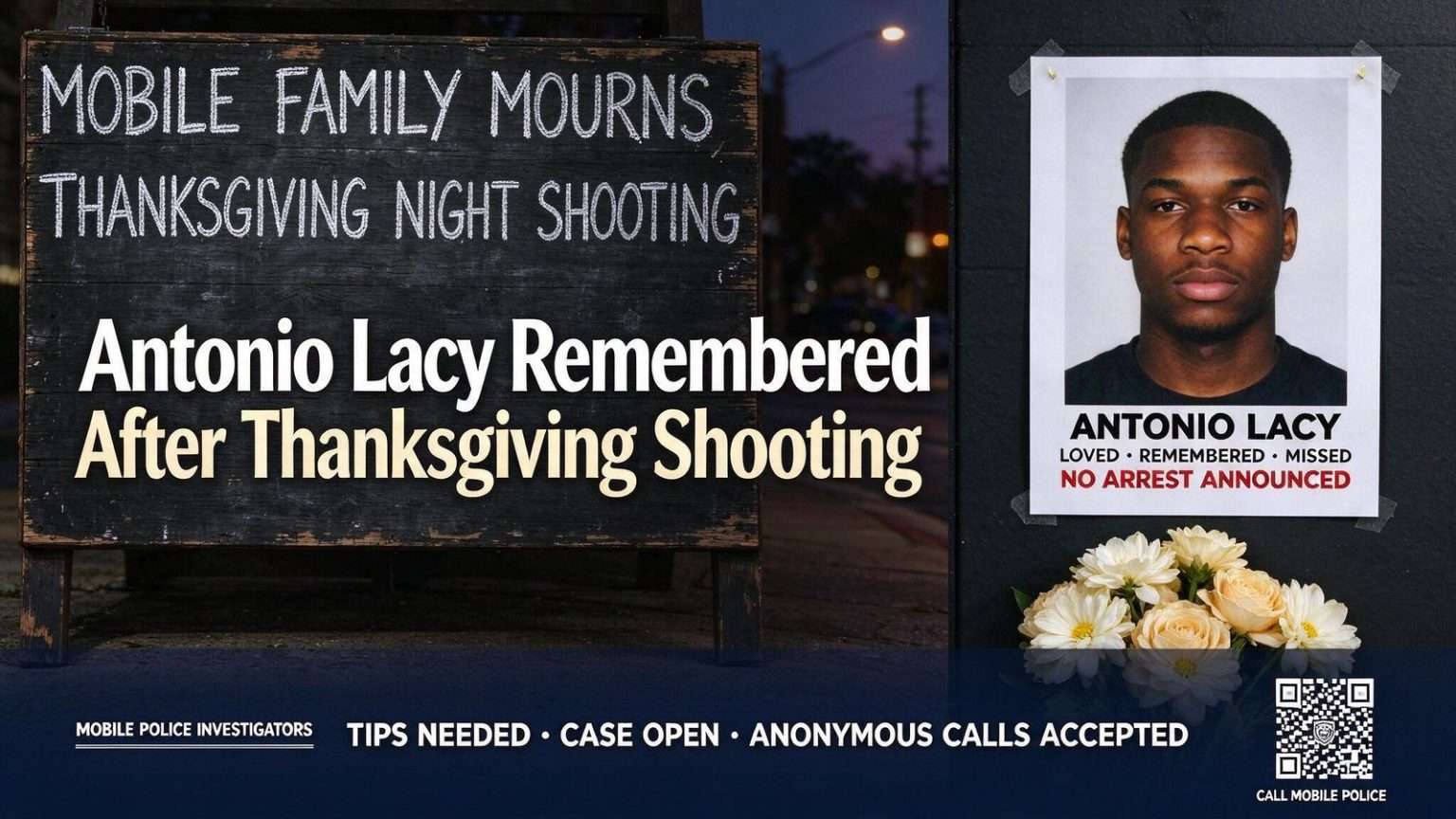
A Mobile family is grieving after a 23-year-old man was shot and killed on Thanksgiving night, just over a year after he survived being shot multiple times in an earlier, unrelated incident. Antonio Lacy was killed the evening of Thanksgiving Day, not long after finishing dinner with family, according to relatives, turning a holiday that had begun around the table into the family’s second loss of the season.
Mobile police say he was shot at least 10 times in the attack, which occurred in the days following what family members described as an earlier attempt on his life just days before. The holiday timeline has made the loss harder for relatives to absorb: family members said Lacy had spent part of the day with them, and the violence that took his life came within hours of that last meal together.
Lacy’s father told reporters that he had grown concerned for his son’s safety earlier that week after learning someone had shot at him the previous Sunday. He said he spent hours on Thanksgiving looking for his son, hoping to convince him to stay somewhere safer, but was unable to reach him before the fatal shooting occurred, a detail the family has described as the hardest part of the story to carry.
Family members held a visitation for Lacy at a Mobile funeral home on Broad Street, with funeral and burial services following the next day. Relatives and friends who attended the service described Lacy as someone with an easygoing personality who had been working to turn his life around after a difficult stretch of years, and mourners filled the visitation to offer support to a family coping with its second brush with gun violence in little more than a year.
Mobile police have not announced an arrest in connection with the Thanksgiving killing, and investigators continue to work the case. Anyone with information about the shooting has been urged to come forward, as is typical in cases where detectives lack a named suspect and rely on tips from the community to develop leads.
A survivor of an earlier shooting
The shooting was not the first close call for the young father of two. According to family members, Lacy nearly died in 2013 after being shot 10 times in a separate incident that occurred shortly after his release from custody, a survival that relatives once hoped would mark the end of the danger that shadowed him.
That earlier attack left Lacy with wounds that could easily have been fatal, and his recovery became part of the family’s story of resilience. Relatives said they had hoped his survival of the earlier 2013 shooting would serve as a turning point, a chance for the young man to build distance between himself and the circumstances that put him in harm’s way the first time.
Court records show he had pleaded guilty to several charges in prior years, including burglary, theft and escape, a record that placed him in and out of custody during the years between his teenage days and his death. Family members do not dispute the record, but they describe a young man who, in the months before Thanksgiving, appeared committed to a different path than the one his late teens had followed.
Family members said Lacy had lost his mother the year before his death and had been working to build a more stable life for himself and his children in the months leading up to the Thanksgiving shooting. Relatives said the deaths so close together — mother and son within roughly a year — have left the family navigating grief on two fronts while caring for the two children Lacy left behind.
A family’s thanksgiving turned to mourning
The details of the holiday itself have stayed with relatives who recounted the day. Dinner, they said, was ordinary in the best sense: food, conversation, the kind of gathering families measure the rest of the year against. Lacy left afterward, and by evening his father was still searching the city for him, worried about the Sunday shooting he had learned of days earlier and hoping to persuade his son to lie low somewhere safer until the danger passed.
The father’s account of that search — hours spent driving and calling, trying to get ahead of the violence he sensed was coming — has resonated with Mobile families who have lived through similar countdowns. In the end, the effort fell short, and the call every parent dreads came on a night the family had expected to spend celebrating.
Those who attended the visitation and funeral described a young man remembered with affection rather than defined by his record. Friends spoke of his easy laugh and willingness to help, and relatives said his children were never far from his thoughts as he worked toward stability. The services drew mourners from across the community, including many who had known the family through the years and had watched Lacy grow up in Mobile.
Gun violence and Mobile’s families
The case remains part of a broader pattern of violent crime that has affected families across the city, a pattern that community leaders, clergy and neighborhood organizations have worked for years to interrupt. Mobile, like cities across Alabama and the country, has seen shootings concentrate among young men with prior records, and the cycle of retaliation that follows such violence has made intervention work — mentoring, mediation and street outreach — a growing part of the local response.
The dynamics in Lacy’s death mirror what violence-prevention workers describe as a familiar sequence: an initial shooting, a survivor believed by some to be marked for a second attempt, and a window in which de-escalation either happens or does not. Lacy’s father said he understood the danger clearly enough to spend Thanksgiving looking for his son, and his account illustrates both the warning signs families often see and the limits of what they can do once the danger is set in motion.
For families left behind, the aftermath extends well beyond the funeral. Young children lose a parent, households absorb sudden funeral costs, and relatives live with the knowledge that an arrest has not been made and may never be. Mobile’s victim services network and faith communities provide support in such cases, but relatives say the practical and emotional weight falls hardest on the mothers, fathers and grandparents who raise the children left behind.
What comes next in the case
The Thanksgiving timing places Lacy’s death among the holiday-period homicides that city leaders have repeatedly called on residents to help solve, noting that violent incidents cluster around gatherings where emotions run high and weapons are within reach. Each such case, advocates say, deepens the damage in neighborhoods already carrying the weight of previous losses, and each unsolved killing lowers the community’s confidence that reporting a shooting will lead anywhere.
Community groups in Mobile have responded in recent years with a mix of approaches, from candlelight vigils that keep victims’ names in public view to structured programs aimed at young people before their first arrest rather than after their last release. The gap those programs try to close — between a record like Lacy’s and a stable path forward — is precisely the space his family says he was working to cross when Thanksgiving ended his efforts.
With no arrest announced, the investigation into Lacy’s death remains open. Mobile police typically work holiday shootings with the same tools applied to any homicide: canvassing for witnesses, reviewing surveillance footage from nearby homes and businesses, and following up on tips submitted through the department’s lines. Investigators have emphasized that even fragments of information — a vehicle description, a voice heard nearby, a comment made in passing — can move a case forward weeks or months after the fact.
Relatives have asked anyone who knows anything to speak with investigators, saying the family cannot begin to heal while the person responsible remains free. The plea is a familiar one in Mobile’s faith and neighborhood circles, where unsolved killings leave families in a holding pattern of grief and vigilance, marking birthdays and holidays with one question unanswered.
For now, the family is focused on Lacy’s children and on remembering him the way mourners described him at the visitation: a young man with an easygoing spirit who had stumbled but was trying, in his final months, to stand on steadier ground. The Thanksgiving meal he ate with them hours before his death has become, in the family’s telling, the memory they hold onto — a last ordinary moment before the violence that took him.
Anyone with information about the Thanksgiving night shooting is urged to contact Mobile police or the department’s tip channels, where callers can remain anonymous. For the Lacy family, the hope is simple and repeated by relatives at the funeral home on Broad Street: that someone who saw something will say something, so that a father who spent his last Thanksgiving searching for his son can at last stop searching for answers.