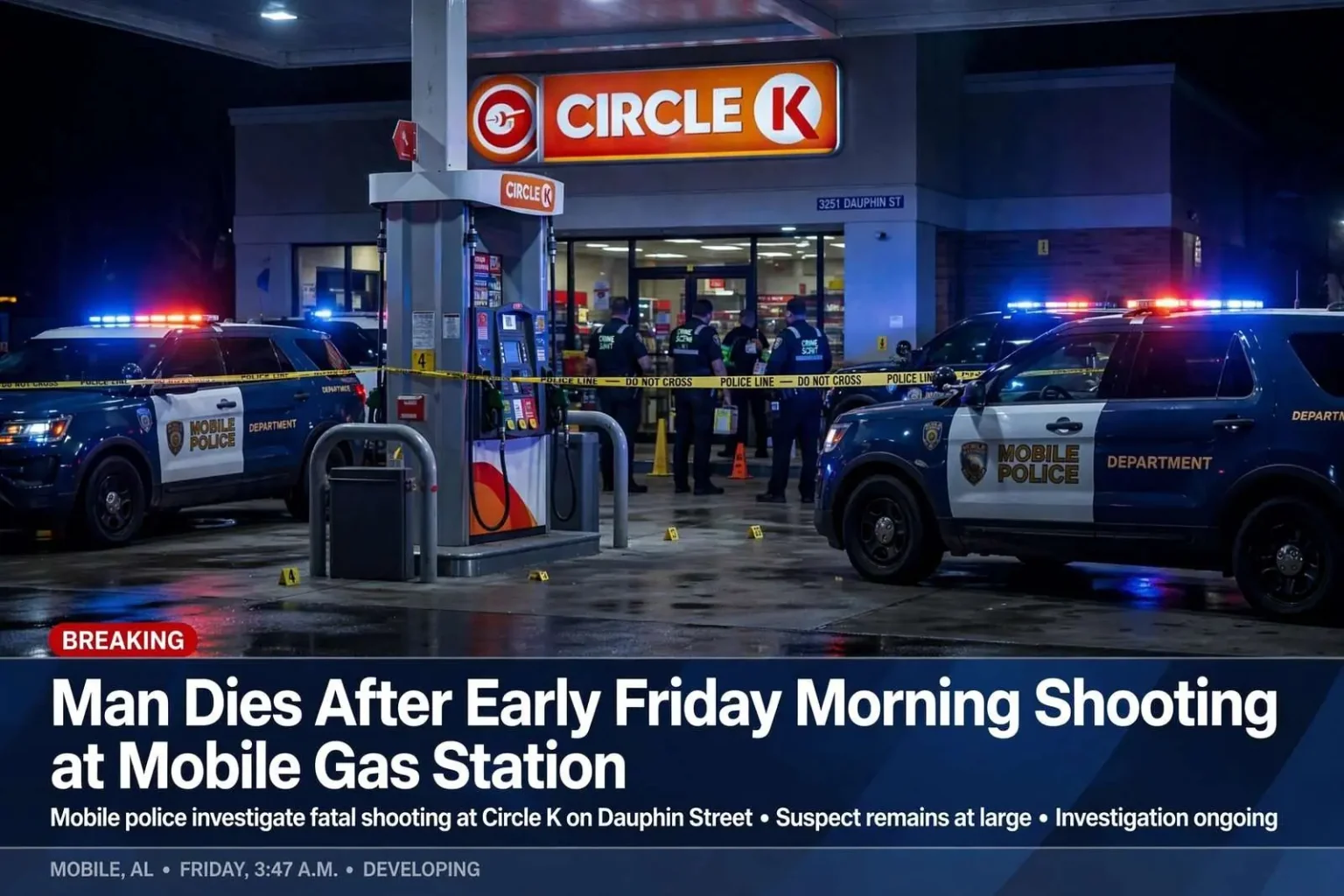
Mobile police are investigating a fatal shooting that occurred early Friday morning at a gas station on Dauphin Street, adding another homicide to the city’s caseload as investigators work to identify who pulled the trigger.
According to the Mobile Police Department, officers responded to a report of a shooting at approximately 3:47 a.m. and found an injured victim at the Circle K located at 3251 Dauphin Street. Officers and medical personnel provided aid, but the victim later died of his injuries, police said. The case is being investigated as a murder, and police said a suspect remains at large.
Investigators have not released further details about the victim’s identity or a possible motive. In the hours after such a shooting, detectives typically work to pull surveillance footage from the business and surrounding properties, canvass for witnesses who may have been in the area before dawn, and wait on the findings of the medical examiner’s office, which formally establishes the cause and manner of death. None of those threads had produced a public break by the time police released their initial account.
What Investigators Are Doing
A homicide investigation of this kind begins with securing the scene. The gas station’s lot, its pumps and its store are treated as evidence territory, with patrol officers holding the perimeter until crime scene technicians photograph, measure and collect whatever the scene offers — shell casings, tire marks, items left behind. The 3:47 a.m. response time means the investigation unfolded in the dark, complicating both witness collection and scene work.
Surveillance video often becomes the spine of a case like this. Gas stations record continuously, and their cameras frequently capture the approach, the encounter and the departure of everyone involved, including vehicles that may have followed or fled with the shooter. Detectives will also request footage from nearby businesses and residences along the Dauphin Street corridor, looking for a trail that leads away from the scene.
Police have not said whether they believe the shooting was random or targeted, and they have not described a suspect beyond confirming that no one is in custody. That silence is standard early in a murder investigation, when disclosing details could compromise the case. What is clear is that the department considers the death a murder and is treating the search for the shooter as an active, open investigation.
The Dauphin Street Corridor
The Circle K at 3251 Dauphin Street sits along one of Mobile’s major east-west arteries, a commercial corridor lined with businesses, churches, schools and neighborhoods that stretch from the western suburbs toward the city’s core. Late-night violence along commercial corridors is a persistent challenge for cities across the Gulf South, and the businesses that operate around the clock often become the settings where overnight incidents unfold.
For the surrounding community, a fatal shooting at a familiar landmark reverberates beyond the immediate scene. Residents who pass the location daily are asked to remember anything unusual they saw in the hours around the shooting, and the department’s appeal for information is directed at exactly that pool of potential witnesses — people who may hold a detail they do not yet realize matters.
About the Mobile Police Department
The Mobile Police Department is the law enforcement agency responsible for policing Alabama’s third-largest city, a port community of neighborhoods stretching from downtown and the waterfront to the expanding western reaches along Airport Boulevard and Cottage Hill Road. The department patrols the city around the clock, and its overnight shifts handle the window in which incidents like Friday’s shooting occur — when traffic is light, witnesses are few, and the darkness shapes everything that follows.
MPD investigates crimes ranging from property offenses to violent felonies, and it routinely asks members of the public to share tips that may aid an investigation. Its investigations division separates casework by category, with homicide detectives carrying the city’s most serious cases from the first patrol response through arrest, testimony and trial preparation. Those detectives work scenes like the one on Dauphin Street against a clock: the first days of a homicide investigation are when memories are freshest and digital evidence is most recoverable.
The department works alongside the Mobile County District Attorney’s Office, which prosecutes state criminal cases, and with state and federal agencies on matters that cross jurisdictional lines. When a suspect in a Mobile homicide is identified, the path from warrant to conviction runs through that partnership — MPD builds the case, the DA’s office presents it to a grand jury and tries it in Mobile County Circuit Court, and federal partners step in when a case touches interstate or firearms statutes that carry federal jurisdiction.
How the Public Can Help
Residents can report non-emergency information through the department’s tip line and through national crime-reporting programs. Tipsters who want to remain anonymous can submit information without giving their names, and programs tied to the system can pay rewards for tips that lead to arrests in serious cases. Detectives emphasize that even fragments — a description of a vehicle, a glimpse of someone running from the scene, a comment overheard afterward — can supply the missing piece in a case built from a handful of hours of darkness.
The distinction between emergency and non-emergency channels matters at hours like the ones after Friday’s shooting. Urgent sightings or imminent dangers go through 911; everything else — recollections, photographs, video files — flows through the tip lines that feed detectives working the case. The department’s repeated message in cases like this one is direct: anyone who knows something should come forward, because a killer at large remains a danger to the community until an arrest closes the file.
For the victim’s family, the investigation’s pace is measured in grief. Homicide cases in Mobile and across the country routinely take weeks, months or longer to reach an arrest, and detectives describe them as puzzles assembled from thousands of small pieces — canvass notes, phone records, video files, forensic results. The department has committed its investigations division to the case, and the appeal for public help is the standing offer that accompanies every unsolved killing: the community holds pieces of the answer, and police are asking for them.
When Police Arrive at the Scene
The sequence that began at 3:47 a.m. follows a choreography every patrol officer knows. First units on scene address the victim — aid rendered while the scene is frozen around them. A supervisor takes command, the perimeter is set, and detectives are called out from home if the victim’s wounds prove fatal. Once the death is confirmed, the investigation shifts classifications and stakes: the medical examiner is notified, the scene is held indefinitely, and the case formally becomes a murder investigation.
The location adds its own evidence channels. A Circle K that operates overnight has employees on shift who were present at 3:47 a.m., registers and transaction logs that timestamp everyone who stopped in the minutes before and after, and exterior cameras that face the pumps and the street. Combine that with the witnesses an early-morning scene can produce — delivery drivers, late-shift workers, passersby — and investigators have a finite but real set of threads to pull.
What happens next is deliberately unglamorous. Detectives will re-interview the people on scene, run the victim’s history and associations, and compare the case against others in the area for patterns. If the department believes the public is in danger from an unknown shooter, it will say so; its initial release stopping short of that assessment signals an investigation still forming its picture of what happened.
The Community’s Stake
Every homicide case in Mobile carries costs that extend past the victim’s circle. A business absorbs the disruption of a crime scene at its front door; a neighborhood absorbs the fear; and the courts absorb the eventual weight of prosecution. City leaders and police across south Alabama have repeatedly tied violence reduction to community cooperation — the recognition that the majority of serious cases are solved when someone who knows decides to speak.
The department’s outreach in cases like Friday’s shooting also reflects how Mobile policing works in practice. Officers who patrol the Dauphin Street corridor know the businesses and residents along it, and tips that flow in after a public appeal are worked by detectives who can act on them immediately. The connection between a neighborhood’s willingness to share information and an arrest is the reason every MPD release ends the same way: with the phone numbers, and with the request.
As of the latest update, no suspect had been named, no arrest had been announced, and the investigation remained active. Anyone with information about the fatal shooting at the Circle K at 3251 Dauphin Street is asked to contact the Mobile Police Department.
Homicide Cases and the Path Through Court
When a suspect is eventually charged, the machinery of Alabama’s criminal justice system takes over. An arrest warrant issued on a murder charge leads first to Mobile County Metro Jail, then to a preliminary process that moves the case toward a grand jury. In Alabama, murder prosecutions are tried in circuit court, and a conviction can carry a sentence of decades to life — the stakes that explain both the length of these investigations and the care taken before charges are filed.
The District Attorney’s Office prosecutors who take such a case work from the file the detectives build: the scene evidence, the autopsy, the video, the witness statements and the forensic results. Cases built on strong public tips and solid digital evidence tend to move faster; those that depend on lab work can stretch for months before an indictment. Through it all, the family of the victim is kept in the loop by investigators whose caseload rarely allows for quiet weeks.
Mobile’s homicide detectives work more than one active case at a time, which is why the department so frequently renews its appeals months after a killing. Anniversaries of unsolved cases, renewed media attention and the slow drift of former associates’ loyalties all create second chances for information to surface — and the department’s standing request is that the public take them.
A Corridor on Watch
In the days following the shooting, the routine around the Circle K will return to normal for most of the city, but not for everyone. The business’s overnight staff will remember the morning; the neighborhood will note the patrol presence; and the family at the center of it all will wait for the phone call that says an arrest has been made. That call begins with information — a name, a vehicle, a timestamp — and the Mobile Police Department has made clear where that information should go.
Until then, the case stands where Friday’s release left it: a man dead at a gas station before dawn, a suspect at large, and detectives assembling the answer one piece at a time. Anyone with information is asked to contact the Mobile Police Department, where tips about this case — like every case — are worked as they arrive.