Murphy High School Arts Students Stage Renaissance Gala to Fund Next Year’s Musical
Murphy High School's Four Arts students are staging a Renaissance-themed gala fundraiser in the cafeteria, since their auditorium remains storm-damaged.
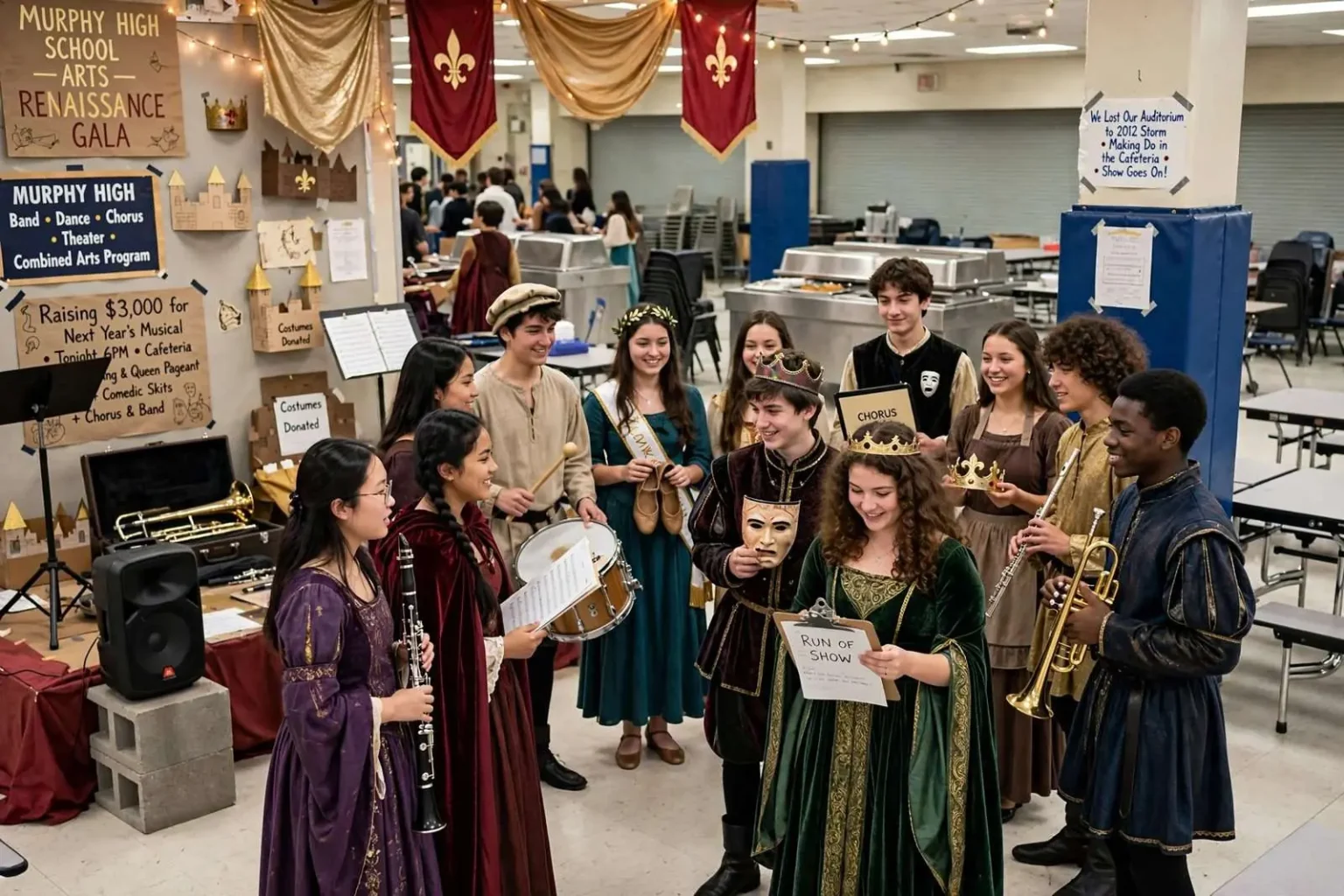
Students in Murphy High School’s combined band, dance, chorus and theater program are pressing ahead with their annual gala fundraiser this week, staging a Renaissance-themed showcase despite having lost their auditorium to storm damage more than two years ago.
The performance, which raises money to help fund the following year’s school musical, will be held in the Murphy cafeteria rather than the school’s traditional performance space.
A tornado that tore through the Mobile campus in December 2012 badly damaged the auditorium’s roof, sidelining the venue that once housed the program’s lights, sound system and large stage. Repairs remain incomplete more than two years later, forcing students to adapt their fundraising performances to whatever space is available.
This year’s show leans into an old-world theme, featuring a king-and-queen pageant format paired with comedic bits, an approach the program’s fine arts teacher said was chosen because the Renaissance period offers rich material to draw from.
About 40 students are expected to take part in the production, which organizers hope will raise roughly $3,000, an increase over the roughly $1,500 typically brought in during past years.
Making Do Without a Stage
Without a dedicated auditorium, the program has had to redirect some of its fundraising dollars toward renting outside venues and lighting equipment for larger productions, cutting into the budget available for costumes, sets and performance royalties.
The lack of a home venue has also limited students’ ability to hold full rehearsals ahead of competitions, though that hasn’t stopped them from succeeding: the group’s chorus students recently advanced from district competition to the statewide contest.
Faculty who run the program say they’ve worked to instill a resilient, audience-first mindset in their students despite the setbacks. The school’s chorus teacher said the students have responded well to being reminded that their performance matters more than the challenges behind it.
The cafeteria workaround is familiar to school performing-arts programs across Mobile County, where acoustics, sightlines and stage space in lunchrooms are poor substitutes for an auditorium. Riser blocks stand in for a stage, portable sound equipment replaces the wired system, and every setup and teardown consumes rehearsal time that a permanent venue would preserve.
The money the gala raises matters more under those conditions. Rental fees for outside venues and lighting packages can consume hundreds of dollars per production, and the program’s roughly $3,000 goal — double the typical take in past years — reflects the gap between what the shows cost now and what they cost when the auditorium’s lights still worked.
The Long Road to Repairs
The December 2012 tornado that struck the Murphy campus was part of a Christmas-week storm system that caused damage across Mobile, and the school’s auditorium was among the most significant casualties at the historic Midtown institution. More than two years later, the repair work remains unfinished, and the program has built its calendar around the uncertainty, scheduling performances in the cafeteria and borrowed spaces.
Murphy High School is one of Mobile County’s oldest and largest public high schools, and its arts programs have long been among the strongest in the region. The combined program — band, dance, chorus and theater under one organizational roof — gives students a range of performance opportunities that many larger schools cannot match, even without a functioning auditorium.
The Renaissance theme gives this year’s gala a pageant structure that suits a cafeteria setting: a king and queen preside, comedic bits fill the program between musical numbers, and the staging demands are modest enough to work without professional lighting. The fine arts teacher who designed the format said the period simply offers rich material — court intrigue, madrigal singing, colorful costumes — that students can perform well in limited space.
For the 40 participating students, the gala doubles as a rehearsal for bigger demands ahead. The program’s musical each year is its largest production, typically staged off-site or adapted to available space while the auditorium is out of service, and the gala’s proceeds underwrite that production’s rights, sets and costumes.
The chorus students’ advance from district to state competition offered the program a highlight amid the disruption, and faculty said the competitive success showed that the loss of a venue had not cost the students their preparation. What it has cost, teachers said, is time and flexibility — full-company rehearsals are hard to schedule in shared spaces, and every rental event competes with the regular school calendar for the cafeteria.
What the Money Funds
The gala’s roughly $3,000 target would cover a meaningful slice of the musical’s budget. School musical productions carry expenses that audiences rarely see: performance royalties paid to licensing houses, set materials, costume rentals or construction, and the technical costs of sound and lighting — the last of which has grown for Murphy since the school must rent lighting equipment for larger shows.
Royalties alone can run into the hundreds or thousands of dollars for a full musical, depending on the title and the licensing agreement, which is why fundraising galas are a fixture of school arts programs. The Murphy program’s structure — combining band, dance, chorus and theater — multiplies the expense and the benefit, since a single musical draws musicians, dancers, singers and actors from across the program.
Program faculty have framed the gala as both a fundraiser and a performance opportunity, giving younger students stage experience in a low-stakes format before the musical’s demands arrive. The pageant-and-comedy format puts students in front of an audience in character work, small ensemble numbers and hosting roles that build the confidence a full production requires.
Arts Education Under Pressure
Murphy’s gala arrives amid broader pressures on school arts funding across Alabama, where programs routinely depend on ticket sales, fundraisers and booster clubs to cover costs that school budgets do not. Educators in the arts have long argued that performances generate the revenue and community support that keep programs alive, and Murphy’s students have embodied that argument by continuing to compete and perform through more than two years without their home venue.
The storm damage also connects to a larger story in Mobile County schools, where aging buildings and storm vulnerability have driven capital needs that outpace repair schedules. An auditorium roof is the kind of repair that requires district-level funding, contractor bids and scheduling, and the two-year wait illustrates how long that process can stretch even for a flagship school.
In the meantime, the program’s calendar has become an exercise in adaptation. Competitions go on as scheduled, with students rehearsing in sections and combining shortly before events. Larger productions move to rented venues or are scaled to the cafeteria. And the annual gala, the program’s signature fundraiser, has become a test of how much the show can accomplish without the stage it was designed for.
Faculty have leaned on the lesson they most want students to carry: the audience is the point. The chorus teacher’s reminder that the performance matters more than the challenges behind it has become the program’s operating principle, and this week’s Renaissance gala is the latest expression of it — 40 students, a cafeteria, and a show that goes on.
Community members who want to support the program have a direct path: attending the gala, whose proceeds flow straight into next year’s musical. For a program that has doubled its fundraising goal out of necessity, the audience is not just an audience — it is the difference between a full production and a scaled-back one.
The gala also serves as a public accounting of sorts for the auditorium’s absence. Each performance in the cafeteria is a reminder that the repairs have not yet come, and each successful show is an argument that Murphy’s arts students will make the most of whatever space the district eventually gives them back.
The Program Behind the Gala
Murphy’s combined arts program is unusual among Alabama high schools for how it groups disciplines. Rather than running band, dance, chorus and theater as separate fiefdoms, the program coordinates them, letting a musical draw its orchestra from the band room, its dancers from the dance classes and its leads from theater and chorus alike. Students frequently cross over, and the gala reflects that breadth, with numbers from each discipline woven into the pageant format.
That structure also spreads the fundraising burden and the benefit. When the gala clears $3,000, it supports a production calendar that includes the musical, choral competitions, band performances and dance showcases — all of which carry costs for music, licensing, costumes and transportation to events across the region.
The students who advanced to state chorus competition did so by working through the district round under the same handicaps that shape every performance: limited rehearsal space and no home stage. Faculty said the result validated the program’s emphasis on fundamentals — sight-reading, blend, discipline — that transfer to any venue, whether a competition hall or a cafeteria.
Waiting on the Auditorium
For Midtown Mobile, the Murphy auditorium has historically been more than a school facility. Its size and stage made it a venue for school-system events and community gatherings, and its loss has been felt beyond the student body. The December 2012 tornado damage, coming in the same Christmas week as other storm losses across the Gulf Coast, added Murphy to the list of Mobile institutions carrying storm-repair needs years after the event.
Roof repairs on a large auditorium involve structural assessment, moisture remediation and phased construction, and school districts must sequence such work against other capital priorities. The practical effect for students has been a two-year lesson in flexibility: plan for the space you have, not the one you expect to get back.
Program faculty have turned that constraint into curriculum of a kind. Students help load in and load out equipment for shows, learn to light a stage with rented gear, and adapt blocking and choreography to unconventional spaces — skills professional touring performers use routinely. The Renaissance gala, with its pageant structure and comedy bits, was designed to thrive in exactly that environment: minimal set, strong performances, and a format that works whether the room is a theater or a lunchroom.
When the auditorium finally reopens, the program will have a backlog of ambitions to stage — full-scale productions, technical theater projects and the rehearsal schedule the venue would restore. Until then, the gala’s king and queen will preside over a cafeteria, and the show, as the program’s teachers keep reminding their students, is what matters.