Baldwin County Officials Plan Joint Meeting After School Tax Vote Fails
Baldwin County leaders are holding a joint commission-school board meeting for public input after voters rejected a major school tax package.
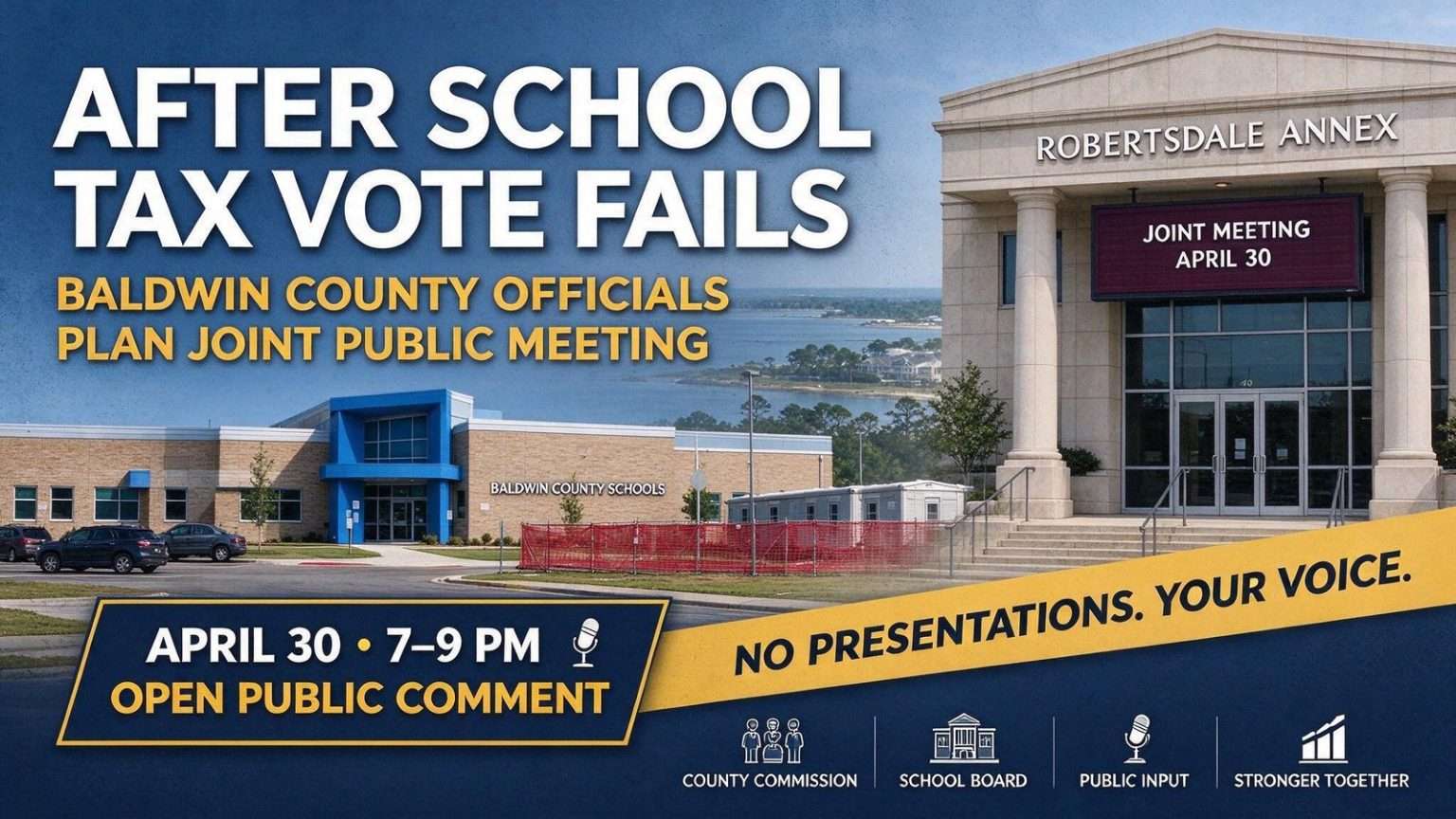
Baldwin County officials are planning a joint public meeting later this month between the County Commission and the School Board, an unusual gathering aimed at giving residents a direct say in the school system’s future after voters rejected a major tax package earlier this spring.
Commission Chairman Charles “Skip” Gruber said the meeting, set for the evening of April 30 at the commission’s Robertsdale annex, will run from 7 to 9 p.m. and will skip the usual administrative presentation in favor of open public comment. “We want input from the citizens,” Gruber said, adding that he specifically does not want the session to turn into a forum for residents to vent frustration or assign blame following the failed referendum.
The ground rules reflect what is at stake. Baldwin County is among the fastest-growing counties in Alabama, and its school system has been racing to build classroom space for the families arriving along the Eastern Shore, the I-10 corridor and the coast. A failed tax package does not make that growth pause; it leaves officials searching for another way to pay for it, and the April 30 meeting is designed to let the public shape that search rather than merely hear its result.
What voters rejected — and approved
The meeting comes after voters resoundingly rejected two proposed property tax increases totaling 8 mills that would have funded a 10-year, $350 million school expansion plan intended to relieve overcrowding across the district. The plan was one of the most ambitious facility proposals in the county’s history, aimed at campuses from the bay area to the beach, and its defeat left the district’s building program without a funding source.
Voters also rejected two of three separate mill renewals worth roughly $14 million combined, though they did approve a third renewal covering 3 mills. The split result complicates the picture: the electorate was not uniformly opposed to school taxes, since it renewed one measure outright, but it declined to continue two others that keep existing schools running rather than build new ones.
Local officials have since raised concerns that if the rejected renewals are not eventually approved in some form, the district could lose approximately $7 million in funding. That is the quiet crisis behind the louder referendum fight — money that pays for current operations, not new construction, and money that disappears if the renewals simply lapse. County leaders will be weighing how to make that case without appearing to relitigate a vote the public has already cast.
A scheduling dispute of its own
The process of scheduling the meeting itself became a small point of friction within the school system. Because it was arranged while schools were on spring break, at least two School Board members initially said Superintendent Robbie Owen was unaware the meeting had been scheduled at all, learning about it only after it was reported publicly.
School Board President Norm Moore said he found that sequence of events “a little disconcerting,” while board member Tony Myrick said he had assumed Owen was in the loop from the start and would not attend if the superintendent had genuinely been left out of the planning. The exchange, brief as it was, exposed the sensitivities between two boards that are legally separate but operationally intertwined — the commission levies and the schools spend, and neither can plan without the other.
County officials pushed back on that characterization. Gruber said Owen is aware of the meeting and intends to attend along with members of his staff, and a Baldwin County school system spokesman confirmed that Owen is on board with the plan and will be present. With that settled, the focus shifted back to the meeting’s substance — and to how a county recovers from a referendum defeat without deepening the divisions it revealed.
Where the next schools should go
Beyond addressing the immediate fallout from the failed referendum, the meeting is expected to touch on how the district should proceed with any future school construction. Board member David Cox has floated a piecemeal approach that would prioritize construction in Bay Minette and Gulf Shores, arguing that overcrowding is most severe in those communities.
The geography of Cox’s proposal matters. Bay Minette, the county seat in the county’s interior, and Gulf Shores, the beachfront city at its southern end, sit at opposite corners of a county that is geographically among the largest in Alabama. Prioritizing them means accepting that growth along the Eastern Shore and the I-10 corridor would wait — a trade-off that other communities’ representatives are unlikely to accept without argument.
Moore, however, has pushed back on that framing, questioning why other growing communities such as Spanish Fort would not also warrant priority consideration. Spanish Fort’s explosive residential growth over the past two decades has made its schools a perennial pressure point, and Moore’s objection captures the central dilemma of school construction in a fast-growing county: every corner of it can make a credible claim to need, and a piecemeal plan picks winners and losers by definition.
That tension is exactly what a joint meeting is suited — or unsuited — to resolve. Public comment sessions tend to amplify whichever communities pack the room, and the risk for officials is that the April 30 hearing becomes a competition between municipalities rather than a countywide strategy session. Gruber’s insistence that the evening not become a blame forum suggests both chairmen understand how fragile the goodwill around school funding currently is.
After the referendum: what comes next
The April 30 gathering will mark the first public forum held jointly by the commission and school board since the referendum failed, and is likely to shape how — and whether — county officials attempt another run at securing tax renewals or new funding mechanisms for the district’s long-term facility needs.
The options on the table generally come in three shapes: return to voters with a revised tax package, scale the building program down to what existing revenue supports, or find financing that does not require a referendum at all. Each has a different politics. A second referendum invites a second defeat; a scaled-down program tells fast-growing communities to wait; and non-referendum financing moves decisions further from the voters who just rejected the plan — a move that rarely goes unnoticed in a county with an active taxpayer community.
The renewals add urgency to the choice. Because two renewal measures failed alongside the new taxes, the district faces an operating-revenue gap of roughly $7 million, not merely a construction shortfall — meaning officials must decide quickly whether to ask voters to reconsider the renewals alone, stripped of the more contested expansion plan. Some county leaders believe a clean renewals-only ballot could fare very differently than the combined package did.
For residents, the Robertsdale meeting is the first chance to say which of those paths they would support — and the first test of whether, a month after the votes were counted, the county’s two governing boards can talk about schools in the same room without the referendum’s residue hardening into positions. Gruber’s open-microphone format gives citizens the floor; what the boards do with what they hear will determine whether the county’s school building debate restarts this year or stalls for another cycle.
Why overcrowding defines the debate
The overcrowding Cox and Moore both cite is the product of demographic arithmetic that Baldwin County has been running for a generation. New subdivisions along the Eastern Shore, continued growth around Spanish Fort and Daphne, residential development in the county’s central corridor and steady coastal building in the Gulf Shores area have pushed enrollment upward faster than classroom capacity almost everywhere at once. Portable classrooms and boundary adjustments have absorbed much of the strain, but both are stopgaps that communities notice and dislike.
The failed $350 million plan was designed to replace that improvisation with buildings — new campuses, expansions and core facilities sized for a decade of growth. Its rejection leaves the district managing capacity with the tools it had before, which is why the post-referendum conversation has immediately turned to prioritization rather than whether to build at all. Nobody on either board argues the crowding is imaginary; the dispute is over whose relief comes first.
For parents, the practical stakes show up in daily details: class sizes, lunch periods that start mid-morning, teachers sharing rooms and bus routes that stretch as attendance zones shift. Those symptoms accumulate quietly in fast-growing systems, and they are what residents will be describing at the microphones in Robertsdale — specific, local and hard to dismiss as abstractions about millages.
What residents can expect on April 30
The meeting’s format — two hours, no presentation, open comment — is rare enough that attendees should plan for a wide-ranging evening. Without a slide deck to anchor discussion, commissioners and board members will hear whatever the room brings: crowding stories from specific campuses, questions about how millages work, opinions on whether taxes were the problem or the message, and doubtless a measure of the frustration Gruber hopes to keep constructive.
Officials on both boards will be listening for signals they can act on. Whether speakers separate the renewals from the failed expansion plan will matter, since that distinction offers the most immediate policy path — protecting roughly $7 million in existing funding is a materially different ask than reviving a $350 million construction program. Whether the room is dominated by one municipality’s parents will also shape the priorities debate between Cox’s Bay Minette–Gulf Shores approach and Moore’s wider framing.
Whatever the boards take away, the joint meeting marks a deliberate change in how Baldwin County makes school funding decisions: not behind closed doors followed by a ballot, but in public, with both boards seated together and citizens speaking first. Whether that openness produces a workable second plan — or simply documents how far apart the county’s communities remain — will become clear in the weeks after April 30, when the commission and the school board must decide what, if anything, to put before voters next.