University of South Alabama Gulf Shores
Gulf Shores Pitches Combined High School and College Campus to Baldwin Board
Gulf Shores Mayor Robert Craft outlined a plan for a joint high school and Faulkner State campus aimed at easing crowding and traffic on Ala. 59.
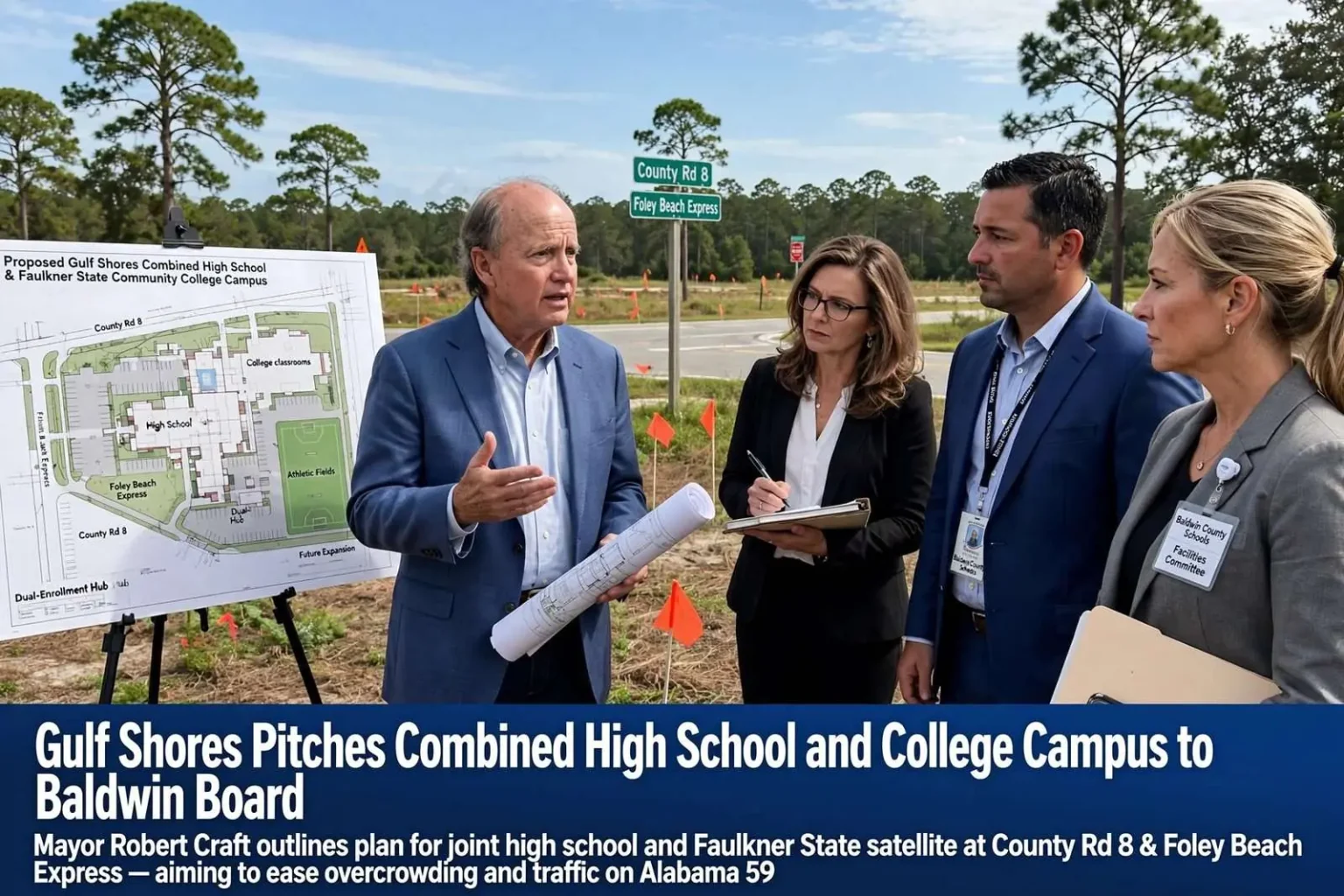
Baldwin County school board members got a firsthand look this week at Gulf Shores’ vision for tackling overcrowded classrooms, as Mayor Robert Craft laid out a proposal for a combined high school and community college campus during a facilities committee meeting held at W.J. Carroll Intermediate School in Daphne.
Craft’s pitch centers on a parcel of city-owned land at the corner of County Road 8 and the Foley Beach Express, where officials envision a joint facility that would house a traditional high school alongside a satellite campus of Faulkner State Community College.
The site itself is central to the pitch. The Foley Beach Express is the toll route that carries beach traffic inland toward Interstate 10, and the County Road 8 intersection sits far from the gridlock of the coastal highway strips while remaining minutes from the city’s residential neighborhoods. A campus there would put classrooms where families actually live, with room for athletic fields and future wings on a single tract the city already owns — an advantage in a county where land along the corridors is increasingly spoken for by rooftops first.
The idea, Craft explained, does double duty: it would relieve pressure on Gulf Shores’ increasingly packed schools while also cutting down on the daily traffic crunch along Alabama 59, one of the busiest corridors in Baldwin County.
Anyone who has driven the beach highway on a summer morning understands the second half of that equation. Alabama 59 funnels beachgoers, commuters and school buses through the same narrow lanes, and a new campus on the Beach Express would pull a share of student traffic off that corridor entirely. School siting has become a genuine transportation question in Baldwin County, where the population’s rapid spread has outpaced the road network, and city officials have increasingly treated classroom construction and congestion relief as two halves of the same planning exercise.
A college campus in the high school
Beyond the high school and community college partnership, the plan leaves room for dual-enrollment arrangements with four-year universities. Craft told board members he has already gathered letters of interest from Faulkner State, the University of South Alabama and the University of Alabama, each expressing willingness to explore how their programs might connect with a Gulf Shores-based campus.
The letters matter because they sketch what a coastal campus could eventually offer: a student who starts at the new high school might earn community college credits in the same building, then continue into university coursework without leaving the city. Dual enrollment has grown into one of the fastest-moving trends in Alabama education, prized because it lets students test college-level work early, shave tuition costs and arrive at a university with momentum. For a resort economy like Gulf Shores’, the local college presence also promises workforce programs — hospitality management, culinary training, marine trades — that match the jobs the city’s own industries create.
If it comes together, the project would represent a joint effort spanning the city, the Baldwin County school system, Faulkner State and the participating four-year schools.
Partnerships of that breadth are rare in Alabama public education, and the mechanics would be demanding: the city would contribute land and possibly construction dollars, the county system would staff and operate the high school, and the college would run its satellite under state higher-education rules. Each partner answers to a different board and a different funding stream, which is precisely why Craft was laying groundwork in a committee meeting rather than at a groundbreaking.
The Orange Beach question
The proposal also touches on a sensitive regional issue: schooling for Orange Beach students. Craft said in a follow-up conversation that Orange Beach students would still be welcome to attend the new high school as long as the city remains part of the Baldwin County school system.
That caveat matters because Orange Beach voters are set to weigh in later this month on a proposed 5-mill property tax increase, a ballot measure widely seen as the opening step toward the city breaking away to form its own independent school district.
The possibility of coastal cities splitting from the county system has hung over Baldwin County school politics for years, driven by the same growth that crowds the classrooms. Beach-city taxpayers contribute heavily to county coffers, and the prospect of a Gulf Shores campus raises the stakes of that debate: a new high school in Gulf Shores could serve Orange Beach students whether or not the neighboring city stays in the county fold. Craft’s phrasing kept the door open in either scenario, an acknowledgment that the map of Baldwin education may look different within a few years of the campus opening.
Craft said he was invited to present at the meeting because board members are gathering input from cities across the county on how each community sees its educational future taking shape.
For Gulf Shores, the new campus fits into a broader roadmap the city council adopted last spring, a long-range planning document built around sustainable growth that treats education as a core piece of the city’s identity going forward.
That framing reflects how resort cities along the coast have come to view schools as infrastructure on par with sewers and roads. Families who might otherwise visit only in summer become year-round residents when schools are strong, and cities competing for permanent residents increasingly market their classrooms as hard as their beaches. A high school attached to a college campus makes the pitch concrete.
Growth across the county
The same meeting included a broader look at growth pressures facing the entire Baldwin County school system. Associate Superintendent Russ Moore updated committee members on efforts to track enrollment and space needs systemwide, work that includes an independent facilities-utilization study examining how every square foot of every school building is currently being used.
According to a school system spokesman, the fastest-growing pockets of the county remain Gulf Shores, Foley, Spanish Fort and Daphne, with districtwide enrollment now topping 30,600 students, an increase of more than 600 since the previous school year.
Numbers like those arrive year after year in Baldwin County, which has ranked among the fastest-growing counties in the state as retirees and families move to the shore. Every several hundred new students is the equivalent of an entire school, and the district’s challenge is anticipating where the rooftops will fall before the classroom seats run out. The utilization study — an outside audit of every building — is meant to replace guesswork with data, identifying schools with room to spare and those already over capacity, so that new construction follows the growth rather than chasing it.
The meeting wasn’t only about Gulf Shores’ ambitions. Residents from the Elberta community also spoke up, asking the school board to consider building a new high school in their area as county leaders weigh where future construction dollars should go.
Elberta’s appeal is the counterweight in the room: the southern end of the county feels its own growth and its own distance from existing campuses, and residents there fear that a marquee project in Gulf Shores could absorb the dollars their community has been waiting on. The facilities committee now holds both petitions — a city with a site, a plan and a mayor making the case, and a community asking simply not to be last in line. How the board sequences the two will say much about how Baldwin County grows for the next generation.
Community colleges have quietly become the connective tissue of Alabama’s workforce pipeline, and a Faulkner State satellite on a high school campus would extend that role to the coast. The college already serves the area from its campuses in the Bay Minette, Fairhope and Gulf Shores area network, and placing classrooms inside or beside a new high school would let students cross the hall rather than the county for a nursing prerequisite, an industrial certification or a first college course. Educators call the arrangement an early-college model, and its virtues are practical: fewer missed transitions, lower costs, and teenagers who finish high school already knowing what a college classroom demands.
The financial picture behind the proposal remains the unwritten chapter. A new high school is among the most expensive buildings a community can raise, and Baldwin County funds its classrooms largely through property taxes whose yields lag the enrollment growth they must serve. City participation — land, construction support, or shared facilities — is one way fast-growing municipalities can accelerate a project the county might otherwise schedule years out. That is the unspoken logic of Craft’s presentation: Gulf Shores is offering to help pay for capacity that the county system needs anyway, in exchange for a say in where and how it is built. Whether the board accepts that partnership, and on what terms, will shape not just the beach cities’ schools but the county’s building program for a decade.