Fairhope Crossing Guard, Vietnam Veteran, Honored for Pushing Student to Safety
A Fairhope crossing guard and Vietnam veteran was honored by city leaders after he pulled a student out of the path of an accelerating vehicle.
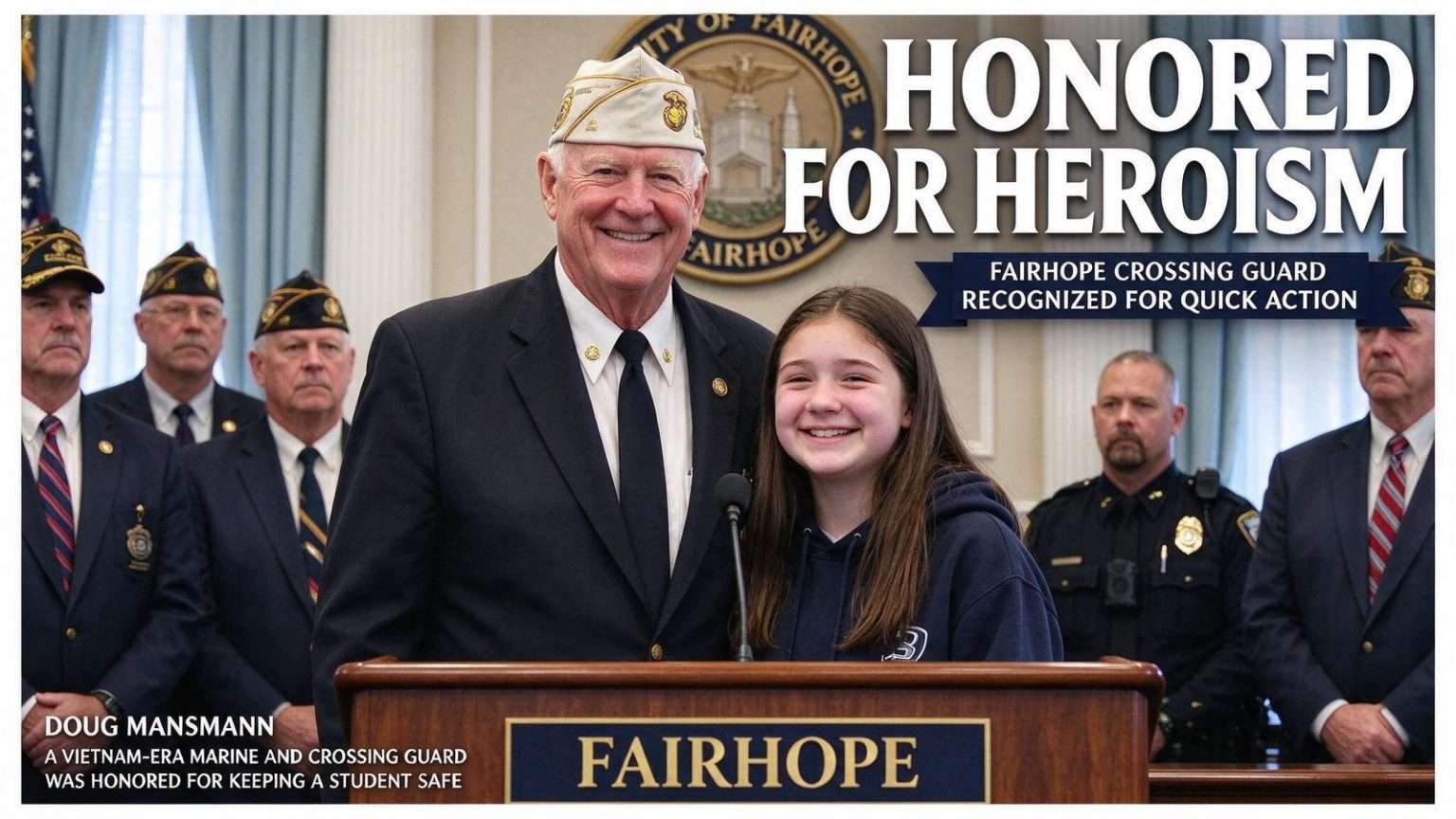
A longtime Fairhope school crossing guard received a hero’s welcome at a recent city council meeting after his quick action in March kept a young student from being struck by a vehicle. Doug Mansmann, a Vietnam-era Marine Corps veteran who has guided children across Fairhope Avenue for eight years, was recognized by both a local veterans organization and the Fairhope Police Department for what officials called a selfless act — the kind of quiet heroism that usually goes unrecorded until the moment it matters.
The incident happened on the morning of March 19 at the crosswalk near Bishop Road, a route used daily by students walking to Fairhope Intermediate School. According to Mansmann, a sports utility vehicle appeared to be slowing for the crossing before its driver suddenly accelerated toward a sixth-grade student who was partway across the street. “He was slowing down, so I thought I had him stopped, and for some reason he went from about 15 mph to about 40,” Mansmann recalled.
Reacting instantly, he ran into the roadway, waved the student back and positioned himself in front of the oncoming vehicle, which stopped just short of striking either of them. The sequence unfolded in a matter of seconds — the time it takes a driver to press an accelerator instead of a brake — and ended with a crossing guard standing between a speeding SUV and a child, on a street corner he has worked for eight years without incident.
The student later said the moment was frightening but that she felt fortunate the crossing guard reacted so quickly. Her account, relayed after the near-miss, captures the split-second math of the situation: a sixth-grader partway across a four-lane route to school, a vehicle accelerating toward her, and the one adult whose job and instinct placed him squarely in the path.
Aftermath and Investigation
Mansmann had the driver pull over and summoned a Fairhope police officer to the scene. According to a police spokesman, no citation was issued, since investigators determined there had been no criminal act or injury, though the driver appeared to have simply failed to stop for pedestrian traffic. The finding — a close call without a chargeable offense — is exactly the gray zone that makes crossing guards so essential: traffic law can punish a collision, but only a watchful adult at the curb can prevent one.
Word of the near-miss spread through the community, prompting local veterans groups to nominate Mansmann for recognition. The story traveled the way such stories do in a small Eastern Shore city — through school parents, then veterans’ posts, then City Hall — until the recognition ceremony at Monday night’s council meeting became the community’s formal answer to what happened on March 19.
At Monday night’s city council meeting, members of the Marine Corps League stood alongside him as the American Legion’s Alabama state commander presented a certificate honoring his “selfless act of heroism.” Fairhope Police Chief Joe Petties followed with a department commendation for exemplary service, thanking Mansmann for the dedication he shows every morning he takes his post.
Eight Years at the Crosswalk
Eight years of mornings on Fairhope Avenue have made Mansmann a familiar figure to the families of Fairhope Intermediate School. Crossing guards occupy a peculiar place in a community’s daily life: present for only minutes at a time, but so reliably routine that children structure their walks around them and parents measure the safety of a route by whether one is posted. In Fairhope, where students walk and bike to school along streets that carry both neighborhood traffic and visitors drawn to the city’s bayfront, the crossing guard is the human infrastructure that makes the walk possible.
His Marine Corps background informed the recognition twice over. The veterans’ organizations that nominated him — the Marine Corps League and the American Legion — described the act in the vocabulary of service: a veteran who spent his career guarding others, standing in harm’s way once more, this time on a school crosswalk rather than a distant shore. The certificate from the American Legion’s state commander carried that framing to the podium, and the Marines of the local League chapter stood beside one of their own as it was presented.
Pedestrian Safety on the Eastern Shore
The near-miss also put a spotlight on a danger familiar to school communities across Baldwin County and Alabama: drivers who fail to yield to pedestrians in marked crosswalks. Alabama law requires drivers to stop for pedestrians in crosswalks and imposes enhanced penalties for speeding in school zones, yet the moments when a crossing guard steps into the roadway remain among the most hazardous of the school day, dependent entirely on driver attention.
Safety officials’ guidance is unchanging — slow down near schools, expect children at the curb, and treat a crossing guard’s raised hand or stop paddle as a traffic signal in human form. Fairhope’s experience this spring offered a demonstration of both the risk and the remedy: a driver’s lapse at one crosswalk, met by a veteran’s reflexes, ended without injury. Not every corner has a Doug Mansmann, which is what officials at the council meeting urged residents to remember the next time they pass a school route.
For the Police Department, the commendation for exemplary service capped an investigation that found no crime but plenty of cause for gratitude. Petties’ tribute to the guard’s daily dedication acknowledged what the ceremony made official: eight years of mornings, and one morning in March when the habit of watching saved a child from a 40-mile-per-hour SUV.
Fairhope’s Tradition of Recognition
The council chamber recognition reflects how Fairhope honors its own. The city’s council meetings routinely draw residents who follow local government closely, and ceremonies that bring veterans organizations into the room carry particular weight in a community with deep military ties across the Eastern Shore. When the American Legion’s state commander travels to present a certificate, it signals that the story of March 19 resonated beyond city limits.
Fairhope itself provides the backdrop that makes the story fit. A city of tree-lined streets, walkable neighborhoods and a bayfront park that draws visitors year-round, Fairhope has long billed itself as a community designed for pedestrians — a claim that depends on safe routes to school along corridors like Fairhope Avenue. The intermediate school sits within that walking culture, and the families who use the Bishop Road crosswalk each morning now know precisely what stood between their children and the traffic: a retired Marine’s watchfulness, eight years running.
What Comes Next
Mansmann, by all accounts, plans to keep taking the post. The commendations now on his wall change nothing about the morning routine: the same corner, the same students, the same raised hand that expects — and gets — traffic stopped. School officials and parents have expressed renewed appreciation for crossing guards throughout the district, and the visibility of the ceremony served as a citywide reminder that the position is a frontline safety job, not a courtesy.
The sixth-grader whose morning he saved returned to school the same week, walking the same route past the same corner. Community members say the episode has already changed behavior at the crosswalk, with drivers slowing earlier and parents pausing to thank the guard on their way through. That, more than the certificates, is the outcome the ceremony was meant to produce: a city that sees the person at the crosswalk, and a veteran whose act of heroism got its day before the council.
The Marine Corps League’s presence at the meeting closed the circle neatly. Eight years after taking the post, Mansmann received the thanks of the department he serves daily, the police department he summoned on March 19, the veterans’ organizations that nominated him and the state Legion commander who made the trip — a full accounting, at last, for a few seconds’ action that kept a Fairhope sixth-grader safe.
The Job Explained
Crossing guards occupy a role defined by municipal budgets and morning arithmetic. A guard is assigned where children cross streets with meaningful traffic volume, positioned at the critical minutes before and after the school bell, and trained — often through police department programs — in the procedures for stopping traffic, grouping children and managing the unpredictable. The equipment is minimal: a reflective vest, a stop paddle, and the authority of a visible adult standing in the roadway. What the position cannot supply, no budget can purchase: the judgment to read a driver’s intentions, and the reflexes to act when they turn dangerous.
That is what makes the March 19 episode instructive rather than merely dramatic. Mansmann had done everything correctly — he watched the SUV slow, judged that he had the crossing secured, and moved the student through. The danger emerged when the driver’s behavior contradicted every expectation the guard’s training had built on. His response, stepping back into the path and pulling the child clear, is precisely the scenario crossing-guard training drills for and that no one wants to see performed in real life.
School-route safety reviews across Alabama typically examine the elements of that morning: sight lines at the crosswalk, speed limits approaching the intersection, signage and markings, and the presence of adult supervision. The finding that the driver simply failed to stop — no criminal act, no injury — leaves officials with the hardest kind of safety problem, one that education and enforcement must address together because the law alone cannot.
For Fairhope parents, the episode has become a conversation starter about routes and routines. School officials encourage families to remind students to wait for the guard’s signal, to look both ways even when the guard is present, and to report close calls so that intersections can be reviewed. The near-miss at Bishop Road ended safely because the system had one exceptional human in place; the lesson officials draw is to strengthen every layer around that human so the next close call never gets that far.