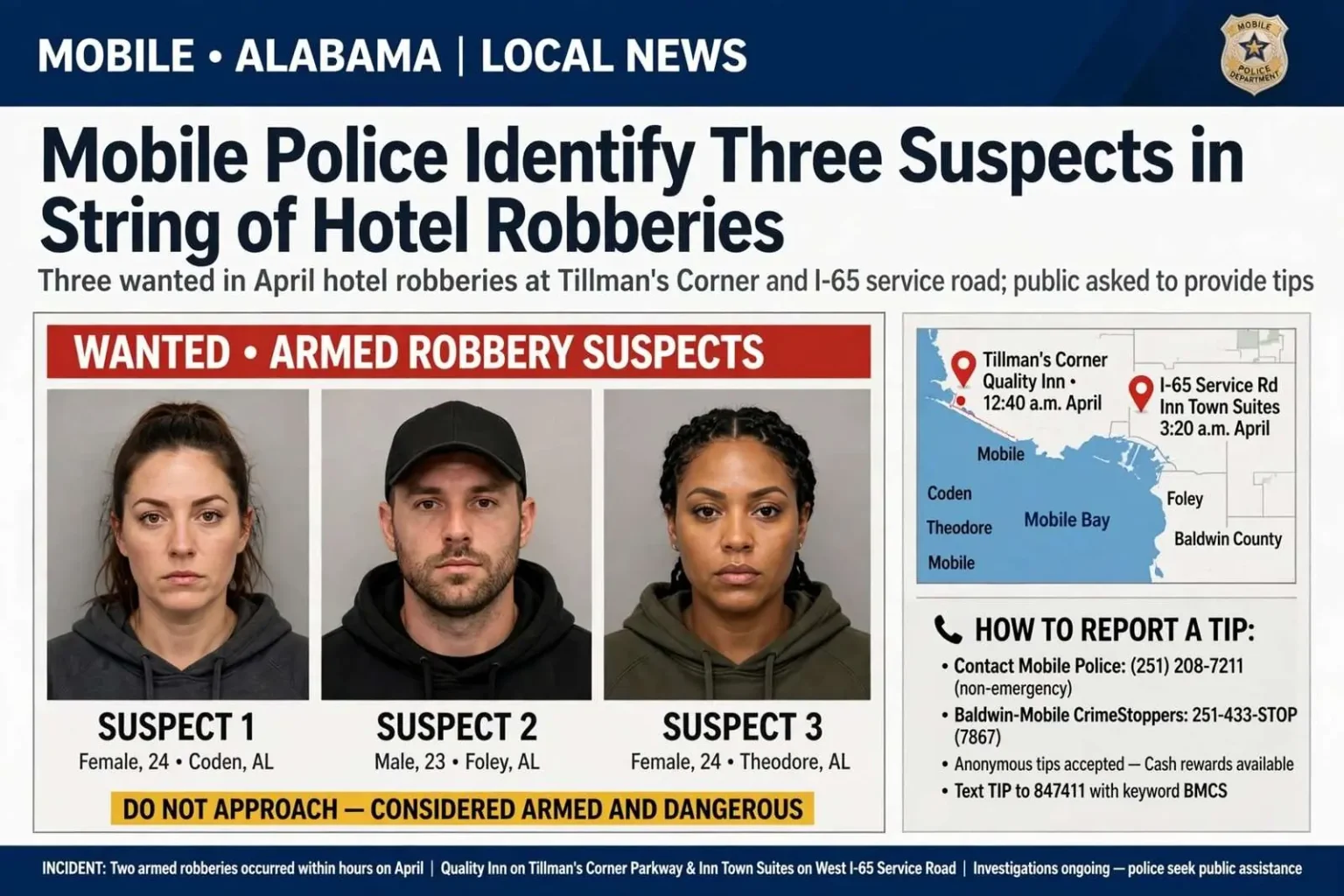
Mobile police have identified three suspects accused of carrying out a pair of armed robberies at local hotels earlier in April, releasing names and images publicly in hopes that someone can help track them down. The announcement came after detectives assembled evidence from two crime scenes, witness accounts and jail records into a single case file tying the same trio to both holdups. Publishing the suspects’ identities is a step investigators use when they believe the public can help locate people who have not yet been taken into custody.
Investigators say a 24-year-old woman from Coden, a 23-year-old man from Foley and a 24-year-old woman from Theodore worked together in both holdups, which happened within hours of each other in the overnight darkness. The combination of suspects drawn from communities on both sides of Mobile Bay — Coden and Theodore on the bay’s western shore, Foley across the bay in Baldwin County — illustrated the regional character of crime along the Interstate 10 corridor, where the trip from one side of the bay to the other takes well under an hour.
Mobile County jail records show two of the three suspects had previously listed addresses in Mobile, Eight Mile and Irvington, and all three had been arrested in unrelated cases by Mobile County sheriff’s deputies just weeks earlier. That detail placed the alleged hotel robbery crew among the rotating population of repeat offenders that moves through Mobile County’s court system, where sheriff’s deputies handle arrests across the unincorporated county and its smaller municipalities while Mobile police cover the city itself.
How the Robberies Unfolded
According to police, the first robbery happened around 12:40 a.m. at a Quality Inn on Tillman’s Corner Parkway, where a woman and an armed man approached a man in the parking area and demanded his wallet. The victim managed to escape into the hotel’s front office before the pair could take his belongings, according to a Mobile police spokesman. Tillman’s Corner, the dense commercial district around U.S. 90 and Azalea Road in west Mobile, concentrates dozens of hotels, restaurants and retail outlets along its corridors. Its parking lots are a familiar setting for overnight robberies targeting travelers and late-shift workers.
A few hours later, around 3:20 a.m., officers responded to a second robbery at an Inn Town Suites location along the West I-65 Service Road, where two armed women demanded property from guests on the property. The West I-65 Service Road parallels Interstate 65 through one of Mobile’s busiest lodging districts, a strip of extended-stay hotels and budget motels that serves contractors, traveling nurses and families in transition as often as vacationers. Investigators say evidence gathered from both scenes led them to believe the same group of three people was responsible for both incidents.
The pattern — multiple suspects, overnight hours, hotels clustered along high-traffic corridors, and victims approached in parking areas rather than lobbies — matches the profile detectives see repeatedly in Mobile’s armed robbery cases. Overnight parking-lot robberies are difficult to prevent with cameras alone, and hotel guests arriving or leaving between midnight and dawn are among the most frequently targeted victims in the city’s commercial strips.
What Happens Next
Mobile police are asking anyone with information on the suspects’ whereabouts to contact the department directly or reach out through Baldwin-Mobile CrimeStoppers, which allows tipsters to remain anonymous. CrimeStoppers programs operate on a simple premise: tipsters call a dedicated line or submit tips online, receive a code number instead of giving a name, and can qualify for cash rewards when information leads to an arrest. The Baldwin-Mobile organization serves both counties, reflecting how investigations in the two counties routinely cross the bay.
Tips can also be submitted by text message using a designated keyword sent to the CrimeStoppers short code, a system local law enforcement agencies use to gather information on wanted suspects without requiring people to come forward publicly. Text tipping has become one of the most productive channels for agencies across Alabama, since it allows witnesses who fear retaliation — or who simply do not want to be involved — to pass along names, addresses, vehicle descriptions and timestamps that detectives can corroborate with surveillance video and phone records.
Robberies targeting hotel guests and staff during overnight hours have periodically prompted local hotels along heavily traveled corridors like Tillman’s Corner Parkway and the I-65 service roads to review their security practices. Property owners in Mobile’s lodging districts have increasingly relied on surveillance camera systems, brighter parking-lot lighting and night staff trained to call police at the first sign of trouble, measures that detectives credit with providing much of the evidence used to identify suspects after the fact. Camera footage from the two April scenes, combined with witness descriptions, formed the backbone of the case that allowed investigators to put names and faces before the public.
The Regional Nature of Mobile Bay Crime
The suspected involvement of residents from Coden, Theodore and Foley in crimes committed inside Mobile city limits reflects a pattern that Mobile County and Baldwin County investigators have documented for years. The cities and communities of the two counties are bound together by Interstate 10, the George Wallace Tunnel and the Jubilee Parkway causeway across Mobile Bay, and a web of state highways that put nearly every population center in South Alabama within a short drive. Persons suspected of crimes routinely live in one county and offend in another, which is why agencies share jail records, warrant databases and intelligence through regional task forces.
Mobile County’s justice system processes the aftermath of cases like these. Defendants arrested on armed robbery charges face felony prosecutions in Mobile County Circuit Court, where robbery with a deadly weapon carries some of the heaviest penalties in the Alabama criminal code. Cases built on surveillance video, cell phone records and victim identifications can take months to move from arrest to trial, during which suspects may remain in custody at Mobile Metro Jail or be released on bond while the case proceeds.
For hotel operators, each high-profile robbery along the corridors serves as a reminder of the economics of the lodging business in Mobile. The city’s hotels serve travelers arriving via Interstates 10 and 65, patients and families visiting the University of South Alabama and USA Health facilities, and workers on extended assignments at the area’s shipyards, chemical plants and the Port of Mobile. Properties that develop reputations for unsafe parking lots can lose bookings quickly, giving operators a direct financial incentive to work with police on prevention.
Staying Safe and Reporting Tips
Police routinely offer common-sense guidance for hotel guests arriving late at night: park in well-lit areas near the front office, keep valuables out of sight, stay alert when walking through parking areas, and report suspicious vehicles or loitering to the front desk immediately. Property staff are generally the first line of defense, since clerks on overnight shifts are positioned to see who is coming and going and to call police before a situation escalates into a robbery.
Residents with information about the three suspects identified in the April robberies can reach Mobile police directly through the department’s non-emergency line or submit anonymous tips through Baldwin-Mobile CrimeStoppers by phone, through the organization’s website, or by text using the designated keyword. Investigators stress that even partial information — a sighting, a vehicle description, a social media reference — can complete a timeline that leads to an arrest. Anonymous tips that result in felony arrests are eligible for cash rewards under the CrimeStoppers program, paid through a code-number system that keeps the tipster’s identity shielded from police and courts alike.
The case remains under investigation, and police have indicated that charges will be presented once the suspects are in custody. Until then, the identification of the trio shifts the burden to the public — the same public whose tips regularly close cases across Mobile and Baldwin counties — to help locate three people accused of turning a pair of April nights into a two-holdup crime spree.
The April hotel robberies also land at a time when Mobile’s police department continues to juggle rising call volumes across a city of roughly 190,000 residents spread over more than 130 square miles. Detectives working robbery cases move from scene to scene with a backlog that makes public tips more valuable than ever, since a single anonymous call naming a suspect’s location can save weeks of canvassing and surveillance. That arithmetic explains why the department publishes suspects’ names and images as soon as investigators are confident enough in their identification to do so.
How Armed Robbery Cases Move Through Court
Once arrests are made, the three suspects would face their initial appearances before a Mobile County district court judge, where bond amounts are set for the robbery charges as well as any outstanding warrants from the earlier sheriff’s office arrests. In Alabama, first-degree robbery — robbery involving a deadly weapon or serious physical injury — is a Class A felony punishable by up to life in prison, which is why bond for such charges often runs to six figures. Prosecutors in the Mobile County District Attorney’s Office review the evidence gathered by detectives, present the case to a grand jury, and carry it forward to circuit court if an indictment is returned.
The involvement of a suspect from Foley adds a Baldwin County thread to the proceedings as well. Should that suspect face charges in both counties, prosecutors coordinate on sequencing, and defendants charged in multiple jurisdictions typically answer one set of charges before being transported to face the others. The two-county justice systems, though separate, maintain the shared jail, court and warrant infrastructure that makes such coordination routine along the Gulf Coast.
For the victims, the identification of suspects brings a measure of resolution to frightening ordeals. The man who fled into the Quality Inn’s front office and the guests confronted at the Inn Town Suites property were targeted in spaces they had every reason to consider safe — the parking lot of a hotel where they had every reason to be. Victim advocates with the district attorney’s office and the police department keep victims informed as cases progress, and restitution orders can require convicted defendants to repay stolen property or losses directly.
The Larger Picture on Commercial Corridor Crime
Robbery patterns along Mobile’s commercial corridors tend to cluster in predictable ways: overnight hours, targets who are alone, quick getaways onto interstate ramps and service roads that make pursuit difficult. Department analysts map the incidents to deploy patrol resources, and the concentration of robberies in lodging districts has made those areas a recurring focus of directed patrols. Departments across the region have also leaned on partnerships with hotel associations and business watch groups to spread information quickly when a pattern emerges.
The three suspects identified in the April robberies remain wanted as of the department’s announcement, and police have not ruled out additional charges as the investigation continues. Anyone who recognizes the individuals in the released images is asked not to approach them, but to contact Mobile police or Baldwin-Mobile CrimeStoppers with the details. The department’s message in cases like this one is consistent: investigators build the case, but the community’s eyes — the neighbors, night-shift workers and travelers who notice what does not belong — are often what bring a suspect file to a close.