
Study Ranks Mobile Among The Weakest Mid-Sized Metros For Building Savings
Mobile placed 78th of 97 mid-sized U.S. metros in a study of where households can save money, with Pensacola at 69th and both trailing national income.
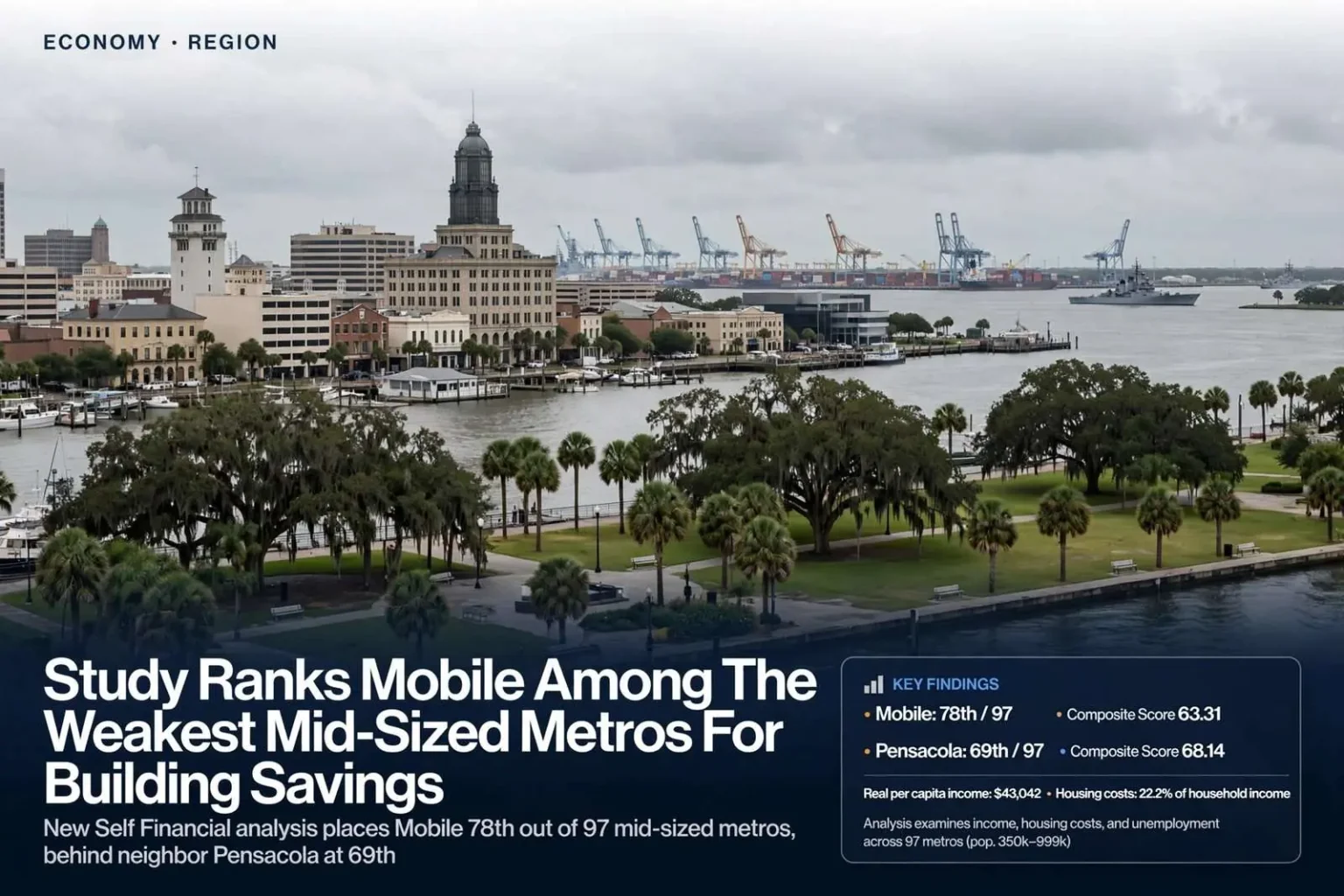
Households in the Mobile area have a harder time setting money aside than those in most comparable American cities, according to a national analysis of mid-sized metropolitan areas released this summer. The study, produced by Self Financial, scored 97 metro areas with populations between 350,000 and 999,999. Mobile finished 78th. Pensacola, its neighbor across the state line, landed at 69th.
The gap between the two Gulf Coast metros is narrower than their distance on the map might suggest, and both sit well down the national list. For Mobile, a 78th-place finish out of 97 puts it in the bottom quartile of its population class, a ranking shaped less by any single weakness than by the compounding effect of below-average incomes on a household budget that still has to absorb housing, transportation and the Gulf Coast’s insurance and utility costs.
How the rankings were built
Researchers drew on figures from the U.S. Census Bureau, the Bureau of Economic Analysis, Zillow and the Department of Housing and Urban Development. Each metro received a composite score built from three inputs: real per capita personal income, median housing costs measured as a share of median household income, and the area’s historical unemployment rate. Median home prices and fair market rent for a two-bedroom apartment were included for additional context.
The methodology matters for how the results should be read. By using real income, adjusted for what a dollar buys locally, the study tries to measure actual purchasing power rather than headline paychecks. By measuring housing costs as a share of income, it captures affordability rather than price alone, which is why a metro with cheap houses can still score poorly if its paychecks are cheaper still. The historical unemployment input rewards metros whose job markets have been steady rather than volatile.
Why mid-sized metros get compared at all
The population band the study chose, 350,000 to 999,999 residents, captures the tier of American cities that compete for the same relocating employers and remote workers: places large enough to offer an airport, a hospital system and a downtown, but small enough that a handful of major employers can shape the whole labor market. Mobile sits squarely in that tier, alongside Gulf Coast and Southeastern peers that it trades businesses, workers and tourists with every year.
For residents, the practical use of such a study is less the ranking than the mirror. A family that has wondered why the monthly surplus never materializes in a metro with famously cheap housing can see the answer in the numbers: it is the income side of the equation, not the housing side, that keeps the cushion thin.
Where Mobile landed
Mobile posted a composite score of 63.31, with real per capita personal income of $43,042 and median housing costs consuming about 22.2 percent of median household income. The report listed the metro’s historical unemployment rate as roughly average, its median home price at $122,892 and fair market rent for a two-bedroom unit at $874.
The housing figures deserve a second look. A median home price of $122,892 is a fraction of what buyers face in most of the country, and an $874 fair market rent is well below the national figure. On paper, Mobile looks like a bargain. The problem is the other side of the ledger: with real per capita income at $43,042 against a national mark of $50,372, local households bring in roughly $7,300 less per person than the typical American, and that shortfall follows them into every month’s budget.
Pensacola scored 68.14, with real per capita personal income of $43,623 and housing costs at about 20.1 percent of median household income. The Florida metro’s edge over Mobile comes almost entirely from that housing-cost ratio: its incomes are barely higher, but its households spend about two points less of their paychecks on keeping a roof overhead, enough to move it nine places up the table.
Both cities trail the national picture on income. Across the United States, real per capita personal income stood at $50,372, with median housing costs at 21.0 percent of household income, a historical unemployment rate of 5.3 percent, a median home price of $242,141 and fair market rent of $1,204 for a two-bedroom apartment. Set against those numbers, Mobile’s housing looks even cheaper, its incomes even thinner, and its position in the rankings easier to understand.
The unemployment input flatters the region slightly. A historical jobless rate described as roughly average means Mobile’s problem is not boom-and-bust instability but the level of wages during the good years. A metro can hold jobs steadily and still leave its workers unable to save if the jobs themselves cluster in industries where raises are rare and hours vary with the tourist season.
The comparison points to the same tension familiar to many Gulf Coast households: housing that costs less in absolute dollars than the national median, paired with incomes low enough that a similar or larger share of each paycheck still goes toward keeping a roof overhead. Savings, the study’s ultimate subject, is what remains after that share is paid, and it is the line item that gives way first when a transmission fails or a hurricane season brings a deductible.
What the numbers mean locally
The rankings give quantitative shape to what Mobile’s economic developers have said for years: the region’s challenge is not cost but income. The metro has landed major industrial wins in recent years, anchored by the port and by the aerospace manufacturing that has grown up around the aircraft assembly industry at the airport, and those employers pay wages that lift the households who hold them. The study’s income figure, though, is an average across everyone in the metro, and it reflects a labor market still weighted toward retail, hospitality, healthcare and logistics work that pays modestly.
That mix explains the local arithmetic. A region can have cheap houses and still leave its households exposed, because savings depend on the margin between what a family earns and what it must spend. In Mobile, the margin is thin: 22.2 percent of income to housing is only slightly above the national share, but the absolute dollars left over after housing, transportation and utilities are fewer, and the Gulf Coast adds costs northern metros do not face, from hurricane deductibles to summer power bills.
For the households at the middle of the distribution, the study’s findings translate into familiar advice with sharper stakes. Financial counselors generally recommend an emergency fund of three to six months of expenses, and in a metro where incomes run below the national mark, reaching that cushion takes longer and is interrupted more often. Automatic transfers, even small ones, and attention to the fixed costs that can be shopped, particularly auto insurance in a high-premium state, are the standard tools.
The study also carries a message for local policy. Rankings of this kind circulate among site-selection consultants and corporate decision-makers, and a low savings score doubles as a portrait of a metro where workers have little slack. Improving it means the same things economic developers already pursue: higher-wage employment, and housing and utility costs that do not quietly absorb every raise.
The regional picture
Mobile’s finish looks different depending on the comparison. Against the nation’s large metros, where housing devours far more of the paycheck, the Gulf Coast’s affordability is a genuine asset. Against its mid-sized peers, the metro’s combination of low costs and lower incomes lands it near the bottom, and the study suggests that the second comparison is the one that matters for whether families get ahead.
Pensacola’s slightly better standing offers its own lesson. Nine places and a few points of composite score separate the neighbors, and the difference comes down to a single ratio rather than any dramatic gap in income or jobs. Small movements in housing costs relative to pay can move a metro meaningfully up or down such lists, which is why both cities watch their rental markets and their wage growth closely.
None of the study’s numbers are destiny. Median figures describe a middle that many Mobile households sit above, and the metro’s low cost of living remains a real advantage for families that hold steady employment. What the ranking captures is fragility: in a metro where the typical household has little left after the bills, the difference between getting by and falling behind is one unplanned expense wide.
For now, Mobile remains what the data says it is: an inexpensive place to live that is harder than most to save in, a metro where the national advice to build a cushion collides with a paycheck that leaves little room to build it. Closing that gap, between what living here costs and what working here pays, is the project the numbers point toward.


